By Kevin O'Marah | October 08, 2015
CSCO Outlook for 2027: Cloudy With a Chance of Moderate Growth
October 09 2026


By Kevin O'Marah | October 08, 2015
The United States is in pretty good shape right now, but certain problems seem intractable. Climate change, for instance, remains a “debate” as far as politics is concerned and healthcare is still a battleground separating right and left.
In practical terms, however, supply chain and operations leaders are busily working to arrest carbon emissions, cut waste and streamline deliveries in a patient-centred value chain. It’s not easy but it is happening and alignment with economic efficiency is obvious.
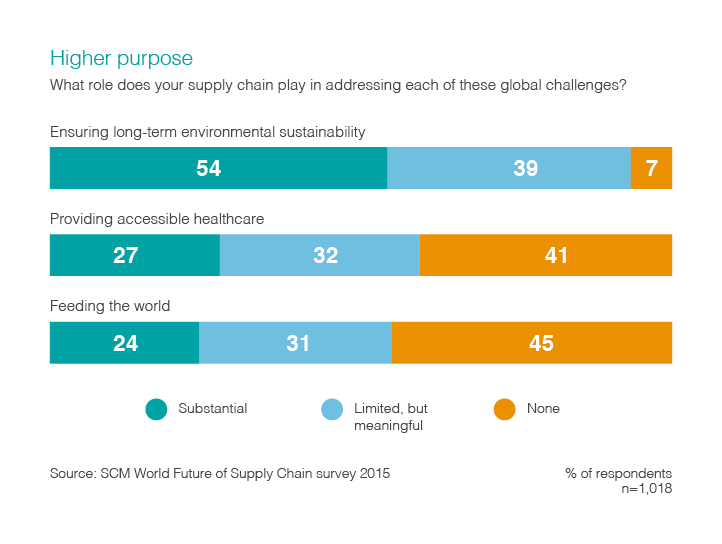
SCM World’s 2015 Future of Supply Chain survey opened with a question that might have been laughed at 10 years ago. With respect to providing accessible healthcare, feeding the world and ensuring long-term environmental sustainability, participants were asked “What role does your supply chain play in addressing each of these global challenges?” The responses were both heartening and somewhat surprising.
A majority, comprising over 550 individuals, believe their supply chains play a “substantial” role in ensuring long-term environmental sustainability. This includes people working in all industries, at all levels of their organisations and in every region of the world. The message is clear – supply chain owns sustainability.
Research conducted with the SCM World community this year on resource economics in supply chain found that while concerns over energy and water dominate, solutions are known and being implemented rapidly. Just this year, major public milestones were reached by Unilever, Coca-Cola and IKEA in managing waste, water and agricultural sustainability at the 100% level. Similar initiatives are in place all over the world from the chemicals industry (BASF) to apparel (Gap). Unlike the dysfunction so common in government, most companies are making massive strides.
Nearly as impressive are the high rates of accepted accountability for human health and hunger. Respondents asserting “substantial” roles for their supply chains in these areas certainly align by sector, with healthcare, pharmaceutical and medical devices owning health and food companies owning hunger. Outside of these groups, however, chemicals, logistics and industrial company respondents stepped up to high levels of accountability.
The future of supply chain clearly incudes a high level of commitment to help solve these three great global challenges. Leaders of the future will most certainly need to demonstrate not only that they understand how their operations affect the world and its people, but also that they are accountable for what happens.
With a presidential election heating up in the US, the rhetoric surrounding world welfare topics like climate change, drug pricing and global trade is quickly becoming politicised to the point of stupidity. Candidates on the left (Bernie Sanders) and right (Marco Rubio), as well as those thirsty for approval (Donald Trump, Carly Fiorina) are pumping our irresponsible ideas faster than the media can put them in front of us. The election dynamic in the US seems unable to look meaningfully and responsibly into the future to offer anything close to real leadership.
Supply chain leaders can and should be different. We understand the mechanics of supply and demand, and are generally in control of the levers that guide the machinery of production and distribution. We have proven that environmental sustainability, including reductions in emissions, is achievable and often financially beneficial. We also know what it will take to access new consumer markets cost effectively with both food and medicine. Why not stand up and say so?
Last year SCM World launched an awards programme called “Power of the Profession”. It was modelled on the Oscars, which for decades has encouraged the film industry to strive for creative excellence as well as profits. Supply chain leaders bought into this idea, with 70 submitting nominations, and over 1,000 casting votes before a panel of 35 C-level executives reviewed finalists and selected winners.
It should come as little surprise that last year’s winners included Unilever, Schneider Electric, General Mills, and Sisters of Mercy ROi, among others, and that the essential thread linking all was a demonstrated willingness to take public positions of leadership on such vital issues as sustainability (Unilever), health (ROi), hunger (General Mills) and, maybe above all, the development of people (Schneider).
Supply chain is central to our collective need to build a better future. The power of the profession means proactively taking a lead. Nominations for this year’s awards are invited now.
Beyond Supply Chain
Subscribe on LinkedIn to receive the biweekly Beyond Supply Chain newsletter.