By Kevin O'Marah | March 07, 2013
Navigating the Supply Chain AI Fog
September 18 2026


By Kevin O'Marah | March 07, 2013
“People expect a job for life, but the world isn’t like that anymore, is it?” This stern, bitter quote ends a nasty but thought-provoking newspaper article about harsh work conditions in one of Amazon’s UK fulfilment centres. The gist of the article is that Amazon’s labour management practices control and degrade employees to the extent that they feel “sort of like a robot, but in human form”. The message, it seems, is that the future of work looks bleak.
Amazon does not really come off as the bad guy in this article, although CEO Jeff Bezos is quoted as saying “our culture is friendly and intense, but if push comes to shove, we’ll settle for intense”. What is clear from mapping this detailed look into the operations of e-commerce against SCM World data on challenges facing supply chain leaders is that people better start thinking differently about work right now.
The first force of change is the digitally empowered consumer whose ability to shop elsewhere is not just greater than it was in 1995 but orders of magnitude greater. I had an interesting discussion this week with the multi-channel team at US retailer Target who concede that free shipping appears inevitable and that they are ready to do it profitably. This comes on top of exploding complexity in terms of SKU assortments, bundling and configuration options and ship-to locations. Digital demand will not allow Amazon or anyone else to pay people more than necessary. Bezos’s intensity is being applied to make sure the whole consumer supply chain sticks to this principle.
The second force of change is automation and robotics. I have argued in the past that robotics will expand rapidly, starting now. According to the International Federation of Robotics, almost 69,000 units were installed worldwide for materials handling applications in 2011. That’s a 42% increase over 2010 and more than double the figure for 2009, which saw some of the highest unemployment in decades. The shape of the growth curve is starting to look a lot like the typical technology adoption pattern where costs are high and volume low early, only to reverse roles as the “hockey stick” trend takes off. Add the low cost of capital currently available to business and conditions look ripe for a big increase in the use of automation in supply chains.
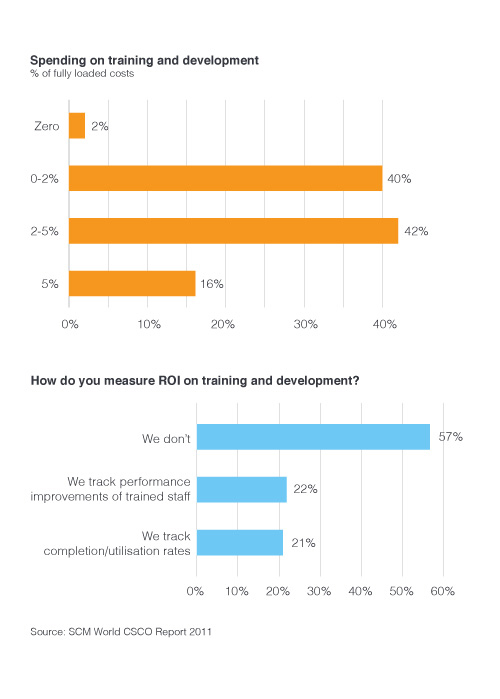
The final thread, perhaps ironically, is the talent crisis facing supply chain leaders as they work to build global teams of smart people. Our 2011 CSCO survey of 865 supply chain executives found that talent acquisition and development was an important challenge for 91%. It also showed that training and external education is a significant investment for most, despite the fact that few even attempt to measure return on investment in skills development. The supply chain discipline is desperate for talent but clearly not able to find the right kinds of skills in the labour market.
The problem with Amazon’s jobs, as dissected in the aforementioned article, is that they are designed around the mechanical advantages of human labour rather than the creative advantages of human intelligence. From Amazon’s perspective this is just good industrial engineering, and for many types of work the dexterity and range of motion available from human physical labour will long provide advantages over machinery. In time, however, jobs based on these advantages are likely to be woven into an increasingly impersonal network of automated productive nodes. People working alongside robots may find themselves dehumanised in ways that are even worse than during the peak of the industrial revolution where trade unions at least offered some camaraderie.
The openings that offer growth and are also most highly valued by employers will be those for problem solvers. Many will be in service roles at the point of consumer contact where websites, no matter how smooth, can be significantly improved with good people skills. Some will be in design roles where new ideas percolate up into products of ever greater diversity. Many, especially in supply chain, will be in decision-making roles where the supply-demand balancing equation never stops evolving and those who enjoy puzzles will rise fastest and farthest.
The trend away from unskilled labour is inexorable and jobs for life a thing of the past. But careers based on continuous learning look more promising than ever.
Kevin O’Marah
Chief Content Officer
SCM World
Please contact me directly with any comments, questions or suggestions. I welcome your feedback.
Beyond Supply Chain
Subscribe on LinkedIn to receive the biweekly Beyond Supply Chain newsletter.