By Kevin O'Marah | November 21, 2014
Navigating the Supply Chain AI Fog
September 18 2026


By Kevin O'Marah | November 21, 2014
In 2012 SCM World conducted a detailed field study which found that learning curves were 50% steeper for trading partners working in “truly collaborative” relationships than for ordinary supply chain links. This is good news for strategists trying to improve operational performance, but hardly a surprise.
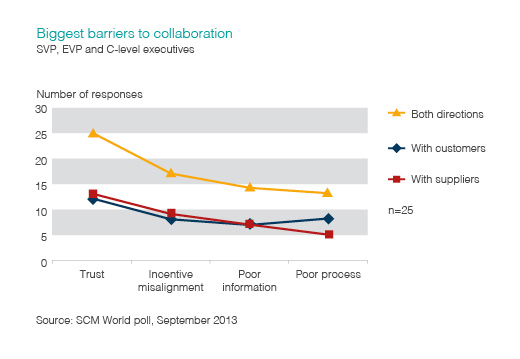
What did surprise us, however, was the finding that trust – a universally agreed key ingredient to successful collaboration – was of less concern for mid-level practitioners than for executives at senior vice president and higher levels of seniority. Is this a paradox?
No. In fact, it reveals a vital point of leadership that top executives must articulate and demonstrate. Mid-level planners, operations staff and logisticians fully grasp the collective win of better visibility between trading partners and are much more likely to fault poor information systems than distrust as a barrier to collaboration.
But senior executives, who see things from the top, anticipate the eventual splitting of jointly created value and are therefore wary of sharing too much information.
Trust is there for the taking, but somehow it’s always just out of reach.
Uber, whose rapid rise as app-based start-up bent on transforming the taxi business and ultimately automobile transport as a whole, has been busted for scheming to undermine the credibility of journalists unfriendly to it.
The problem, as noted by one writer for the New York Times, is that Uber’s mission requires that “people trust the company implicitly and automatically”. How, the article asks, can we be expected to trust Uber with our personal information if they’re willing to stoop this low?
The same can be said of a consumer brand that promises wholesomeness, but then engages in unsavoury labour practices or ignores consumer safety. It also applies to sourcing people who elicit competitive information in the RFP process only to betray such secrets to the eventual winner of the business.
Suppliers commit money, time and personal credibility when they engage, especially for big chunks of business. If buyers are manipulative or even just careless in managing these commitments, they can quickly destroy trust. One SVP of supply chain articulated the trust problem as a “fear that transparency will result in the buyer taking increased or unfair share of the value”.
Senior leaders worry about trust because they are often forced by powers above (ie, Wall Street) to renege on long-term promises in favour of short-term gain – a dynamic that played out between disk drive makers and some server customers following the Thailand floods in 2011. It happens to iron miners, shoemakers and truckers, and once it is lost trust is hard to rebuild.
Cynicism need not rule the day. Examples of trust-enabled supply chain relationships are out there and across a wide spectrum of industries. General Mills, for example, has created huge joint value with some of its key customers by launching a programme for demand-supply collaboration that funds a promotional spending pool to support both parties’ business goals. Trust depends in part on systematic measurement of shared value.
Intel and Lenovo share market demand forecasts, technology roadmaps and even operational scorecards to assure both win together in their deeply co-dependent market.
Imperial Logistics has worked without a contract for a quarter century with Distell, a South African spirits maker, because both share in the ups and downs of transport costs.
The common thread is senior leadership willing to look at the long-term value of trust and structure relationships accordingly.
Trust is gold because it streamlines co-operation and allows buyer and seller to focus less on the deal and more on the result of the relationship. In today’s increasingly concentrated supply chains, competition over who gets a bigger slice of the pie works against the greater goal of developing deeply integrated product platforms that enable quicker innovation and more customisation for end consumers.
For supply chain leaders smart enough to resist temptations to out-manoeuvre their trading partners or even just overplay a negotiating position, the pay-off is trust. In terms of supply chain performance this means faster improvements on operating metrics across the board.
Trust is the key to a steeper learning curve.
Beyond Supply Chain
Subscribe on LinkedIn to receive the biweekly Beyond Supply Chain newsletter.