By Michael Uskert | April 16, 2021
CSCO Outlook for 2027: Cloudy With a Chance of Moderate Growth
October 09 2026


By Michael Uskert | April 16, 2021
After a year of turmoil, we are reaching a point where we can finally assess what has happened and what the future may hold.

There have been some positives. A Gartner HR study found that in Q2 of 2020, galvanized by the challenge posed by the pandemic, employee engagement had increased to its highest level in two years. The study observed a significant increase in optimism, pride and energy. At the same time, however, corporations find themselves increasingly involved in issues such as diversity, social justice and government suppression. It is increasingly clear — work is not separate from life. The work environment is a complex social organization.
At the moment, you likely find yourself focused on building a more agile, resilient and innovative organization. This effort is often pursued through initiatives such as collaboration with key customers and suppliers, redesigning products to remove complexity, segmenting offerings to customers, and diversifying the supply base, products and/or geographic markets. These are important initiatives, but you could be missing something.
Gartner colleagues Ken Chadwick and Dana Stiffler recently published a report titled, “Designing a Social Supply Chain.” In this report, they found more agile, resilient and innovative organizations can be built by looking at how we design the complete social system rather than focusing on just one variable.
Often overlooked are the following questions:
These questions are extremely important considering that a year ago the work environment was turned upside down when we were forced into remote work. Today, many of us face the choice between returning to an on-premises location, staying remote or developing a hybrid arrangement. Adding to the complexity of the decision, we are only now beginning to understand the impact of remote work.
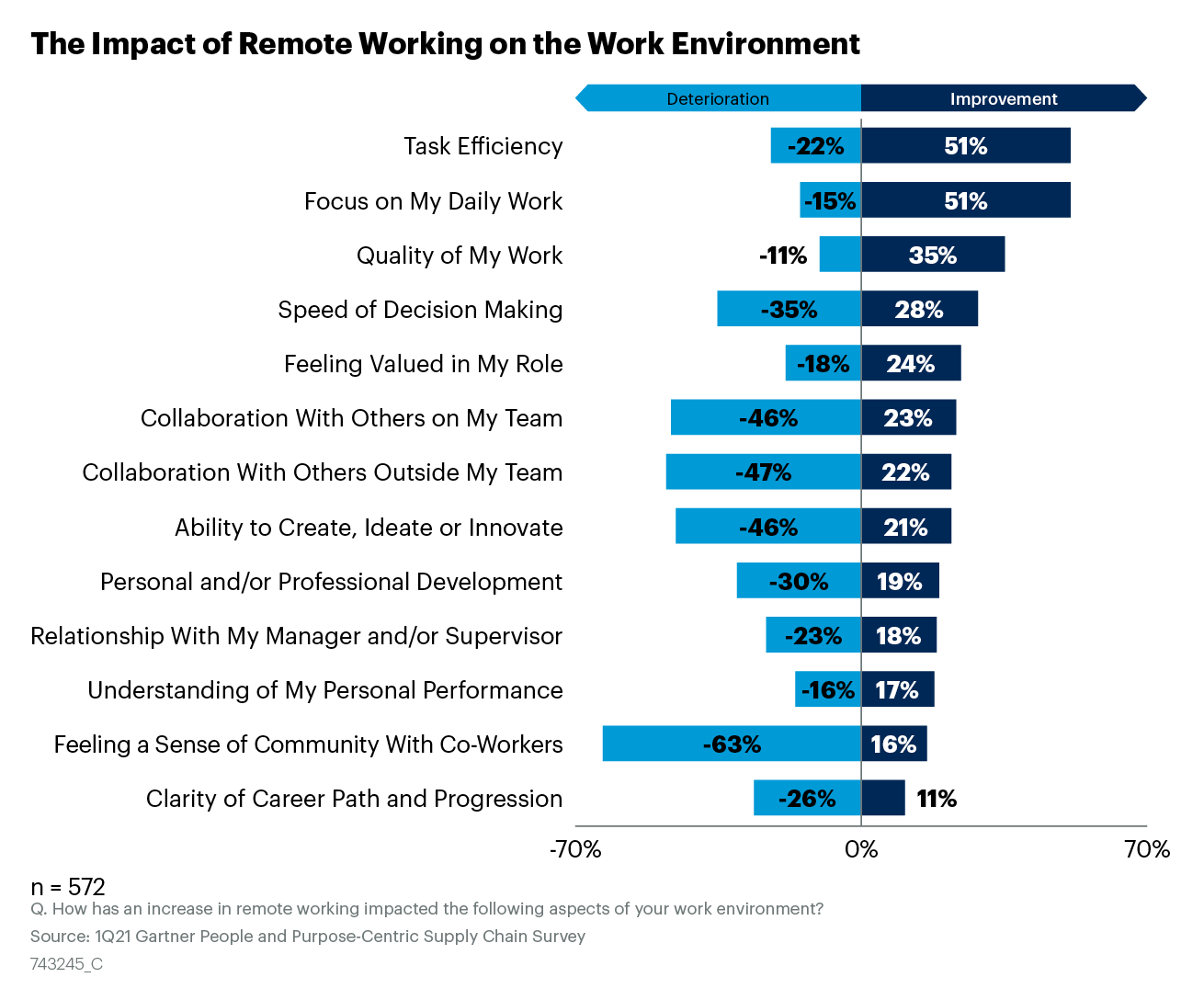
On the positive side, we have seen evidence of improvement in task efficiency and increased focus. These two, particularly efficiency, can be measured. They have a positive impact on the bottom line so it isn’t surprising that these two data points are finding their way into rationale for future work design. The concern, however, is in what we may be losing. The same study showed a deterioration in an employee’s sense of community, collaboration with colleagues and the ability to innovate.
Ken and Dana identified three core themes that enabled success during the COVID-19 pandemic that should endure:
Remote work has proven to have significant advantages, but the disadvantages must also be considered when making future design decisions. While sense of community, collaboration and the ability to innovate are hard to measure, they are important.
Employees are highly engaged now, which is good, but it is possible that we are reaching a trough of disillusionment as the original catalyst of engagement (the pandemic) wanes. It is being replaced by more polarizing and enduring challenges to the social fabric of the work environment, especially when they may directly challenge the organization’s published value statement.
There is no blanket answer when it comes to choosing between returning to an on-premises location, staying remote or developing a hybrid arrangement. However, regardless of the design, being aware of and having had a hand in intentionally building the social system within your organization can only be an asset.
Michael Uskert
Chief of Research
Gartner Supply Chain
Michael.Uskert@gartner.com
Beyond Supply Chain
Subscribe on LinkedIn to receive the biweekly Beyond Supply Chain newsletter.