By Kevin O'Marah | November 14, 2014
CSCO Outlook for 2027: Cloudy With a Chance of Moderate Growth
October 09 2026


By Kevin O'Marah | November 14, 2014
This week amid blizzard conditions in the Great Lakes region of the United States a huge news item appeared on many front pages with surprisingly little forewarning. Presidents Obama and Xi Jinping announced an agreement to aggressively reduce greenhouse gas emissions over the coming decade and beyond.
For the US, the deal specifies at least a 26% lower carbon output level in 2025 than in 2005. For China, the promise is that carbon emissions will peak no later than 2030 and then start to come down.
The news is big on many levels. First is simply that the US and China are co-operating. The same round of negotiations between the world’s two dominant economic powers also delivered an important trade agreement to drop more than 200 classes of tariff on technology products.
For anyone interested in a vibrant global economy this kind of co-operation is huge. China’s appeal as a growth opportunity is limited mostly by the risk that its leaders will slap some unlucky sector with a new regulation or tax.
This particular Information Technology Agreement applies to about $1 trillion in business per year, which is substantial, but better still is the signal that China trade may lose some of its opacity.
On a far higher plane, however, is the fact that this week’s agreement links the two biggest carbon emitters in a public and truly massive-scale effort to address the genuine problem of climate change.
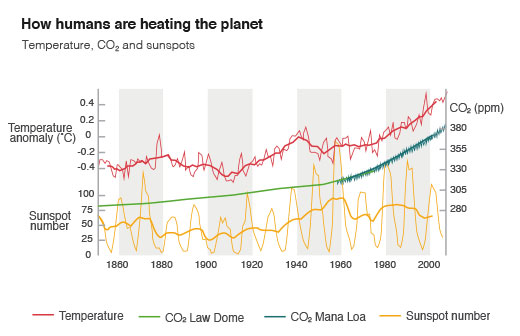
The chart below is one of many available that show rising global temperatures being driven by human activity (the yellow line demonstrates that sunspots are not to blame). For all who hope and believe that we can stop global warming, this agreement may turn out to be the tipping point when action finally gained primacy over awareness.
For petty-minded politicians this agreement can be viewed through the lens of whether it makes Obama look good or bad. Of course, some are decrying what they claim is a “job crushing” policy.
Others may feel cynically that this is all window dressing and that far more dramatic measures are needed. For supply chain people, however, it signals the start of a game we know how to play: set the target, get the target.
SCM World research on sustainability has shown a steady and robust increase in the importance of cost savings as a motivation for company investments in social and environmental responsibility (SER).
Other reasons to invest in SER – most notably increased sales for green products – have lost ground. The lesson being learned is that a sustainability initiative cannot thrive without a scorecard to drive the actors (primarily supply chain people) each and every day to get better.
Supply chain leaders generally want to do the right thing, and some like Unilever create and manage their own public scorecards as a form of self-discipline. Many also see the obvious wisdom of a balanced energy portfolio from both a cost and risk standpoint – Google, for instance, with its investments in wind, or AT&T, which has converted its service fleet to natural gas.
Even those companies that consumers failed to reward for greening their product lines have generally stayed the course, because cash savings on materials and energy with smarter packaging pays off – Clorox being a perfect proof point.
To be fair, the agreement is just a start. Many economists assert (and I agree) that the best way to pursue a goal like cutting carbon by 26-28% is to introduce a carbon tax. By pricing the externality of pollution on a variable scale, business can still decide to pay for CO2 where it’s worthwhile, but trim it out elsewhere.
The incentive to reduce emissions with this approach is more carrot than stick, rewarding supply network designs that are leaner on carbon without blindly prohibiting activities that may be messy but still economically wise, like running furnaces to make glass.
The US-China carbon deal could give supply chain professionals what they crave: an objective function to optimise. Planners, start your engines!
Beyond Supply Chain
Subscribe on LinkedIn to receive the biweekly Beyond Supply Chain newsletter.