By Kevin O'Marah | March 03, 2017
CSCO Outlook for 2027: Cloudy With a Chance of Moderate Growth
October 09 2026


By Kevin O'Marah | March 03, 2017
President Trump’s address to Congress this week included an unequivocal restatement of the most universally loved part of his bouquet of campaign promises: a $1 trillion investment in infrastructure. Nearly everybody agrees on the basic premise including governors around the country, the American Society of Civil Engineers (ASCE), former President Barack Obama, and of course, supply chain executives.
And yet, Washington-watchers seem convinced that it’ll have to wait until 2018 at least and ultimately, may not survive at all in the face of strict fiscal conservatism. That would be a shame.
It’s About Time
Every year, SCM World surveys more than 1,000 supply chain executives on a whole range of topics including risk. In 2016, exactly three quarters of our respondents were at least “somewhat concerned” about shipping & logistics disruptions, with 27% saying they were “very concerned”. This was the top overall worry among more than a dozen risk factors that we considered. It’s also up significantly from 2014 when only 22% said they were very concerned.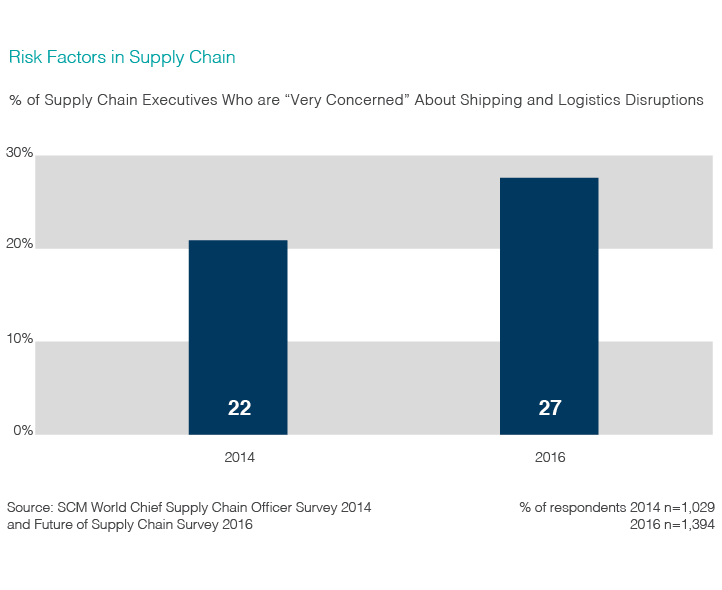 No surprise. In fact, way back in 2007 I did an in-studio segment on CNBC’s Squawk Box to discuss the findings of research that Gartner (then AMR Research) carried out with the National Association of Manufacturers and Procter & Gamble on our crumbling infrastructure. Co-anchor Becky Quick’s bottom line then was: “we’re hosed.”
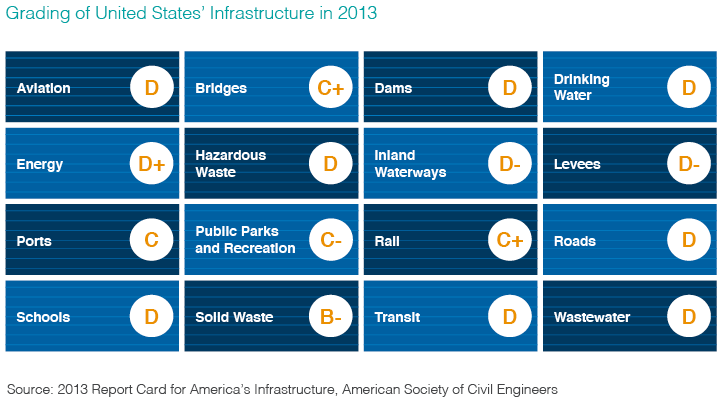
The ASCE publishes a periodic report card on infrastructure in the United States, which says we’re basically failing. The next one is due this month and it’s hard to see how it’ll get better from where we were as of 2013.
One has to go back 70 years to find a really meaningful push on infrastructure in the US when President Eisenhower’s sponsorship gave us the interstate highway system. Even that was just building on a century’s worth of effort starting with canals and railways in the 1800s (see The Men Who United the States for an inspiring look at what infrastructure really means).
Meanwhile, American supply chain leaders have forged ahead in spite of these shaky foundations. Amazon, for instance, has in just two decades gone from shipping books out of Jeff Bezos’ garage to operating 50 fulfillment centers nationwide. During this period, e-commerce grew from nothing to 8% of US retail sales, all of which depends on this sagging infrastructure. FedEx built Memphis, UPS built Louisville and Delta built Atlanta as mega-hubs while the Federal government sat largely idle.
It’s not ok.
Paying For It
The stall is a matter of dogma drowning out vision. Fiscal hawks won’t budge on deficits and many in Congress would rather have tax cuts than debt-financed investments in roads and bridges. This is as short-sighted as renting an apartment forever because you’re scared to take a mortgage. It’s the exact opposite of what happens in Silicon Valley when startups spend borrowed money to build the next Google or Uber. And it bears no resemblance to the way we made America great in the first place, with bold public investments that created the world’s biggest economy.
This blindness is especially baffling when interest rates, both long and short term, are historically low and cash is so fat on corporate balance sheets that many would rather buy back shares than invest in growth. Globally, we are at greater risk of deflation than inflation. Why not invest this idle cash today to create demand, jobs and a scalable physical economy in the present?
Jobs, first in rebuilding this foundation and then riding on the resulting platform for economic expansion, are waiting to be created. Plus, with explosive innovation already underway in the US technology and healthcare sectors, the biggest concern should really be friction that impedes the growth we’ve already initiated.
Bridge to the Future
Two weeks ago, I argued that Warren Buffet sees the productivity boom now happening in the content economy. His investment in Apple suggests that our economic future lies somewhere beyond the industrial nostalgia invoked during the election. His stake in railroader BNSF, however, proves the common sense wisdom of Colgate-Palmolive CSCO Mike Corbo who says “you can’t create the future unless you can control the present”.
We’ve already waited too long to fix our infrastructure.
Let’s start spending immediately.
Beyond Supply Chain
Subscribe on LinkedIn to receive the biweekly Beyond Supply Chain newsletter.