By Kevin O'Marah | November 17, 2017
Navigating the Supply Chain AI Fog
September 18 2026


By Kevin O'Marah | November 17, 2017
Twenty-five years ago this month the Union of Concerned Scientists published what they hoped would be a game-changing wake-up call to the world. In it, 1,700 esteemed scientists called out what they saw as a broad pattern of rising environmental damage that would, if unchecked, lead to “vast human misery.” This week a follow-up warning was published by 15,364 scientists in the journal BioScience. Its message is that we’re failing.
I’m not so sure.
Storm Before the Calm
In the heat of U.S. politics, feelings about sustainability seem dangerously divisive. Mega-storms, rising sea levels and a hotter planet are tangible realities, and yet concerted action feels unattainable. Meanwhile, concern over water supplies, biodiversity and social justice add to anxiety and anger. The working atmosphere feels toxic, and it is tempting to anticipate an apocalypse.
I believe the problem is real, and I believe we can solve it. I also believe, however, that we are making more progress than public opinion seems ready to accept.
First of all, it is important to break down the question of sustainability. Population, which was among the hot buttons flagged back in 1992, has grown by 35% in just 25 years. This factor alone explains much of our increased human footprint on the planet. But is it necessarily bad?
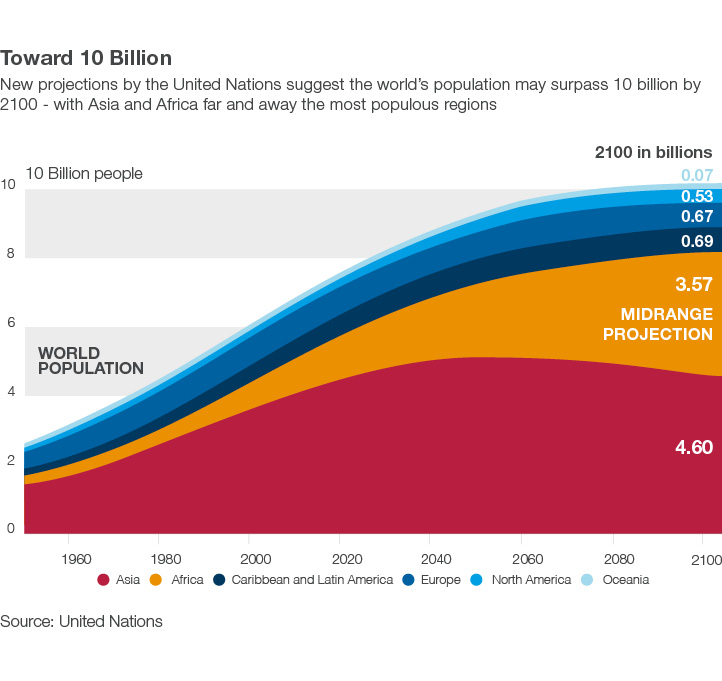
Massive economic growth has elevated Asian and African consumption enormously, and our annual CO2 emissions (up by 62% since 1992) reflect it. UNDP projections, however, say we’ll flatten off at around 10 to 11 billion people worldwide, in which case we’re not facing a population explosion so much as seeking a new plane of existence. Can the world handle it?
Much of the concern surrounding the question of sustainability assumes we can’t handle it, and that conflict over scarce resources is inevitable. Little wonder, then, that the rhetoric has gotten so aggressive, and that good works already underway are being crowded out of the debate.
Carbon Efficiency as a Proxy for Sustainability
Editorials in The New York Times and The Wall Street Journal this week separately supported the idea of reducing carbon emissions. The common thread is all about efficiency, which makes tons of sense to businesspeople, and to supply chain professionals, in particular. Taxing carbon, according to Holman Jenkins at the WSJ, “is better than taxing work and investment,” while business leaders, according to Michael Bloomberg and Jerry Brown in the Times, are already busy “tackling global warming.”
Both are absolutely right, and our new data on carbon emissions reduction efforts in supply chains proves just how ubiquitously carbon efficiency is already baked in. Overall, 81% of companies surveyed said they were investing in carbon emissions reductions initiatives. More than half of these say they do so because it has a financial payback.
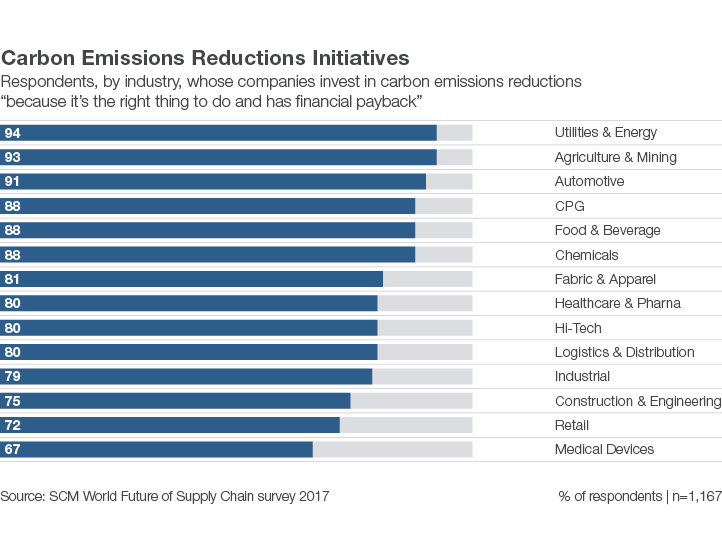
The data is strong across all industries with the biggest carbon footprint businesses also the most highly invested in reducing emissions. Utilities & energy, in particular tops all industry groups not only in the share who are actively investing in carbon reduction initiatives (94%) but in the portion who are saving money as a direct result (67%). Berkshire Hathaway Energy is typical of this trend, with $19 billion already invested in 45 wind and five solar projects. They’re not trying to impress anyone, but Warren Buffet knows that means real ROI.
This data is consistent across sustainability initiative areas, including:
On the Right Track
Sustainability is a big problem, and scientists are right to raise the alarm. Humanity is demonstrably bursting at the seams of our planet. But business, and in particular supply chain, knows this already. We are well past the point of awareness and decidedly on the road to real change. Proclamations and even regulation from above may ultimately matter less than the natural supply chain urge to stay lean.
Beyond Supply Chain
Subscribe on LinkedIn to receive the biweekly Beyond Supply Chain newsletter.