By Kevin O'Marah | September 11, 2015
CSCO Outlook for 2027: Cloudy With a Chance of Moderate Growth
October 09 2026


By Kevin O'Marah | September 11, 2015
A recently released survey of 2,716 Harvard Business School alumni found that the cost of healthcare was the top barrier to entrepreneurship in the United States. For most Americans this finding won’t sound especially surprising. What is surprising, and should be alarming, is that this same barrier is the least important for entrepreneurs outside the US. What are we doing wrong?

Most of what the press picked up in response to this HBS survey was concern over the rising inequality of income distribution in the US. In the context of a relatively robust US economy this crumbling of the middle class is certainly worrying. Yet jobs are still being added at a brisk pace and business is growing well.
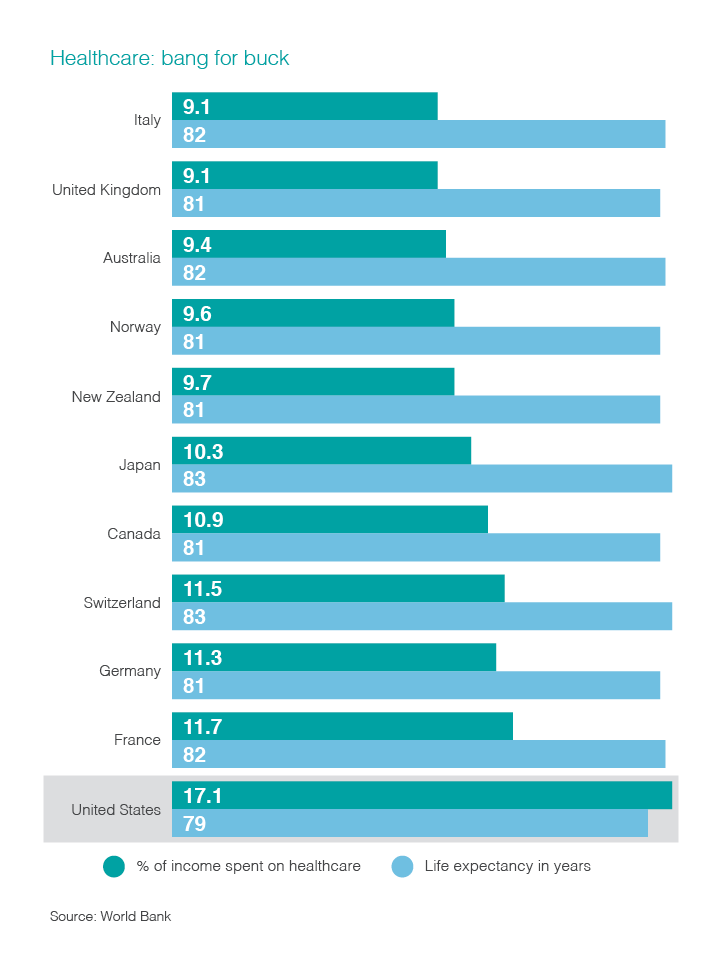
Why, then, do we have a healthcare sector that for all its technical sophistication remains a gigantic burden in terms of efficiency? The US spends around 70% more as a percentage of GDP than other rich countries – including those such as Canada, Australia and the United Kingdom with demographic and cultural similarities – but has an average life expectancy at birth that is slightly worse.
I believe the answer lies in supply chain.
Our team at SCM World has been working with a small group of senior supply chain leaders from the healthcare sector to map the value stream in terms of information flow, cash flow and material flow in service of the patient. This effort has shed light on just how badly the demand signal is distorted on its way back from the patient/provider point of need to the network of distributors, manufacturers and suppliers that delivers the goods.
The problem, so far as I can see, does not lie in the level of understanding among these executives about how to manage inventory or utilise assets. It arises instead out of the convoluted set of perverse incentives driven by a for-profit insurance industry. When publicly traded companies like Aetna or Cigna hold the purse strings, the urge to deny payment is almost irresistible.
Outside the US, healthcare is generally managed as a public service to at least some degree, and while this flies in the face of American free-market orthodoxy it’s hard to argue with the macroeconomic results. From a purely theoretical supply chain perspective, what appeals to me about publicly managed healthcare is the relative clarity of the demand signal. Single payer may not be problem-free, but at least there is a clear sense of who the customer is.
Supply chain management, as a discipline, encompasses not only plan, source, make and deliver but also new product development and launch, field service operations and an overlay of measurement that has driven phenomenal productivity gains in classically customer-centric industries such as automotive, hi tech and consumer packaged goods. The value-for-money advances delivered by the likes of Apple, Wal-Mart and Toyota over the past few decades are simply amazing. All have harnessed the power of customer demand to drive innovation and execution.
Supply chain leaders understand this and are ready to work for change. We’re asking a question in our ongoing Future of Supply Chain survey about the role respondents believe their supply chains play in addressing three global challenges, one of which is described as “providing accessible healthcare”.
In addition to the three-quarters of executives in the pharma and medical devices industries who describe their role in meeting this challenge as “substantial”, a further 25-33% of respondents across logistics, food & beverage, chemicals and industrial companies say they too could have such an impact.
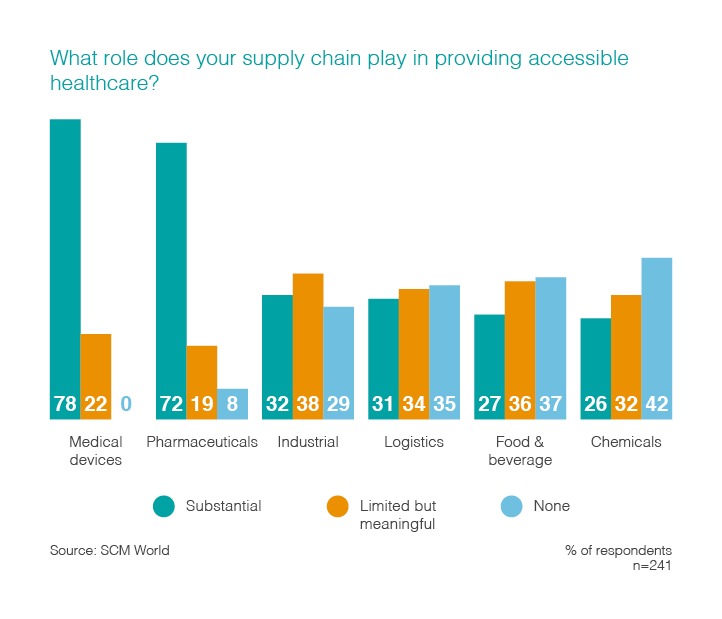
When answers to this question are cut by geography, however, the telling and sad story is that American supply chain leaders are more likely than their European counterparts, and almost twice as likely as those in Asia, to say their supply chain plays no role at all in providing accessible healthcare.
The bottom line: we have a bunch of efficiency experts sitting on the bench right now in the US while the entrepreneurs from HBS are calling for help.
Beyond Supply Chain
Subscribe on LinkedIn to receive the biweekly Beyond Supply Chain newsletter.