By Kevin O'Marah | May 01, 2015
Navigating the Supply Chain AI Fog
September 18 2026


By Kevin O'Marah | May 01, 2015
In my blog last week, I supported Obama fast-tracking the Trans-Pacific Partnership, and I hope that he does it with decision and purpose. Thomas Friedman of The New York Times is of the same mind, although, while I see this an opportunity not only to improve global supply chain, but also to lay some rules on the way our exponentially evolving business world affects the environment, labour and public health, he doesn’t stop short of calling it a bulwark for “national security” against international anarchy.
The post-industrial world is here, but we’re still playing by rules that made sense in 1955. Meltdown is possible, but so is epiphany.
Megatrends
There are three megatrends driving the world across the inflection point between the industrial past and the new information-based economy already exploding beneath us. These are:
The race is on.
What we can do right now
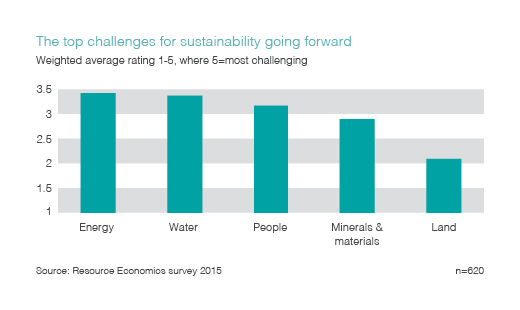
A new survey of over 600 supply chain professionals around the world shows a remarkably clear picture of how we can take care of 10 billion people without breaking the planet. The top overall challenge going forward is energy, followed very closely by water.
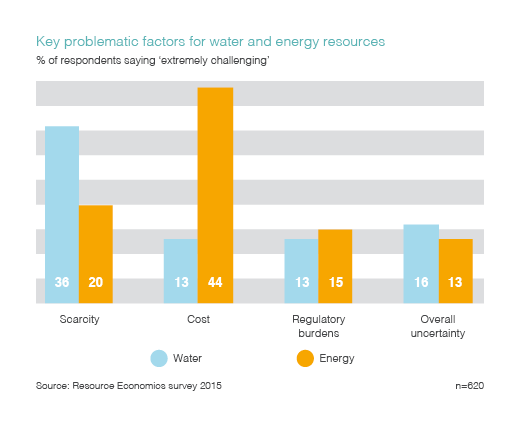
In the case of energy, concerns centre on cost and solutions all include some degree of portfolio management techniques. In the case of water, the chief worry is scarcity and strategies all include re-use techniques. Across all resource questions, there is a common thread of long-time horizon planning approaches and strategic network modelling.
Tactically, many see a role for localising production nodes nearer to vital resources, as well as wider use of smart technologies for precision monitoring. Digitisation and demographic equilibration will contribute to solving our resource problem and, in the process, enable faster economic growth.
The link back to Friedman’s anarchy warning is that none of this is possible without the rule of law. Fast-tracking the Trans-Pacific Partnership is just one part of establishing standards of global trade that would work for everyone and for the long run. Our operations need to strive toward business models that are closed loop in terms of natural resources, but this will take time and teamwork.
Innovation to the rescue
Digital pioneers are building the platform for an economy based on ideas that will be dramatically cleaner per dollar of GDP than anything we’ve ever seen. This platform has the potential to spread opportunity to all and unleash massive human problem-solving genius.
Unfortunately, industrial era rules still in effect are creating a tragedy of the commons problem, where rational individual behaviour clashes with the best interests of the whole. The root problem is that our politics are short term and self-serving, which makes long-range investment difficult for business.
The TPP is just a start, but we’re running out of time and better get moving.
Beyond Supply Chain
Subscribe on LinkedIn to receive the biweekly Beyond Supply Chain newsletter.