Agentic AI adoption will stall if pricing models fail to keep pace with rising inference costs and ROI expectations.
- Gartner client? Log in for personalized search results.
Agentic AI’s value gap is widening
Agentic AI adoption is accelerating, but the economics behind it are becoming harder to justify. A review of nearly 1,000 case studies found that fewer than 10% of agentic AI deployments are currently delivering robust return on investment. At the same time, AI inference costs per agentic workflow are predicted to increase by more than five times through 2028.
The challenge is that the reasoning capabilities that make agentic AI valuable also make it expensive, as advanced reasoning models typically consume five to 30 times more tokens than basic chatbots. This is creating a growing gap between the value organizations expect and the costs required to deliver it.
“The sheer volume increase and unpredictability in token generation and usage presents unprecedented financial risks to users and agentic AI vendors alike,” says Annette Zimmermann, Vice President Analyst at Gartner.
You might also like this webinar: Agentic AI: Inconvenient Truths About Cost and Skills
Sustainable adoption requires a new pricing approach
Traditional software pricing models were designed for predictable usage patterns. Agentic AI changes that equation. As reasoning-intensive workflows become more common, providers and adopters alike need new ways to align costs with business value while maintaining scalability.
Move beyond untiered usage-based pricing
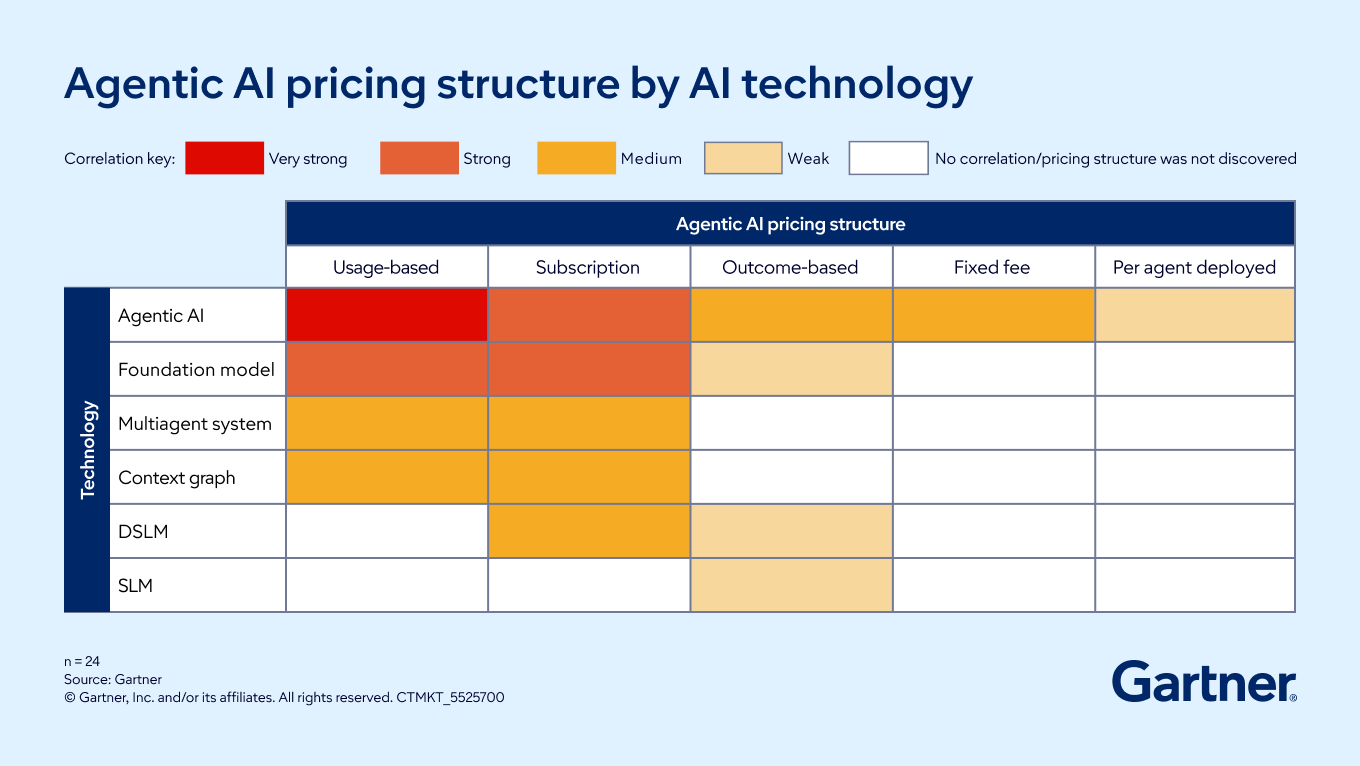
Usage-based pricing has become common across the AI market, but untiered approaches create growing financial risk for both providers and customers.
For customers, rising inference consumption can lead to escalating and unpredictable costs. For providers, highly variable usage can create revenue uncertainty and put margins at risk, Those challenges are amplified when third-party models are part of the solution, as reasoning models generate 20 to 30 times more tokens per task than standard completions.
As a result, providers are beginning to explore alternative approaches, including credit-based entitlements, outcome-based pricing and hybrid models as mechanisms for creating more predictable spending and strengthening alignment between costs and value. Smaller providers have been early innovators in outcome-based pricing, while larger software providers are beginning to explore similar models to address customer concerns around rising AI costs.
Build trust through transparent value measurement
Pricing innovation alone will not solve the value gap. Organizations also need clearer visibility into the relationship between AI spending, model performance and business outcomes.
Establishing transparent value measurement frameworks can help customers understand the trade-offs among cost, performance and results. This becomes increasingly important as outcome-based pricing models gain traction because providers and customers must agree on how success will be measured.
These arrangements often require closer collaboration and greater information sharing than traditional software contracts. While outcome-based pricing can improve spending predictability and strengthen alignment with business value, organizations must carefully define outcomes and maintain transparency to avoid disputes and build trust. The providers that can clearly demonstrate value will be better positioned to increase adoption and strengthen long-term customer relationships.
Invest in inference tiering to contain costs
The most sustainable response to rising inference costs may be reducing the cost of delivering agentic AI in the first place.
By investing in model routing and inference tiering, which match workloads to the most appropriate AI model based on cost and capability requirements, organizations can dynamically route agent workflows to achieve the desired outcome at a lower cost.
Nearly one-third of the vendors participating in the recent use case review indicated that model routing and inference tiering are already part of their strategy. Multimodal architectures are expected to expand significantly in the coming years, making intelligent workload orchestration an increasingly important differentiator.
Product leaders that act now can narrow the agentic AI value gap before rising costs slow adoption. Take these actions over the next six to 18 months:
Build sustainable pricing strategies supported by effective inference tiering.
Establish transparent value measurement frameworks.
Embed usage monitoring and cost controls in your product offerings.
Design modular architectures to seamlessly integrate new AI models.
Pilot tailored, hybrid pricing models to attract price-sensitive customers.
Agentic AI pricing FAQs
Why is agentic AI pricing becoming a challenge?
Advanced reasoning models typically consume five to 30 times more tokens than basic chatbots, while inference costs per agentic workflow are projected to increase by more than five times through 2028. These rising costs are creating challenges for both providers and customers.
What pricing models are emerging for agentic AI?
Alternatives to untiered usage-based pricing include credit-based entitlements, outcome-based pricing and hybrid models that combine subscriptions with outcome-based elements. These approaches can help better align customer spending with business value.
How can organizations manage agentic AI inference costs?
Gartner recommends investing in model routing and inference tiering, establishing transparent value measurement frameworks, embedding usage monitoring and cost controls and designing modular architectures that can orchestrate workloads across multiple AI models efficiently.
Attend a Conference
Experience CIO and IT Executive conferences
With exclusive insights from Gartner analysts on the latest trends, sessions curated for your role and unmatched peer networking, Gartner conferences help you accelerate your priorities.
22 – 23 Feb 2027
Gartner CIO Leadership Forum
Phoenix, AZ

Drive stronger performance on your mission-critical priorities.