Unlock the full value of AI by building a data stack that scales, adapts and delivers results.
- Gartner client? Log in for personalized search results.
How enterprises architect their data stack to support AI at scale
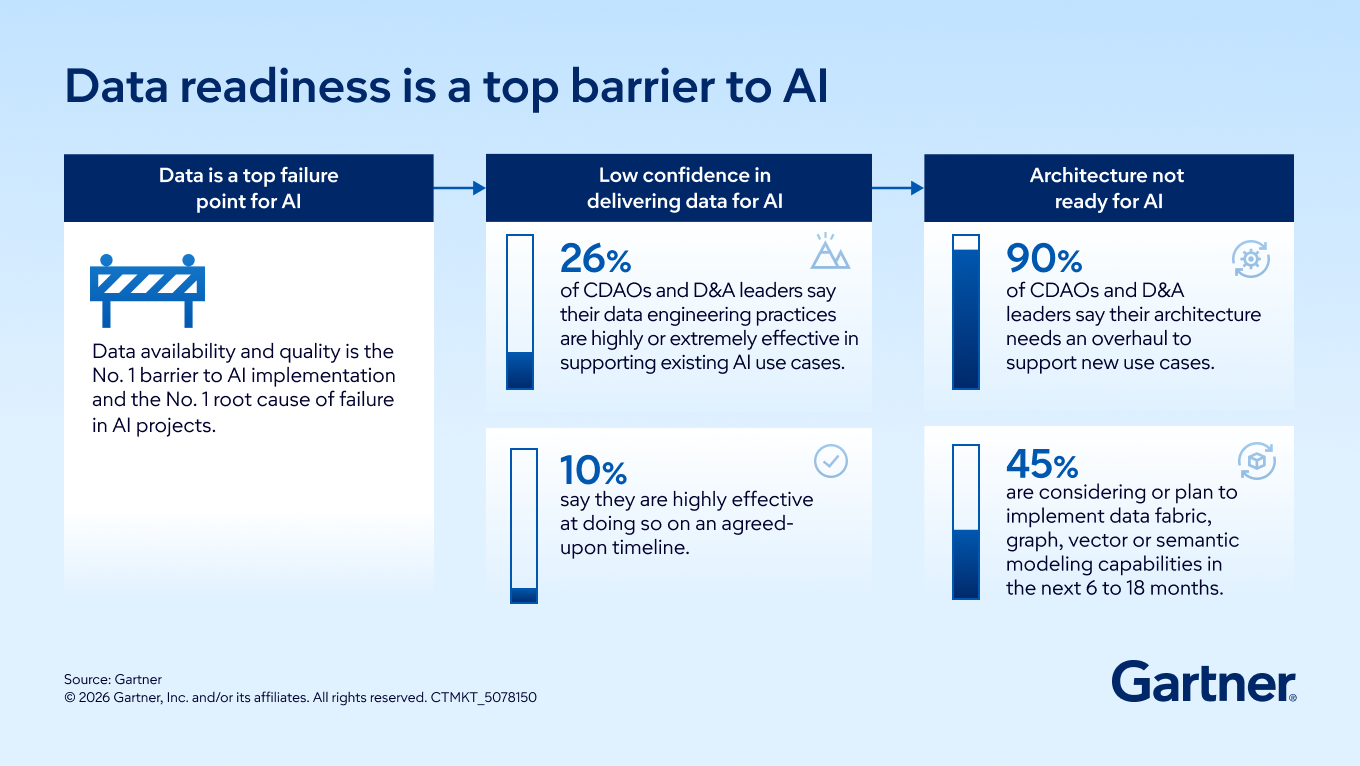
For AI success, your data is your superpower. However, Gartner insights reveal that lack of data readiness is a top barrier to AI, driving over 75% of organizations to prioritize AI-ready data investments.
Traditional data management can’t deliver the speed, scale or trust required to support enterprise AI. Rethink your data stack architecture to enable rapid experimentation, seamless integration and responsible governance — aligned to your business objectives. This includes maturing AI-ready data with context, including metadata management and semantic layers, enabled by converged data management platforms, while adopting synthetic data and multimodal analytics to scale AI, boost decision quality and reduce governance risk.
A framework for architecting an AI-ready data stack
A modern data stack for AI isn’t a single product. It’s a layered approach that scales to support your organization’s AI ambition and key use cases across data discovery, access, quality and governance.
Step 1: Define and communicate AI readiness.
Define AI readiness for your organization by ensuring data is well-governed, representative and adaptable for each use case.
Communicate the need for urgent investment in upgraded data architecture, platforms, skills and processes by linking new AI techniques and data management improvements to business value and measurable outcomes.
Step 2: Map AI ambition to data requirements and prioritize use cases.
Translate your AI strategy into specific, prioritized use cases.
For each, identify the unique data, metadata, modeling and governance needs. As GenAI and agentic AI scale, context — especially semantics, metadata and provenance — becomes critical.
Identify the right data delivery style, such as data fabric or data mesh, that supports your requirements and drives measurable business value.
Step 3: Assess gaps and build the business case for investment.
Benchmark your current state against AI-readiness requirements. Gartner insights reveal that 90% of CDAOs say their architecture needs an overhaul to support new AI use cases.
Identify urgent gaps in architecture, platforms, skills and processes.
Build a compelling business case for foundational investments — such as data fabrics, metadata management and knowledge engineering — using business value metrics. A strong data and context foundation directly impacts GenAI accuracy and cost.
Explore how the Gartner AI Maturity Assessment helps our client prioritize and accelerate their AI maturity.
Step 4: Modernize data management and evolve practices.
Update data management processes and operational disciplines with AI agent-based tools to deliver AI-ready data efficiently at scale.
This includes supporting multimodal data, semantic layers and continuous maintenance of AI-grade datasets.
Failing to evolve practices risks sabotaging AI outcomes, so implement best practices for unstructured data, agentic AI and data migration.
Step 5: Implement technology and operational change.
Select and deploy technologies and architectures that align with your AI ambitions — such as converged data management platforms and multimodal data fabrics.
Use Gartner Magic Quadrants to assess your options.
Plan and execute changes across governance, operating models, teams and skills to embed unified data, context and knowledge management, enabling sustainable AI-driven outcomes.
AI-ready data stack FAQs
Why is data stack modernization critical for scaling enterprise AI?
Legacy data stacks can’t deliver the speed, trust or flexibility needed for enterprise AI. According to Gartner, over 75% of organizations now prioritize AI-ready data investments, citing data readiness as a top barrier to AI success. Modernizing your stack enables rapid experimentation, seamless integration and responsible governance — all essential for unlocking AI’s full value at scale.
What are the most urgent gaps CDAOs must address in their AI data stack?
The most urgent gaps include outdated architecture, fragmented platforms, limited skills and inconsistent processes. Ninety percent of CDAOs say their current data architecture needs an overhaul to support new AI use cases, according to Gartner surveys. Addressing these gaps with foundational investments in data fabric, context management and knowledge engineering is key to sustainable AI-driven outcomes.
How should enterprises prioritize data stack investments for AI?
Start by mapping your AI ambition to specific use cases and identifying the unique data, context and governance needs for each. Benchmark your current state against AI-readiness requirements, then build a business case for investments that close the most critical gaps. Gartner recommends a layered, AI-native approach to maximize value and future-proof your enterprise AI strategy.
Attend a Conference
Experience Data and Analytics conferences
With exclusive insights from Gartner analysts on the latest trends, sessions curated for your role and unmatched peer networking, Gartner conferences help you accelerate your priorities.
8 – 10 Mar 2027
Gartner Data & Analytics Summit
Orlando, FL

Drive stronger performance on your mission-critical priorities.