AI is reshaping cybersecurity — here are the five use cases that deliver results.
- Gartner client? Log in for personalized search results.
Focus on proven AI use cases in cybersecurity
As AI-driven tools change how organizations detect, respond to and prevent cyberthreats, CISOs face pressure to distinguish proven AI use cases from overhyped promises. Gartner finds that 55% CISOs report they have faced costly workarounds from vendor overpromises in AI capabilities and technologies, and 43% feel that AI-assisted tools have failed to deliver promised outcomes. As Charlie Winckless, Gartner Vice President Analyst notes, “Focusing efforts on the most effective uses of modern AI technologies is critical amid the incessant hype around them.” CISOs see the strongest results when they apply AI in targeted ways.
You might also like this webinar: Assess and Benchmark AI Cyber Risk Readiness
Five proven AI use cases for cybersecurity leaders
AI’s real impact on cybersecurity is most evident in these five use cases.
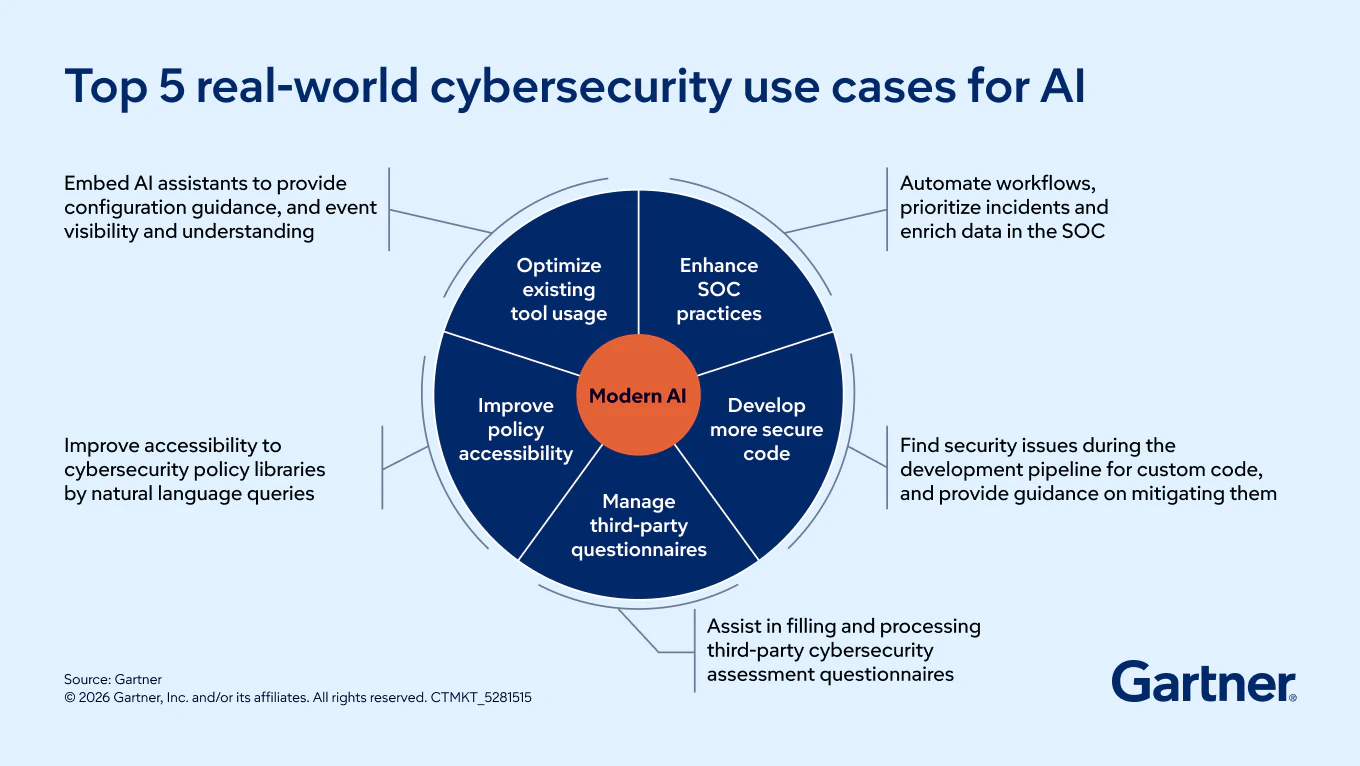
Optimize existing tool usage via embedded AI assistants.
Embedded AI assistants can provide configuration guidance and improve event visibility and understanding. By integrating AI into existing security tools, organizations can maximize the value of their current investments and ensure more effective threat monitoring and response. Use copilots to boost team effectiveness with existing tools and simplify onboarding for new tools. Promote their use to support decision making and uncover new capabilities.
Enhance security operations with AI SOC agents.
AI can automate workflows, prioritize incidents and enrich data within the security operations center (SOC). This enables SOC teams to respond more quickly and efficiently to potential threats, reducing manual effort and improving overall incident management. Larger teams benefit most from augmentation, so match your scale and use cases — focusing on enrichment and proactive alert processing — rather than relying on a single vendor or approach.
Develop more secure code with AI code security assistants.
AI code security assistants (ACSAs) help find security issues during the development pipeline for custom code and provide guidance on mitigating them.
By integrating AI-powered tools into software development, organizations can proactively address vulnerabilities and strengthen application security from the outset. Use ACSAs with regular application security testing (AST) and LLM-based vulnerability tools — AST and LLMs find issues, while ACSAs guide remediation.
Manage third-party questionnaires.
AI can assist in filling and processing third-party cybersecurity assessment questionnaires. This streamlines the evaluation process for third-party vendors, reducing administrative burden and helping organizations maintain compliance with security standards. While AI tools can draft and process security questionnaires, humans must verify results and control models due to sensitive information.
Improve access to policies and standards with policybots.
AI improves accessibility to cybersecurity policy libraries through natural language queries. This allows users to easily search and understand relevant policies, supporting better compliance and awareness across the organization. Integrate LLMs with messaging systems and policy libraries, starting with a limited set and expanding gradually.
Looking for a government perspective? Explore how public sector cybersecurity leaders are managing AI-related risks while enabling innovation and operational resilience.
How can CISOs focus on proven AI use cases that deliver measurable outcomes?
Gartner recommends starting with clear objectives, piloting AI solutions in high-impact areas and measuring results. Developing staff skills and integrating AI into existing workflows are critical for success. As AI capabilities mature, CISOs can expand adoption to additional use cases — always guided by business needs and risk tolerance.
Cybersecurity AI use cases FAQs
What are the top cybersecurity AI use cases for CISOs?
Gartner identifies five key use cases: Embedded AI assistants to improve threat monitoring and response, AI security operations center (SOC) agents to automate workflows, prioritize incidents and enrich data within the SOC, AI code security assistants to detect and remediate security vulnerabilities in code, third-party questionnaire management and policybots to make cybersecurity policies and standards easier to access.
How can CISOs prioritize AI use cases in cybersecurity?
CISOs should focus on use cases with proven effectiveness, starting with pilot projects and measuring outcomes to align AI adoption with business goals.
What skills are needed to implement AI in cybersecurity?
Successful AI adoption requires developing staff skills in data analysis, automation and integrating AI tools into existing security processes.
Attend a Conference
Accelerate growth with Gartner conferences
Gain exclusive insights on the latest trends, receive one-on-one guidance from a Gartner analyst, network with a community of your peers and leave ready to tackle your mission-critical priorities.

Drive stronger performance on your mission-critical priorities.