Data and analytics leaders can turn AI visibility into business influence by strengthening governance and data foundations.
- Gartner client? Log in for personalized search results.
AI may be the headline, but data determines the outcome
AI dominates executive conversations, investments and transformation plans. Yet the Gartner 2026 Predictions highlight a less obvious reality: AI success increasingly depends on the quality of the data infrastructure behind the scenes. As AI becomes central to enterprise strategy, data and analytics leaders have an opportunity to expand their influence far beyond traditional data management responsibilities.
“AI is everywhere, built on data — which stays behind the scenes while AI takes the spotlight,” notes Sarah James, Vice President Analyst at Gartner.
The implication is significant. Organizations eager to scale AI often focus on models, tools and use cases. However, the organizations most likely to create lasting value will instead prioritize the data foundations, governance practices and leadership capabilities that make AI reliable, scalable and trustworthy.
You might also like this webinar: Data and Analytics Leaders Need to Optimize Their Future-Ready Organization for Consistency and Agility
Expanding influence requires stronger data foundations
The growing importance of AI is elevating expectations for data and analytics leaders. To capitalize on that shift, organizations must address three interconnected priorities.
Data leaders are becoming AI leaders
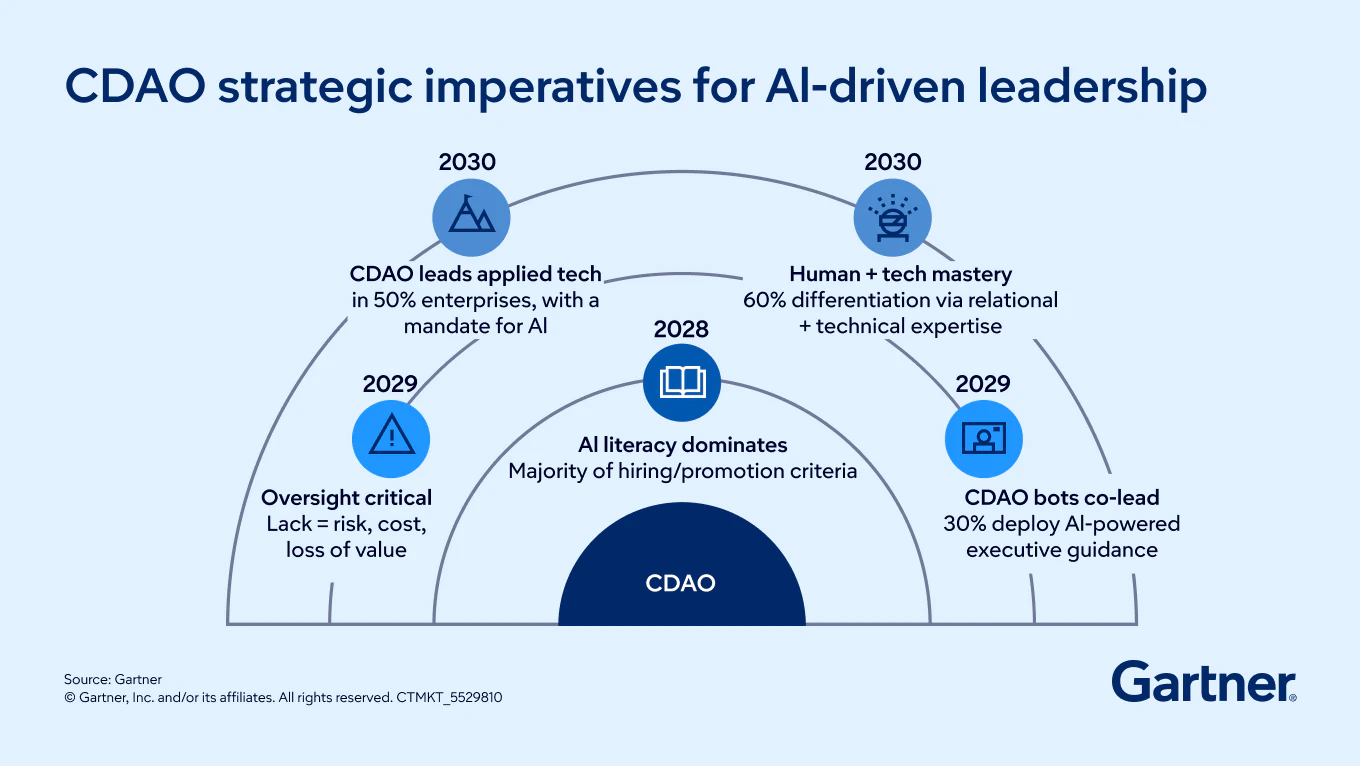
According to Gartner, by 2030 the CDAO will become a de facto leader of applied technology in 50% of enterprises, playing a critical role in organizational AI success. By 2029, 30% of enterprises will deploy AI-powered “CDAO bots” that help deliver real-time, data-driven executive guidance.
This evolution reflects a broader shift in executive expectations. AI is no longer viewed as a stand-alone technology initiative. It increasingly depends on leaders who can connect data strategy, governance and business outcomes. Gartner further predicts that by 2028, AI literacy will become the predominant skill set required for professional knowledge workers, making AI fluency an enterprisewide requirement rather than a specialized capability.
Governance is becoming a prerequisite for AI value
Many organizations still treat data governance and AI governance as separate disciplines. According to Gartner, this approach will become a major obstacle to value realization. By 2027, 60% of organizations will fail to realize AI value because they lack integration between data governance and AI governance.
The challenge extends beyond policies and controls. Gartner predicts that by 2027, 60% of organizations that fail to address the cultural challenges associated with data and analytics governance will also fail to govern AI successfully. At the same time, 80% of organizations are expected to adopt a unified approach to structured and unstructured governance by 2030, driven by AI requirements.
These predictions suggest governance is shifting from a compliance exercise to a business enabler that supports scalable AI adoption.
Strong foundations matter more than AI ambition
Organizations that overlook foundational readiness will struggle to achieve their AI goals. By 2028, 75% of large-scale autonomous business initiatives will stall primarily because of gaps in data foundations and data talent. In analytics, Gartner finds that 60% of agentic analytics projects relying solely on Model Context Protocol will fail because they lack a consistent semantic layer. Meanwhile, by 2028, 25% of ungoverned decisions using large language models will result in financial or reputational loss due to human biases, insufficient critical thinking and AI sycophancy.
Sustainable AI value comes from disciplined investments in data quality, governance and talent. Organizations that balance AI innovation with these foundational capabilities will be better positioned to scale AI responsibly and capture long-term business value.
AI in Data & Analytics FAQs
Why are data and analytics leaders becoming more important in the AI era?
AI is increasing the strategic importance of CDAOs and other data and analytics leaders because AI success depends on data readiness, governance and business alignment. By 2030, the CDAO will become a de facto leader of applied technology in 50% of enterprises.
Why is governance critical for AI success?
Organizations that do not integrate data governance and AI governance risk failing to realize AI value. By 2027, 60% of organizations will fail to realize AI value due to a lack of integration between the two disciplines. Cultural challenges can further undermine AI governance efforts.
What is the biggest barrier to scaling AI?
Weak foundations, not lack of AI ambition, create the greatest risk. Gartner predicts that by 2028, 75% of large-scale autonomous business initiatives will stall because of gaps in data foundations and data talent. Effective governance, high-quality data and skilled talent remain essential for successful AI adoption.
Attend a Conference
Accelerate growth with Gartner conferences
Gain exclusive insights on the latest trends, receive one-on-one guidance from a Gartner analyst, network with a community of your peers and leave ready to tackle your mission-critical priorities.

Drive stronger performance on your mission-critical priorities.