Why emerging IAM investments struggle to deliver value and what cybersecurity leaders can do differently.
- Gartner client? Log in for personalized search results.
Why emerging IAM technologies struggle to deliver value
Identity and access management (IAM) remains a top priority for cybersecurity leaders as organizations contend with increasingly complex digital ecosystems, AI adoption and evolving threats. Recent Gartner survey data shows that 56% of chief information security officers (CISOs) have increased IAM budgets in 2026 compared with 2025.
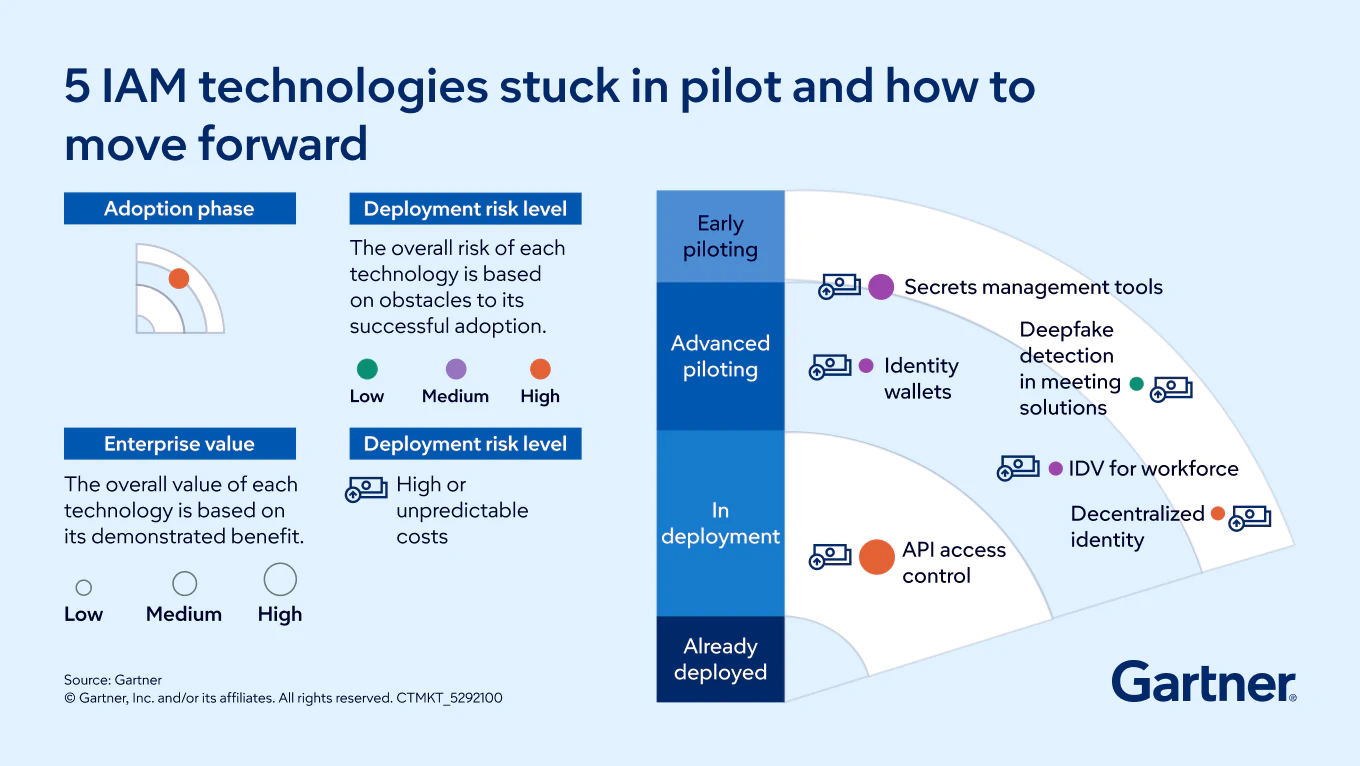
However, increased spending has not always translated into value. In fact, five of six emerging IAM technologies tracked in the Gartner 2026 Technology Adoption Roadmap remain stuck in pilot phases, with many adopters reporting a disconnect between high costs and low perceived value. “Emerging IAM solutions that don’t return proof of value aren’t inherently ineffective; they’re improperly scoped and lack a strong foundation of process and traditional IAM tools,” says Nathan Parks, Senior Specialist at Gartner. “The question cybersecurity leaders must answer isn’t whether these solutions work, but how they can deploy them with the right scope and in pursuit of the right outcomes.”
You might also like this webinar: Top Trends in Cybersecurity for 2026
How cybersecurity leaders can maximize IAM investments
Five emerging IAM technologies remain stuck in pilot: deepfake detection, workforce IDV, decentralized identity, identity wallets and secrets management. Adopters report challenges such as high and unpredictable costs, complex and lengthy integrations, and unsatisfactory stakeholder support. Take the following actions to avoid these pitfalls and move IAM investments toward value realization:
Deploy deepfake detection as part of a defense-in-depth approach, not as a standalone solution
Deepfake detection tools have gained attention as AI-generated impersonation attacks become more common, yet many adopters still rate them as low value during pilots. These tools often perform differently in real-world conditions than in controlled environments, and the market landscape is still immature. To maximize value, organizations should deploy deepfake detection as part of a defense-in-depth strategy alongside strong authentication, meeting monitoring and targeted security awareness training for high-risk employees.
Require workforce-specific capabilities in workforce identity verification solutions
Many organizations are piloting identity verification (IDV) for workforce use cases, but customer-focused solutions often miss important context. Organizations that choose vendors without workforce-specific capabilities can face higher implementation costs, longer deployment timelines and weaker stakeholder support. CISOs should prioritize vendors with workforce IDV expertise, look for granular control over employee biometric data and combine IDV with other controls, such as device profiling, location intelligence and multifactor authentication.
Employ a case-by-case approach to decentralized identity
Decentralized identity approaches continue to attract interest, but many adopters still perceive them as low value. Gartner cites a nascent vendor landscape, ongoing integration requirements and potential market instability as major barriers.
Organizations can improve outcomes by focusing on targeted use cases that do not require broad ecosystem adoption. Embedding decentralized identity initiatives within existing IAM governance and identity governance and administration (IGA) processes can also help reduce identity sprawl and improve long-term value.
Prioritize interoperability when adopting identity wallets
Identity wallets are intended to provide greater control over identity data, but adoption remains difficult due to interoperability gaps, high integration costs and user adoption challenges. To maximize value, cybersecurity leaders should begin with trusted ecosystems and authoritative issuers where possible. They should also evaluate emerging wallet use cases on a case-by-case basis while maintaining support for traditional identity processes.
Update machine IAM governance to support secrets management solutions
Secrets management remains an important technology, but many organizations struggle to unlock its full value. Gartner data shows that only 1% of organizations fully automate secrets rotation, limiting the impact of these tools. Confusion between secrets and rapdly proliferating machine identities can also create process inconsistencies and technical debt. Heads of cybersecurity should centralize machine IAM governance, reduce reliance on static credentials and establish governance guardrails for agentic AI identities before adoption scales.
Emerging IAM technologies FAQs
Which IAM technologies are currently stuck in pilot?
According to the Gartner 2026 Technology Adoption Roadmap, deepfake detection, identity verification (IDV) for workforce, decentralized identity, identity wallets and secrets management remain primarily in early or advanced pilot phases, with many adopters reporting a gap between cost and perceived value.
Why are emerging IAM technologies stuck in pilot phases?
Emerging IAM technologies often face unclear business goals, governance gaps, integration complexity, vendor immaturity and unpredictable total cost of ownership. These challenges can make it difficult for organizations to demonstrate measurable value during pilots.
How can organizations maximize value from emerging IAM technologies?
Organizations can maximize value from emerging IAM technologies by adopting a defense-in-depth approach, selecting vendors based on specific use cases, strengthening governance and investing in the people and process changes required to support successful adoption.
Attend a Conference
Accelerate growth with Gartner conferences
Gain exclusive insights on the latest trends, receive one-on-one guidance from a Gartner analyst, network with a community of your peers and leave ready to tackle your mission-critical priorities.

Drive stronger performance on your mission-critical priorities.