Stop overplanning. Start executing. Use a fast-track approach to build an IT strategy that’s focused, flexible and ready to adapt.
- Gartner client? Log in for personalized search results.

IT strategy planning doesn’t need to be exhaustive
Let’s be honest: Most IT strategies take too long to build and too long to update. CIOs often feel pressure to create a perfect, all-encompassing document — one that answers every question before execution begins. But that mindset slows you down.
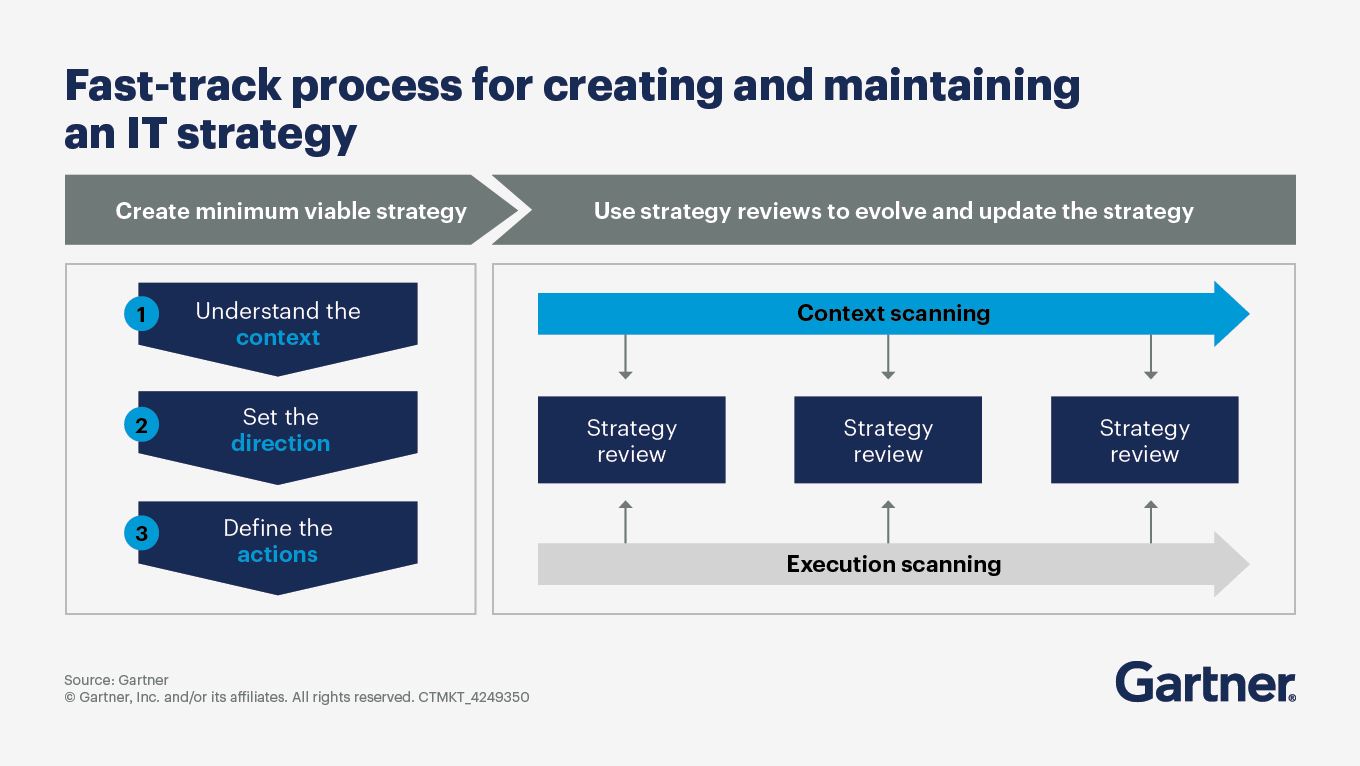
You don’t need a flawless strategy to move forward. You need a focused one. Gartner’s fast-track process helps CIOs build a strategy that’s clear, concise and ready to evolve. The key is to focus on three essentials: context, direction and action.
IT strategy should evolve with business conditions
Most CIOs review their strategy only once a year — or less. That’s not enough in today’s volatile environment. A minimum viable IT strategy enables faster execution and more frequent iteration.
Focus on what matters most
Start with what you know. What are the key business priorities and which business capabilities need to be improved to meet these priorities? What strategic actions will IT take to deliver these improvements? These are the questions that matter — and they’re the foundation of a minimum viable strategy.
This approach helps you move quickly, without sacrificing alignment. It also makes your strategy easier to update as conditions change — because it was designed to change.
Define actions that drive impact
Instead of a rigid three- to five-year plan, tailor the time horizon to fit current needs. Strategic actions may apply to the next quarter, six months or year — or focus on a base set of business capability improvements.
Gartner recommends focusing on four types of capability improvements in the base set: mandatory (for compliance), urgent (to respond to disruptions), foundational (to support other capabilities) and common (relevant across most scenarios). These categories help CIOs prioritize without overcomplicating.
Make strategy reviews routine
Change isn’t just constant — it’s accelerating. Annual reviews can’t keep up. CIOs need a strategy process that’s continuous, not static.
Gartner’s fast-track model includes two scanning streams: Context scanning tracks internal and external shifts, while execution scanning monitors performance and impact. Start with quarterly reviews. Add event-driven updates when needed. This rhythm keeps your strategy relevant — and your team aligned.
Are you a CIO or IT leader at a midsize enterprise?
See how your peers are navigating AI adoption, vendor decisions and evolving business demands — with tools tailored to your role:
Explore our resources for midsize enterprises.
Check out a curated list of Gartner’s most popular research being utilized by your peers.
IT Strategic Planning FAQs
What is a minimum viable IT strategy?
A minimum viable IT strategy is a streamlined framework that guides initial actions and adapts quickly to change. It focuses on essential content — context, direction and actions — to accelerate execution and reduce planning overhead.
How often should CIOs review their IT strategy?
Quarterly reviews are a strong starting point. Event-driven updates should be added when major changes occur. This keeps your strategy relevant and responsive.
Attend a Conference
Accelerate growth with Gartner conferences
Gain exclusive insights on the latest trends, receive one-on-one guidance from a Gartner analyst, network with a community of your peers and leave ready to tackle your mission-critical priorities.

Drive stronger performance on your mission-critical priorities.