Explore the trends defining enterprise technology’s next chapter.
- Gartner client? Log in for personalized search results.
The strategic technology trends CIOs should prepare for now
Organizations have spent the past several years experimenting with AI, deploying agents and modernizing digital capabilities. In 2027, the conversation shifts from adoption to governance. At Gartner IT Symposium/Xpo™ 2026 conference, Distinguished Vice President Analyst Gene Alvarez emphasized that CIOs are no longer deciding whether AI works; they are determining how to safely scale autonomous systems, govern machine behavior and maintain resilience in an increasingly complex technology landscape.
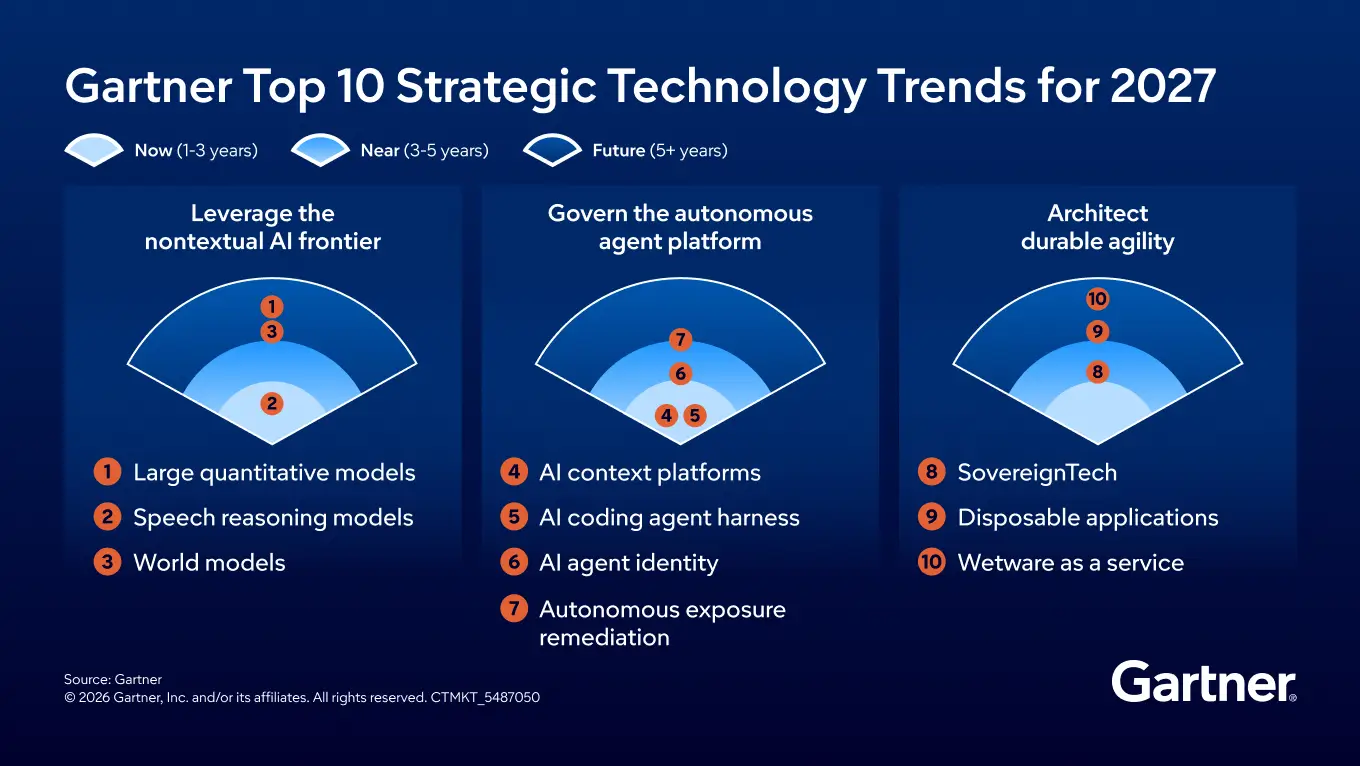
The Gartner Top 10 Strategic Technology Trends for 2027 help CIOs navigate this transition and lead their organizations into the autonomous era:
Large quantitative models
Speech reasoning models
World models
AI context platforms
AI coding agent harness
AI agent identity
Autonomous exposure remediation
SovereignTech
Disposable applications
Wetware as a service
You might also like this webinar: The Gartner Top Strategic Technology Trends for 2027
Why these technology trends matter now
Traditional IT operated in a world of software scarcity. In 2027, organizations face software abundance, autonomous digital workers and increasingly capable AI systems. CIOs must shift from managing technology assets to governing machine behavior, decision making and resilience at scale.
The Gartner Top 10 Strategic Technology Trends for 2027 fall into three major themes that help leaders safely accelerate autonomy while maintaining trust, control and flexibility.
Leverage the non-textual AI frontier
AI is expanding beyond text. Models are increasingly able to reason through numbers, speech and physical environments, opening new opportunities for forecasting, automation and simulation. These technologies move AI beyond text and into numerical reasoning, conversation and simulation. Together, they expand how organizations forecast, interact and make decisions.
Large quantitative models: Gartner predicts that by 2030, large quantitative models will replace large language models in 25% of strategic forecasting and operational modeling tasks, helping organizations improve decision making and forecasting accuracy.
Speech reasoning models: By 2030, Gartner predicts that more than 70% of enterprise voice interactions will be handled autonomously by speech reasoning models, enabling more advanced voice-based workflows and decision making.
World models: These models allow machines to simulate future outcomes and understand physical environments before taking action.
Govern the autonomous agent platform
As organizations deploy digital workers that generate code, execute tasks and make decisions, governance becomes a foundational requirement. Autonomy at scale requires more than model access; it requires system-level control. These technologies create the control planes needed to safely scale autonomy:
AI context platforms: Gartner predicts that organizations prioritizing semantics in AI-ready data will improve agentic AI accuracy by up to 80% and reduce costs by up to 60%, making AI context platforms a foundational capability for autonomous systems.
AI coding agent harness: This harness governs machine-generated software and helps maintain quality, compliance and accountability.
AI agent identity: Gartner forecasts that by 2028, 25% of enterprise security breaches will be linked to AI agent abuse, increasing the importance of AI agent identity and machine governance.
Autonomous exposure remediation: It automates vulnerability detection and response to reduce security risks.
Architect durable agility
CIOs must also prepare for a future shaped by geopolitical uncertainty, infrastructure constraints and accelerating technology change. Durable agility is the ability to remain flexible as these conditions evolve. Building that resilience requires technologies designed to support long term flexibility, including:
SovereignTech (SovTech): According to Gartner, by 2030, more than 75% of non-U.S.-based organizations will adopt digital sovereignty strategies, making SovTech a key capability for long-term resilience and continuity.
Disposable applications: These applications create software portfolios designed to evolve and retire as business needs change.
Wetware as a service (WaaS): It explores biological computing as a potential response to future compute and energy limitations.
Looking to turn strategy into technical execution?
Explore Gartner's Technical Implementation Strategy for CIOs for actionable guidance for technical teams on how to build resilient, scalable systems and align your tech initiatives with mission-critical goals.
Top strategic technology trends for 2027 FAQs
What are the top strategic technology trends for 2027?
The Gartner Top 10 Strategic Technology Trends for 2027 focus on three themes: Leverage the nontextual AI frontier, govern the autonomous agent platform and architect durable agility. Together, these trends help organizations prepare for increasingly autonomous business environments.
Why do the top strategic technology trends for 2027 matter?
The trends highlight how organizations can safely scale autonomous systems, govern AI-driven decision making and build resilient technology foundations for the years ahead. They provide CIOs with a roadmap for preparing for the next phase of enterprise technology evolution.
What is the nontextual AI frontier?
The nontextual AI frontier encompasses technologies that extend AI beyond text by enabling systems to reason through numbers, speech and physical environments. Gartner groups large quantitative models, speech reasoning models and world models within this theme.
What is an autonomous agent platform?
An autonomous agent platform includes the technologies needed to govern autonomous digital workers and AI agents. AI context platforms, AI coding agent harnesses, AI agent identity and autonomous exposure remediation are considered foundational capabilities for trusted autonomy.
What is durable agility?
Durable agility refers to an organization’s ability to remain resilient and adaptable as business conditions, technology dependencies and geopolitical pressures evolve. Gartner groups SovereignTech, disposable applications and wetware as a service within this strategic theme.
Attend a Conference
Experience CIO and IT Executive conferences
With exclusive insights from Gartner analysts on the latest trends, sessions curated for your role and unmatched peer networking, Gartner conferences help you accelerate your priorities.
22 – 23 Feb 2027
Gartner CIO Leadership Forum
Phoenix, AZ

Drive stronger performance on your mission-critical priorities.