As AI adoption accelerates, organizations must close critical gaps in managing technology costs, governance and the IT workforce.
- Gartner client? Log in for personalized search results.
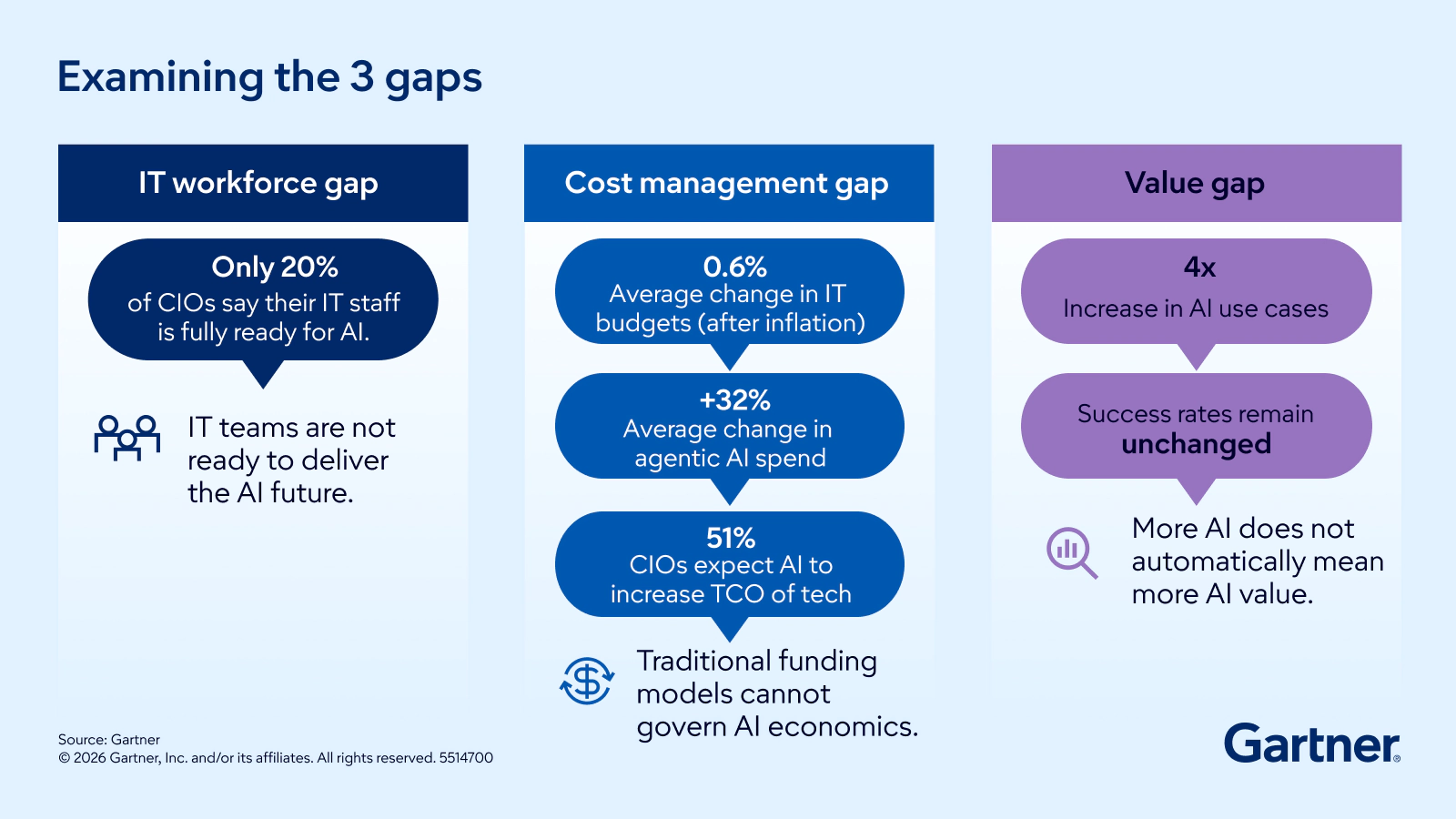
AI investment is rising faster than AI value
AI has moved beyond experimentation for many organizations. AI use cases increased by 400% from 2024 to 2025, while the likelihood of success remained stuck at one in five. Yet for all that activity, many leaders are still asking the same question: Why isn’t AI creating more value?
A Gartner survey of more than 2,000 technology leaders found that only 13% of organizations report achieving significant or transformational value from AI.
Our analysis identified a group of “Vanguard” organizations that consistently outperform their peers in AI value realization and business performance. These organizations are not defined by their industry, IT budget size or revenue band. They are distinct in their bias for action in three areas: managing technology costs, establishing governance to drive value and using AI to expand, not automate, IT talent.
“You don’t need massive budgets and resources to get more value from AI investments,” says Alicia Mullery, Vice President Analyst at Gartner. “You need new mechanisms for managing AI costs and strong governance fundamentals like establishing criteria for when to stop and redirect resources from low-value AI initiatives.”
You might also like this webinar: The Top Priorities for CIOs in 2027: From Technology Strategy to Business Impact
How Vanguard organizations turn AI investment into outcomes
Every organization can learn from the roadmap laid out by Vanguards.
Vanguards co-create the new rules of AI economics for the enterprise
As AI adoption expands, many organizations are discovering that traditional technology funding models no longer fit. Unlike conventional software investments, AI costs are decided at run time and granular cost breakdowns are often absent from the bill. This makes it hard to forecast spending, assign ownership and measure returns over time.
This challenge is becoming more urgent as executives face competing pressures. The survey found that 58% of CIOs report increased pressure to deliver cost improvements through AI, while 51% expect AI to increase the total cost of ownership of technology solutions, particularly for run costs.
Vanguard organizations respond by bringing finance into the conversation earlier and more often. Gartner found these organizations spend 50% more time collaborating with CFOs on AI initiatives than their peers. This includes decisions like who is responsible for ongoing token costs? What must go into a business case beyond the vendor price? What are the AI cost drivers and how do they behave at scale?
Vanguards elevate business readiness to the same importance as use case value
Creating AI value is a team sport. CIOs cannot manage AI value alone. With the average likelihood of success at one in five, business leaders need to be willing to stop and redirect efforts early and often.
Vanguard organizations evaluate both potential business impact and organizational readiness before making significant investments. They assess factors such as workflow readiness, leadership commitment, digital ambition and the organization’s willingness to change how work gets done. This approach helps them prioritize initiatives that are most likely to create measurable business outcomes with a strong business partnership.
By contrast, organizations that focus primarily on the technology itself often struggle to move beyond isolated successes. AI can generate impressive outputs, but realizing value typically requires changes in processes, decisions and employee behaviors. The strongest performers recognize that business readiness matters just as much as technical capability.
They know when more AI isn’t the answer
Business leaders face pressure to embrace AI, which can lead to proliferation in AI use cases. Once a leader has invested time and resources, the sunk cost fallacy mindset can make it hard to walk away even if the value is low. According to Gartner, that mindset can make it harder to achieve meaningful results.
Vanguard organizations are more disciplined about deciding which initiatives deserve additional investment and which do not. Organizations with guidelines for determining when an AI pilot should not move forward are 2.3 times more likely to be Vanguard organizations. Those with guidelines for abandoning low-value AI initiatives already in production are 2.6 times more likely to be Vanguard organizations.
Clear success measures, predefined decision points and a willingness to redirect resources help organizations stay focused on initiatives that drive value.
Vanguards redesign the IT workforce instead of simply automating what they do
Much of the conversation around AI focuses on efficiency and automation. The Vanguard differentiator lies in their bias to redesign jobs that expand the scope of work possible, not just eliminate inefficiencies.
Organizations with explicit plans to redesign roles for a human-agent workforce are 2.4 times more likely to be Vanguard organizations. Yet only 4% of organizations currently report having such plans in place.
Rather than maintaining static job definitions, Vanguards recognize that as AI takes on specialized tasks, the boundaries between established technology jobs begin to blur. For example, designers can increasingly perform testing activities, while testers participate in design. Consequently, organizations will require fewer distinct role types, even as the span of responsibility within each role expands.
They prepare for growing demand for technology talent
AI’s impact on the workforce may be more expansive than many leaders expect. While automation remains an important objective, Gartner finds organizations will also need new skills, new roles and new ways of working alongside AI.
Forty percent of respondents expect IT headcount to increase in 2027, particularly in cybersecurity and data and analytics. As AI adoption grows, so does the need for skills that support governance, oversight, security and value realization.
The organizations creating the most value from AI recognize that the future is not AI replacing people. It’s people and AI working together in new ways. Bridging the gap between AI investment and AI value ultimately requires more than deploying technology. It requires rethinking how organizations fund, govern and operate in an AI-enabled future.
FAQs on AI ROI
Why are organizations struggling to improve AI ROI?
According to Gartner, organizations are expanding AI use cases rapidly, but success rates remain relatively unchanged. Many are scaling AI deployments faster than they are developing the economic, governance and workforce practices needed to turn AI investments into measurable business outcomes.
What differentiates Vanguard organizations from their peers?
Gartner finds that Vanguard organizations bridge three critical gaps faster than other organizations: AI economics, value realization and workforce readiness. They collaborate more closely with finance, assess business readiness before investing and establish clearer criteria for scaling or stopping initiatives.
How can leaders increase AI ROI?
According to Gartner, leaders should strengthen collaboration between technology and finance teams, assess organizational readiness alongside potential business value and establish clear criteria for scaling, redirecting or ending AI initiatives. Organizations should also redesign work to support effective human-agent collaboration.
Attend a Conference
Experience CIO and IT Executive conferences
With exclusive insights from Gartner analysts on the latest trends, sessions curated for your role and unmatched peer networking, Gartner conferences help you accelerate your priorities.
19 – 22 Oct 2026
Gartner IT Symposium/Xpo™
Orlando, FL

Drive stronger performance on your mission-critical priorities.