Data ecosystems unify data management components distributed across clouds and/or on-premises.
- Gartner client? Log in for personalized search results.
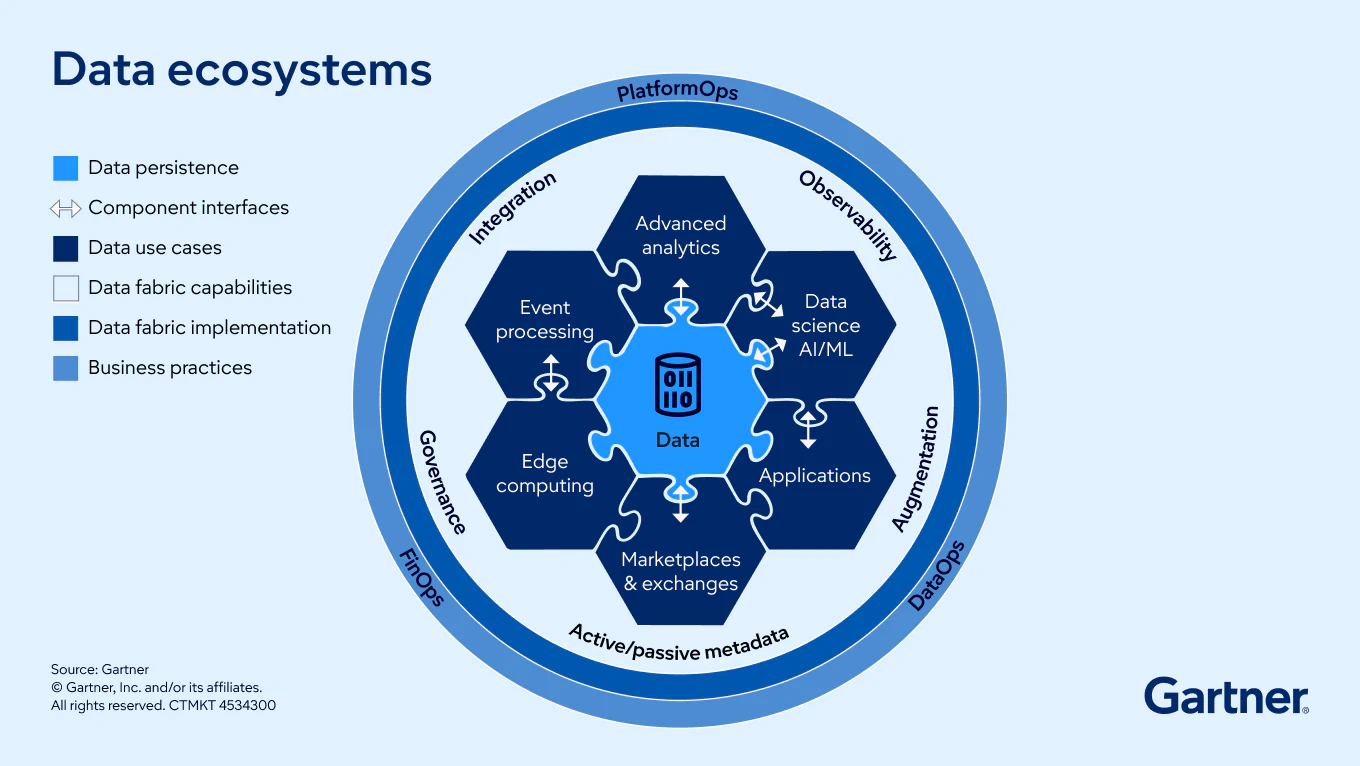
Orchestrate your D&A and AI platforms and capabilities through data ecosystems
Data ecosystems are the future of data management but require interoperability among many D&A components. Now is the time to strategize how, what and why to deploy.
See Gartner research in action at our data and analytics conferences and events.
Unify your data, analytics and AI landscape with a cloud perspective
Today’s data landscape is increasingly distributed, disparate and diverse. As workloads continue shifting to the cloud, D&A leaders should focus on unifying and seamlessly integrating all components across their data and analytics infrastructure.
Cloud providers are responding with more mature data ecosystems that replace the “some assembly required” approach with more integrated platform experiences. This evolution is fueling the rise of converged data management platforms that deliver pre-integrated data, analytics and AI capabilities designed to reduce time to market and minimize integration debt. As organizations move in this direction, many are consolidating their vendor landscape to lower cost while simplifying architectural choices.
The data ecosystem solution
A data ecosystem is a comprehensive system that simplifies the management and use of data across various applications, as it offers:
Streamlined data use. It includes preintegrated solutions, making it easier to handle different data tasks efficiently.
Unified management. It supports everything from day-to-day data operations to complex data science projects, GenAI enabled data applications and data storage.
Integrated framework. Built on a data fabric, it has a shared system for governance and metadata management, ensuring consistent data quality and security.
Access management. Users have a unified way to access and manage data, with enhanced features for better data handling.
Distributed components. These ecosystems can run on multiple cloud platforms and on-premises systems, but function as a single, cohesive unit.
Flexibility and productivity. This setup makes it easier to adapt to new needs, boosting productivity and maximizing ROIs.
The impacts of data ecosystems
While data ecosystems help resolve the inherent stress and complexity placed on the overall D&A landscape, they require new practices like DataOps, FinOps and platform engineering to provide comprehensive financial governance capabilities and streamlined spend and budgeting across components. This necessitates emerging, enabling data architectures associated with data fabric design and leveraging machine learning to self-optimize with augmented data management.
3 data ecosystem approaches
As the role of data and analytics within the enterprise expands from single to secondary environments in the cloud, data ecosystem components may be disaggregated and deployed outside of the primary center of data gravity — while still participating in the cohesive whole. This means data gravity will increasingly drive the choice of data ecosystem delivery styles. There are three styles:
Full CSP native. This is completely built and run on a cloud service provider's platform.
Self-contained ISV. A complete data ecosystem provided by an independent software vendor, typically running on-premises.
Blended. A mix of different services and platforms, including cloud and on-premises solutions.
Build your data ecosystem architecture and strategies
The data and analytics landscape consists of rapidly changing technologies and markets that D&A leaders must navigate to support priorities. This means systems thinking and enterprisewide, value-driven architecture, design and engineering approaches are necessary to develop AI-ready D&A capabilities — all without overlapping and unnecessary investments. And the approach must consider existing technologies, processes and skills to grow the present state into the future.
The goal is to leverage existing infrastructure into converged D&A ecosystems designed to deploy the D&A platform cohesively through seamless integrations — and position the organization to scale and optimize. The D&A operating model must work to overcome gaps in the data ecosystem, architectures, delivery approaches and team skills.
AI is here to stay
While D&A has been a top enterprise priority for years, most D&A leaders have little to show for their investment and effort. Now, however, the recent explosion of AI and related technologies puts D&A as a top priority for many organizations.
To fully realize measurable business impact, organizations must exploit AI-ready D&A technologies, people and processes. While digital businesses rely on data and analytics, many treat D&A and AI as supportive and secondary to business initiatives — rather than strategic, critical drivers of success.
Plan for the future while addressing immediate data management challenges
Disruption from U.S. federal policy changes — spanning geopolitics, trade restrictions, increased tariffs, AI deregulation and new algorithmic decision-making mandates — is testing, reprioritizing and stretching D&A leadership skills, along with business and operational acumen. Enterprises that have invested in a robust data management foundation, compared to competitors who have not, will fare better against these challenges, delivering real-time data, analytics and AI-driven rapid responses while enabling resilience against ongoing economic instability.
Organizations that build and deploy data ecosystems will be more agile in addressing changes related to data sovereignty, governance, access, integration and utilization across domains, business units and partners, especially when localization is crucial. Those that maintain blended ecosystems and enable interoperability between CSP native and SIV-centric D&A components will better handle tool/solution swaps from other countries to mitigate regulatory disruptions.
Evolving data ecosystem technology
Given the importance of AI and related technologies, three interconnected themes enable D&A leaders to evolve and extend their current technology foundation toward a full breadth of data, analytics and AI capabilities:
Identify business and technology trends. Organizations prioritizing accelerated growth — while facing uncertain and fluid global political, economic and societal realities — must assess how business and emerging technology trends will impact the ability of D&A and AI to realize value at scale. Here, understanding top D&A and AI trends helps anticipate change and transforms uncertainty into opportunity. Factoring these trends into strategic investments can effectively drive new growth, efficiency, resilience and innovation.
Architect and optimize your technology. D&A and AI technologies do not independently exist in a vacuum. Nor is it enough to merely manage and improve data before making it available — in the hopes of generating value. Instead, organizations must evaluate and select technologies that build a comprehensive and optimized D&A and AI environment. This means making bold changes in developing insights and decisions that balance needs across a complex landscape of capabilities. And it means thinking about D&A and AI as inseparable.
Scale data, analytics and AI platforms and ecosystems. While the use of D&A and AI is increasingly pervasive, many organizations struggle to achieve effective use of these technologies at scale. Moreover, these platforms no longer exist in isolation and are now enterprisewide and productionized. Given this, D&A leaders must grow D&A and AI capabilities by leveraging current investments and building a consistent, cohesive and extensible environment that includes rapid data delivery, self-service approaches and common cloud patterns.
Strategize your data management cloud migration journey
D&A architectures today are under stress due to a high degree of data distribution and diversity. Traditional data platforms no longer meet the demands of business leaders and customers who want continuous innovation and agility.
The new environment requires new solutions, architectures and operating models. And market trends are clearly moving toward the cloud. In this environment, D&A leaders are considering the challenges associated with moving their data ecosystems to the cloud. And yet almost every factor that makes the cloud attractive — like rapid provisioning or consumption-based pricing — also contributes to potential cost overruns. This means that the total multiyear budget impact of a cloud migration journey will be significant and must be navigated methodically.
7 data priorities for a cloud-focused future
As D&A leaders strategize how best to move from their current state into a cloud-dominated future, here are seven priorities to keep in mind:
Assess your current data management systems and avoid a rushed migration as-is to the cloud. Focus on two core characteristics of your data management solutions: data gravity and entanglement. And use an assessment methodology that identifies application clusters that exchange data and your core data gravity within your D&A landscape to classify each as cloud-ready, cloud-friendly or cloud-laggard.
Balance cloud experimentation and engineering efforts. A comprehensive understanding of cloud services is critical before migrating your workloads to the cloud. This means setting up a pilot program that includes experimentation, testing and validation as phases of your migration plan.
Outline your cloud financial governance model. Cloud migration involves a major switch in the budget and spend process — from operating a capital expenditure model with multiyear ROI to an operating expenditure model for cloud data management services. To avoid unpleasant spend and budget surprises, you must adapt robust financial governance practices early in the cloud journey.
Complement ops-readiness with data observability. To gain a multidimensional view of your data, you need a data observability solution that includes performance, quality, usage and impact on downstream applications.
Evaluate data ecosystems as a possible end state. Consider your data ecosystem in its desired end state and approach the data migration journey through the lens of a cost-benefit analysis.
Infuse automation and AI. Strategize how to minimize human effort, reduce delays and manage operational costs.
Prepare your multicloud and intercloud strategy. While sometimes the result of a merger or acquisition, many enterprises adopt a multicloud strategy to avoid vendor lock-in or to attain different functional advantages from different providers. In any case, monitoring usage and managing costs are complicated in multicloud architectures, and your goal should be to avoid egress charges and remain compliant on data sovereignty regulations.
Data Ecosystems FAQs
How does a data ecosystem enhance decision making within an organization?
A data ecosystem enhances decision making by providing a unified framework for managing and utilizing data. It ensures consistent data quality, streamlines access and management, and supports various operations from daily tasks to complex projects. By integrating AI and machine learning, it improves decision-making accuracy and speed.
What are the key components of a modern data ecosystem?
The key components of a modern data ecosystem include:
Streamlined data use: Pre-integrated solutions for efficient data handling.
Unified management: Support for various data operations, from daily tasks to complex projects.
Integrated framework: A shared system for governance and metadata management to ensure data quality and security.
Access management: Unified access and management features for better data handling.
Distributed components: Functionality across multiple cloud platforms and on-premises systems as a single unit.
Flexibility and productivity: Adaptability to new needs, boosting productivity and maximizing ROI.
Attend a Conference
Experience Data and Analytics conferences
With exclusive insights from Gartner analysts on the latest trends, sessions curated for your role and unmatched peer networking, Gartner conferences help you accelerate your priorities.
8 – 10 Mar 2027
Gartner Data & Analytics Summit
Orlando, FL

Drive stronger performance on your mission-critical priorities.