Secure AI-driven innovation, meet rising governance demands and build trust with the C-suite.
- Gartner client? Log in for personalized search results.
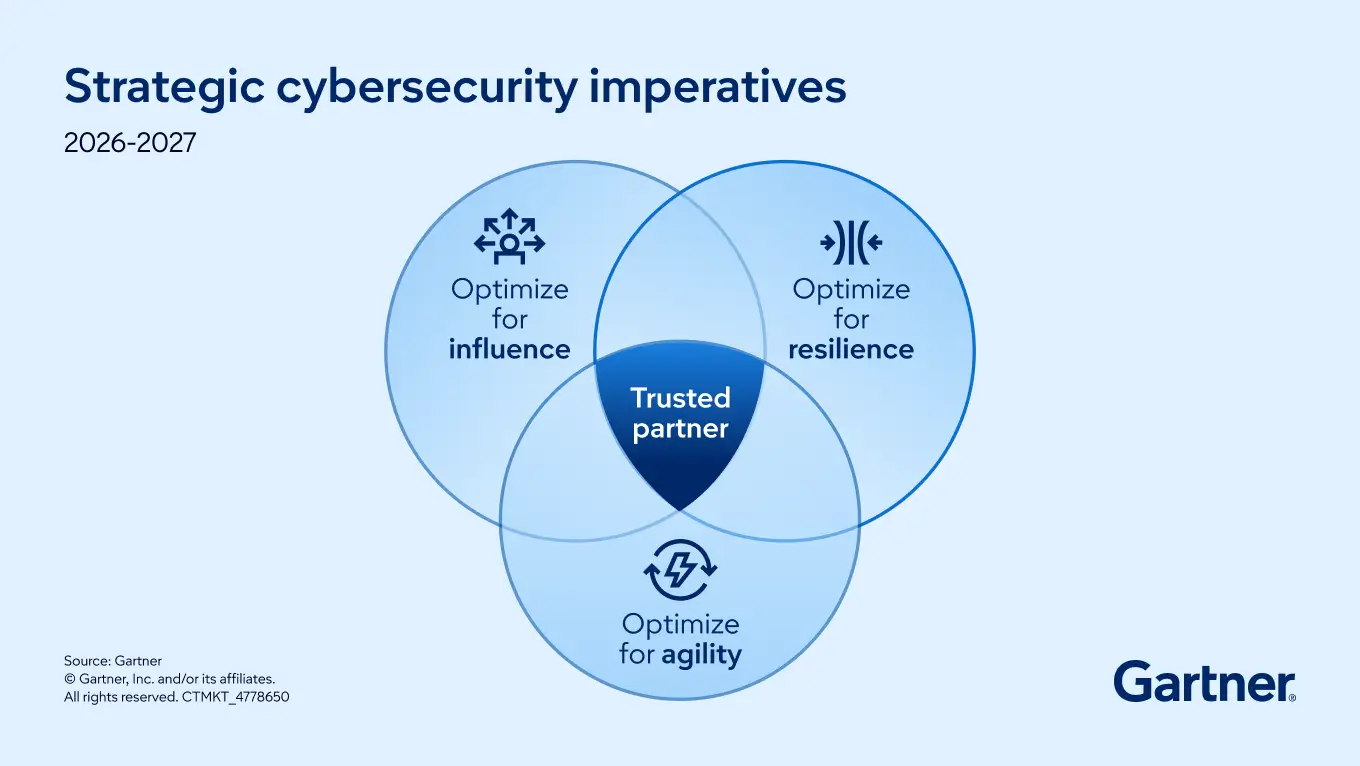
Cybersecurity leadership: Why influence, agility and resilience matter
Cybersecurity leaders are facing mounting pressures from macro external forces, such as market and regulatory volatility and the evolving threat landscape, to enable digital and autonomous business growth — without letting risk spiral out of control. But if you stick to legacy playbooks, you’ll fall behind. Technology adoption is outpacing traditional controls. GenAI and distributed architectures are multiplying attack surfaces. Meanwhile, governance expectations are tightening, and your function’s credibility is on the line.
The opportunity: Shift your cybersecurity program perception from being a “blocker” to a trusted partner and enabler of business growth. According to Gartner, leaders who optimize influence, agility and resilience will sustain trust, drive responsible AI adoption and strengthen enterprise risk posture.
Cybersecurity leadership: 3 top trends and how to get ready
These macro external forces are causing trends that are bucketed into three themes; these three trends are reshaping your mandate — and demand a new playbook.
Securing new frontiers: AI, autonomy and attack surfaces
Gartner insights reveal that the expansion of autonomous systems, edge computing and distributed architectures is introducing new attack surfaces. GenAI and machine-driven workflows are ramping up operational complexity and exposure. Technology adoption keeps outpacing traditional controls, requiring lighter-weight, adaptive security approaches. If you’re not evolving, you’re exposing your organization to unnecessary risk.
Transforming governance: From compliance to risk stewardship
Boards, regulators and executive leaders expect clearer accountability and more quantifiable risk reporting. Gartner insights reveal a clear shift: Governance is moving from compliance-driven oversight to enterprisewide risk stewardship. Prescriptive and evolving regulations are tightening expectations for data protection, incident response and third-party assurance. You need to be ready to demonstrate control — not just ticking the compliance check box.
Normalizing AI adoption: Enablement and protection
AI is now embedded in business operations. That means you must enable responsible, secure use while defending against new threats — model poisoning, prompt manipulation and data leakage. Gartner insights highlight the need for new detection and mitigation capabilities. Your teams must evolve expertise, controls and governance to support both AI enablement and AI protection.
Cybersecurity leadership: Actionable steps to strengthen your program
Weave these three imperatives into your cybersecurity program for 2026: Strengthen influence across the enterprise, increase program agility and build resilient operations.
Influence: Build strong relationships with business leaders. Align security initiatives with strategic goals. Develop power skills to communicate risk in business terms, and position cybersecurity as a driver of trust and innovation.
Agility: Use your operating model to adapt quickly to emerging technologies and evolving threats. Embrace automation, AI-driven security and continuous risk assessment. Establish a data security governance function to enable secure, responsible use of AI.
Resilience: Launch a postquantum security initiative to prepare for emerging cryptographic risks. Integrate supply chain risk into cyber-risk management and strengthen cyber resilience through threat-informed strategies.
Cybersecurity leadership FAQs
What are the top cybersecurity leadership priorities for 2026?
Gartner business and technology insights identify three priorities: Strengthen influence across the enterprise, increase program agility and build resilient business and technology operations. These priorities help you build trust, enable AI-driven growth and strengthen risk posture as technology and regulation accelerate.
How should cybersecurity leaders address AI adoption and risk?
Gartner insights show you must enable responsible, secure AI use while defending against emerging threats like model poisoning and data leakage. Evolve your team’s expertise, controls and governance to support both AI enablement and protection.
Why is agility critical in cybersecurity leadership now?
Agility lets you adapt to rapid technology shifts and evolving threats. Gartner recommends using risk-informed prioritization, automation and continuous assessment to keep your program ahead of change.
Attend a Conference
Accelerate growth with Gartner conferences
Gain exclusive insights on the latest trends, receive one-on-one guidance from a Gartner analyst, network with a community of your peers and leave ready to tackle your mission-critical priorities.

Drive stronger performance on your mission-critical priorities.