CMOs: Build Your AI Literacy to Enhance C-Suite Credibility

Introduction

CMOs are falling behind both consumers and their own teams in AI execution, creating a critical readiness gap as AI transforms marketing. While many marketing leaders recognize AI’s transformative potential, few see the need to update their skills or the CMO role itself. At the same time, CMOs lag behind CEO expectations to leverage AI for driving growth. This disconnect not only widens the gap between leadership and AI adoption but also undermines CMO influence and threatens marketing’s position as a strategic growth driver.

Key Findings

1
Only 15% of CEOs view their CMOs as possessing strong AI savviness for 2026
2
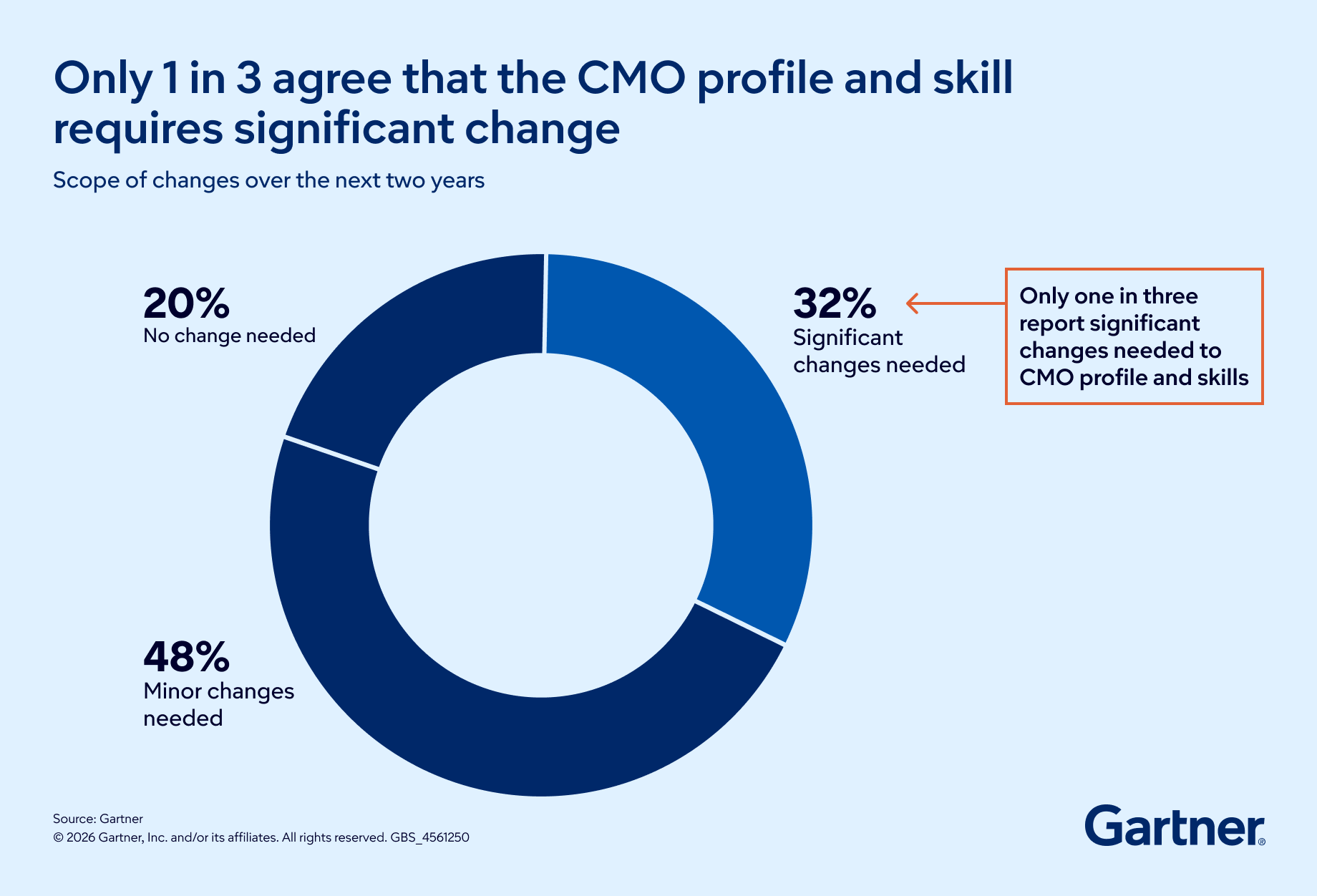
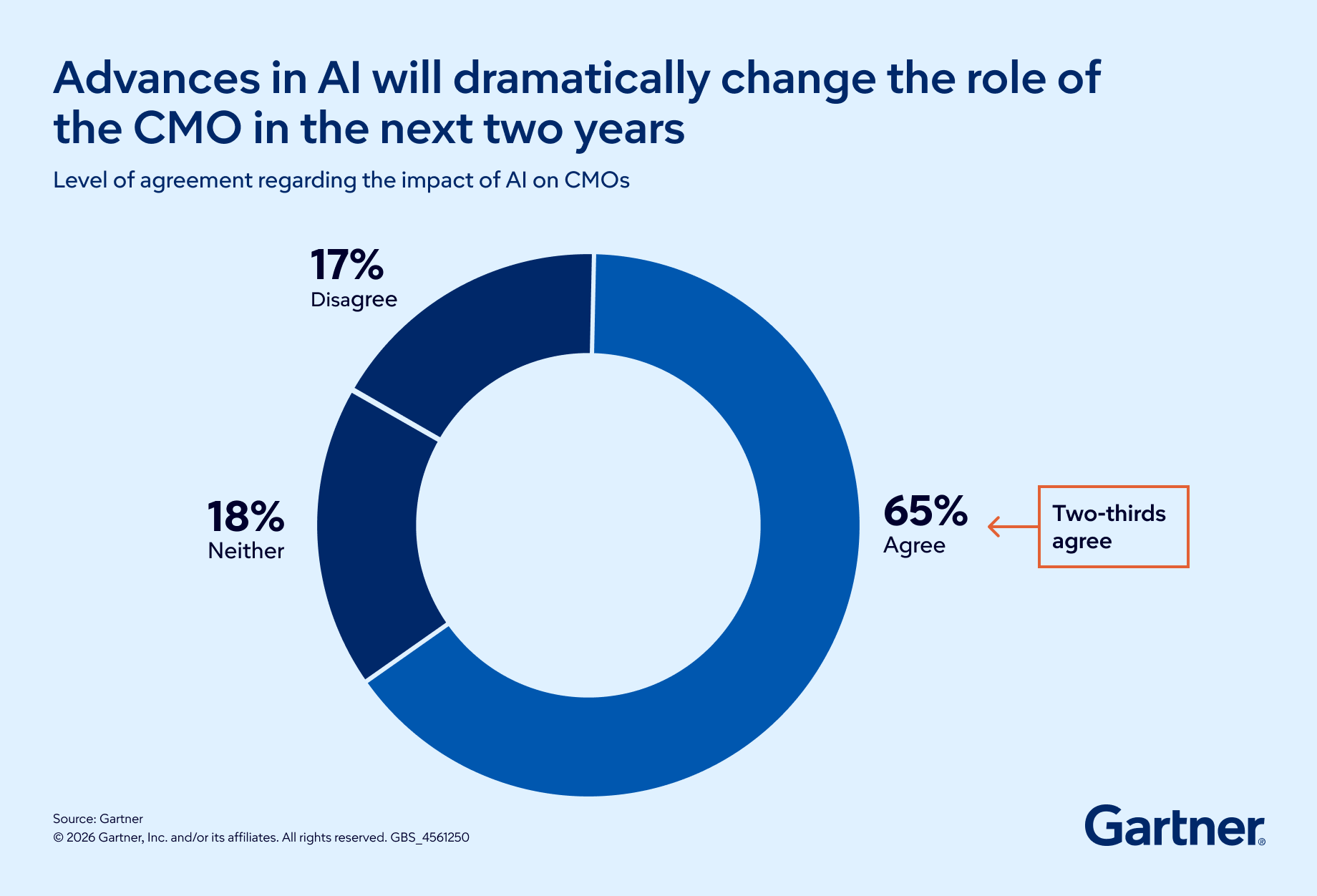
65% of CMOs expect roles to change, yet only 32% see a need to upgrade personal skills.
3
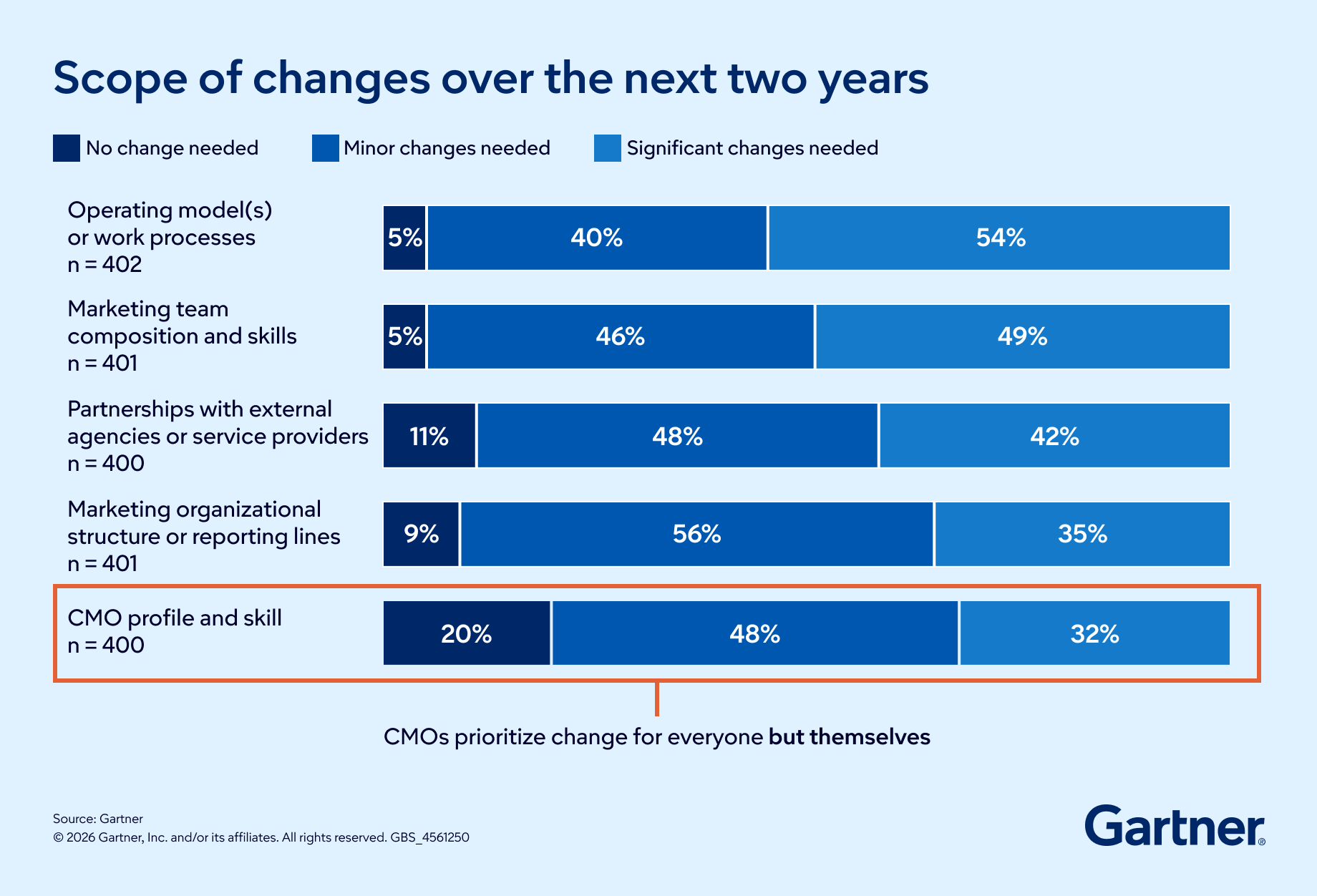
CMOs focus on teams and partners instead of their own skills, widening readiness gaps.

To close the gap, CMOs must prioritize their own development alongside the evolution of the broader marketing function. For the most senior marketer, this requires building technical fluency in large language models and prompt engineering. As a chief officer, you must also prioritize high-impact AI use cases that deliver measurable business outcomes, demand agency accountability for advanced capabilities and outcome-based value, and cultivate a community of practice through regular C-suite forums to accelerate experimentation and strategic alignment.

Analysis

Chief marketing officers (CMOs) have long driven growth through customer insight. Yet as AI reshapes business models, many CMOs experience cognitive dissonance. They recognize their role is changing but often underestimate the personal transformation needed to lead effectively. Why does this disconnect persist?

  1. Category error — the productivity trap: CMOs often first encounter AI in operational contexts like content generation, analytics, and workflow automation. This installs a view of AI as a productivity tool, not a strategic growth driver, making upskilling seem like a team issue rather than a leadership priority.

  2. Delegation drift — deference to IT: When AI is seen as “efficiency tech,” governance shifts to IT, which handles platforms, security, and compliance. CMOs support adoption but delegate technical ownership and learning, remaining removed from AI-driven transformation.

  3. Status memory — legacy thinking from the digital era: Today’s CMOs rose to prominence during digital transformation, when tech fluency was a key part of their success. But rather than the long tail of one transformation, AI is redefining priorities, decision making, and experimentation in entirely new ways. Leadership-level fluency is essential, yet many still see AI as “automation for the team,” not a capability that redefines their own role.

  4. Strategic blind spot — AI and the growth mandate: What is often missed is that AI is now central to the growth mandate itself. AI influences how customer signals are interpreted, how decisions are automated or augmented, how experimentation scales, and how advantage is sustained. This moves AI upstream into prioritization and resource allocation, which are the very decisions CMOs own.

The irony is that while CMOs expect AI to replace team roles, their own position is at risk if they do not update their skills and strategic focus. To stay relevant, CMOs must move past legacy thinking, build AI literacy, and lead AI-driven growth.

The longer CMOs continue without evolving their personal skills and orientation toward AI, the more likely a CEO may view the CMO as replaceable by AI.

Impact

The rise of AI marks a pivotal shift for CMOs, demanding technological proficiency and cultural adaptability. Today’s CMOs face a self-awareness gap: while most recognize AI’s impact, few believe their own skills need upgrading, risking career longevity and influence. CMOs who proactively build AI fluency, prioritize high-value use cases, and foster strategic experimentation will secure stakeholder trust, drive measurable growth, and differentiate themselves as indispensable leaders. Ignoring this shift risks obsolescence. Consider this a call to action for CMOs to close the gap and reestablish their strategic relevance. Now is the time for CMOs to modernize their profile and skill set to unlock AI’s true business value.

CMOs Anticipate Change in Everything but Themselves

Nearly two-thirds (65%) of senior marketing leaders agree that advances in AI will “dramatically change the role of the CMO in the next two years” (see Figure 1). This perspective reflects a mainstream executive recognition of fundamental disruption, not a fringe viewpoint, but it is limited to the responsibilities, not the individuals responsible.

Despite the anticipated upheaval, a notable disconnect emerges when this perception of systemic change is contrasted with individual career risk: only 32% of leaders anticipate that significant changes to the CMO profile and skill set are required (see Figure 2).

This highlights a subtle yet significant paradox. While awareness of external, role-based transformation is high, the willingness to internalize this change and proactively adapt at a personal level lags behind.

This disparity reveals a profound leadership blind spot: when asked where significant change is necessary, leaders consistently prioritize nearly every other aspect of their function over their own capabilities (see Figure 3). CMOs neglect not only their own leadership evolution but also the demand for them to upskill.

The implications of this data are consequential: it reveals a tendency for CMOs to project the need for change outward. Instead of focusing on developing their personal capabilities, they instead believe they need to change their teams, processes, agency partners, and organizational structures. CMOs perceive a greater and more urgent need to transform their operational environment than to evolve their own leadership profile. While prioritizing organizational change is essential in today’s fast-changing environment, it need not come at the expense of personal development.

This internal disconnect does not exist in isolation; it shapes how the broader C-suite perceives marketing leadership’s readiness for the future. According to the Gartner CEO and Business Executive Survey, only 15% of CMOs are seen by CEOs as having the strong “AI savviness” needed to be effective in 2026. This reveals a profound crisis of confidence between the C-suite and their CMOs. This gap is not merely about skills; it represents a significant erosion of trust and credibility, leading CEOs to question the strategic value of marketing leadership and putting the function’s role as a growth driver at risk. Consider this a call to action for CMOs to close the gap and reestablish their strategic relevance.

Obstacles to CMO Success

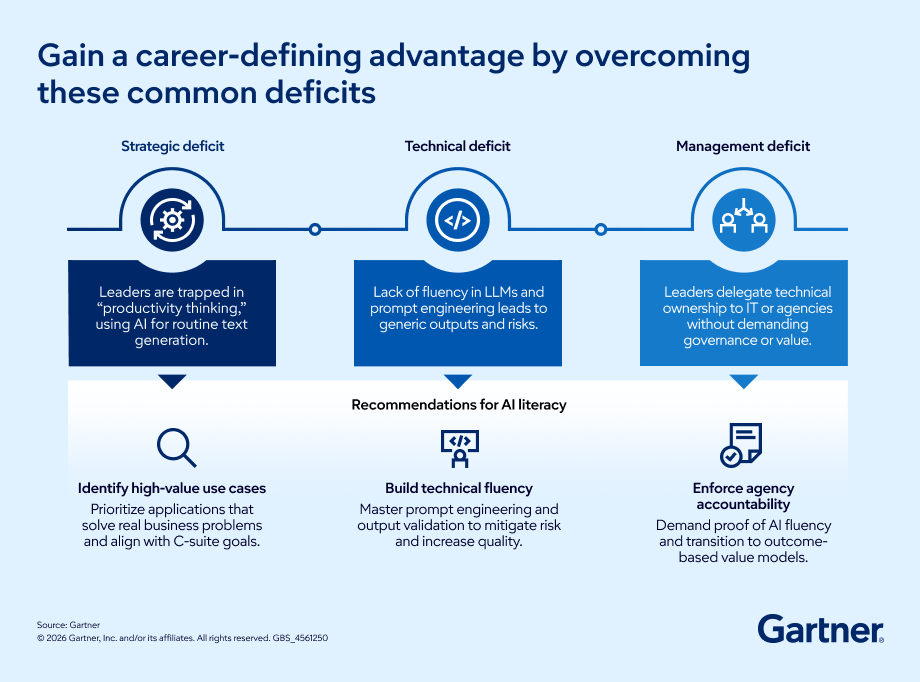
The Strategic Deficit: Routine Tasks Versus Real Value

The readiness gap stems from a failure to move AI from a tactical tool to a strategic asset. Many marketing leaders still use AI mainly for routine tasks like text generation, rather than identifying high-value applications that solve real business problems. This issue is made worse by working in isolation; without building a “community of practice” to share successes and failures with C-suite peers, CMOs struggle to align AI initiatives with broader organizational priorities or secure the leadership support needed to scale.

The Technical Deficit: Limited Understanding of LLMs

A lack of technical fluency keeps CMOs from managing the risks of generative AI (GenAI). Many leaders don’t realize that large language models (LLMs) generate responses based on patterns, not facts, making it harder to spot errors or “hallucinations.” Additionally, many treat AI as a one-off tool instead of mastering prompt engineering as an ongoing process. Without using techniques like persona framing or context layering, results tend to be generic and low-quality. This lack of rigor extends to validation — accepting AI outputs at face value without questioning their credibility or bias can undermine decision making.

The Management Deficit: Reliance on Agencies

The gap also widens when CMOs depend too heavily on external agencies without strong internal oversight. Too often, leaders take agencies at their word about their GenAI capabilities instead of demanding clear governance and proof of risk management. By not requiring agencies to demonstrate real AI fluency — beyond basic automation to measurable business value and innovation — CMOs miss the chance to align external resources with strategic priorities like personalization and customer experience (CX).
Recommendations

For the CMO who acts decisively, these gaps represent a clear opportunity to lead, differentiate, and secure their position as an indispensable, AI-savvy strategist (see Figure 4). Turn this looming crisis into a career-defining advantage:

Overcome the strategic deficit

  • Identify high-value use cases: Proactively pinpoint and prioritize where AI can address business and marketing challenges, moving beyond routine tasks to strategic, high-impact applications.

  • Foster a community of practice: Regularly convene with C-suite peers to experiment, share learnings, and embed AI initiatives into strategic priorities. Build vibrant, self-sustaining communities that align with the organizational goals and culture.

Overcome the technical deficit

  • Build technical fluency: Develop a foundational understanding of AI models and their applications. Learn to select, pilot, and optimize tools for marketing needs, ensuring you can mitigate risks and maximize value.

  • Master prompt engineering and output validation: Iteratively design effective prompts and formalize best practices to scale across your team. Rigorously evaluate and validate AI outputs for accuracy, relevance, and alignment with organizational standards.

Overcome the management deficit

  • Thoroughly evaluate agency AI capabilities and governance: Go beyond self-disclosures by directly probing both internal and client-facing AI applications to ensure agency risk management aligns with your organization’s risk tolerance.

  • Insist on demonstrated AI fluency and strategic value: Require agencies to articulate how their AI expertise drives tangible business outcomes, including flexible, outcome-based compensation; robust training; and alignment with high-impact goals like personalization and CX orchestration.

Ready for what’s next? We can help.

Access objective insights, exclusive peer networks and expert guidance designed for leaders like you.