Orlando, Fla., March 13, 2024
- Gartner client? Log in for personalized search results.
Gartner Data & Analytics Summit 2024 Orlando: Day 3 Highlights
Overview
We are bringing you news and highlights from the Gartner Data & Analytics Summit, taking place this week in Orlando, Florida. Below is a collection of the key announcements and insights coming out of the conference. You can read the highlights from Day 1 here and Day 2 here.
On Day 3 from the conference, we are highlighting the cost, risk and value of AI, the top D&A predictions for 2024 and decision intelligence platforms. Be sure to check this page throughout the day for updates.
Key Announcements
Data Lakes, Data Warehouses and Lakehouses: How to Choose
Presented by Roxane Edjlali, Sr Director Analyst, Gartner
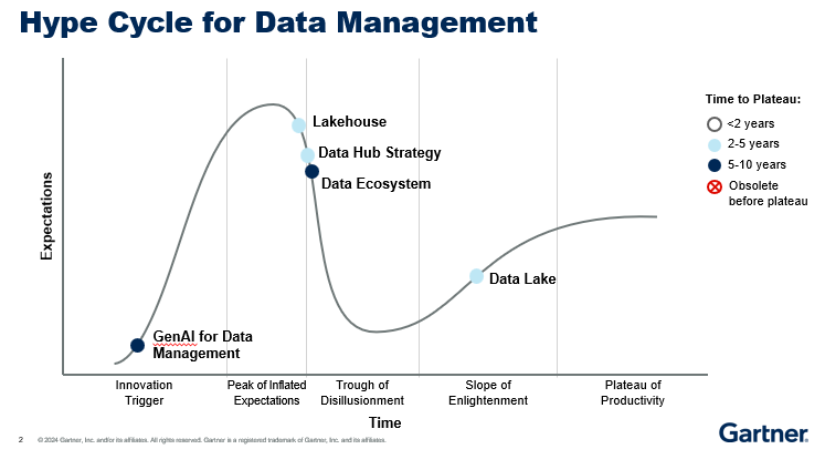
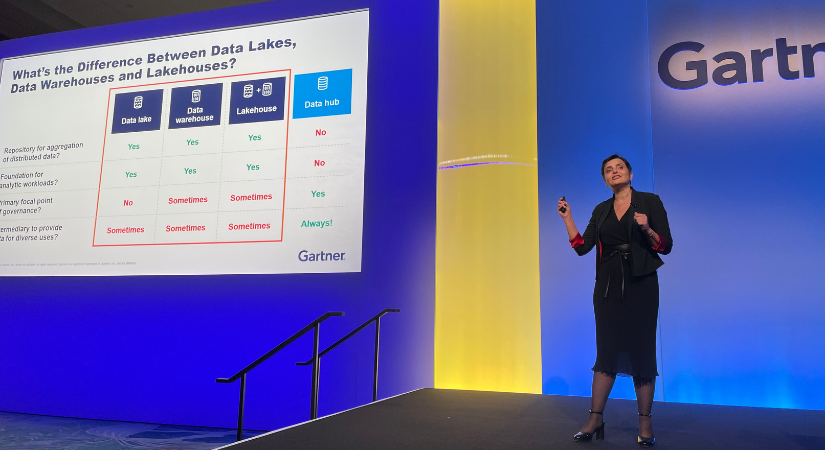
Confusion persists regarding the role of data warehouses, data lakes and lakehouses. In this session, Roxane Edjlali, Sr Director Analyst at Gartner, discussed the different data repository models in use today, as well as what the key differences are between these models.

Key Takeaways
“Both the data warehouse and the data lake are analytic structures, but they are for different purposes.”
“The data warehouse has its “sweet spot” mostly in the region of ‘knowns’ – well-known, structured and trusted data, and well-known, widely-asked and used questions and insights.”
“The data lake is the opposite – its ‘sweet spot’ is more in the region of the ‘unknowns’ – raw data, less metadata, perhaps less structure, and application toward more exploratory analysis which may or may not have a direct connection to well-known and needed questions and insights.”
“But they overlap – and this overlap is actually increasing as more rigor on governance and integration is brought into data lakes, and as the supporting technologies get broader in their capabilities.”
“Data lakehouses integrate and unify the capabilities of data warehouses and data lakes, aiming to support AI, BI, ML and data engineering on a single platform.”
Top Data and Analytics Predictions, 2024
Presented by Rita Sallam, Distinguished VP Analyst, Gartner
This year, data and analytics (D&A) leaders must step up to make data and analytics, and AI, strategic to the business. In this session, Rita Sallam, Distinguished VP Analyst at Gartner, revealed Gartner’s top D&A predictions for 2024, discussing how D&A leaders can plan for the impact of AI on all aspects of data and analytics, including leadership, governance, talent, market, and the need for AI-ready data for value realization.



Key Takeaways
- “By 2028, more than 50% of enterprises that have built their own large language models (LLMs) from scratch will abandon their efforts due to costs, complexity and technical debt.”
- “By 2027, 75% of new analytics content will be contextualized for intelligent applications through GenAI, enabling a composable connection between insights and actions.”
- “By 2027, GenAI enhanced cost optimization will automate 40% of data and analytics spending in cloud-based data ecosystems.”
- “By 2025, use of natural language as a primary data management application programming interface (API) will be the dominant interface leading to a 100x consumption of data across the ecosystem.”
- “By 2027, 60% of organizations will fail to realize the anticipated value of their AI use cases due to incohesive ethical governance frameworks.”
Learn more in the Gartner press release “Gartner Unveils the Top Data and Analytics Predictions for 2024.”
Decision Intelligence Platforms — No Excuses for Bad Decisions Anymore
Presented by Erick Brethenoux, Distinguished VP Analyst, Gartner
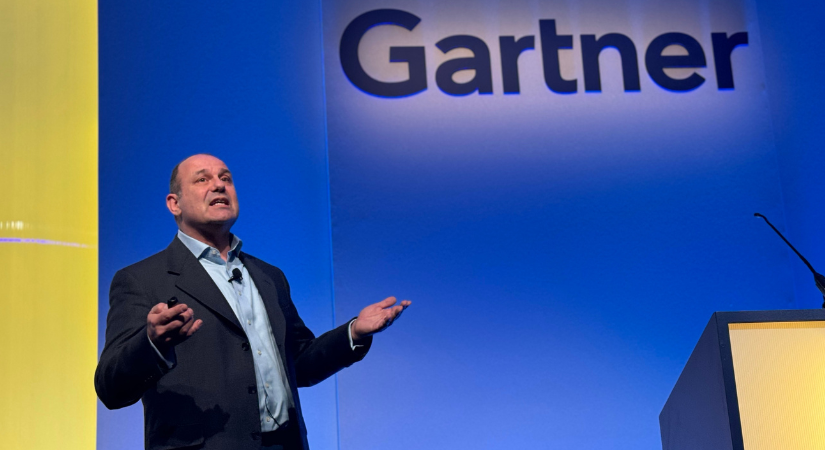
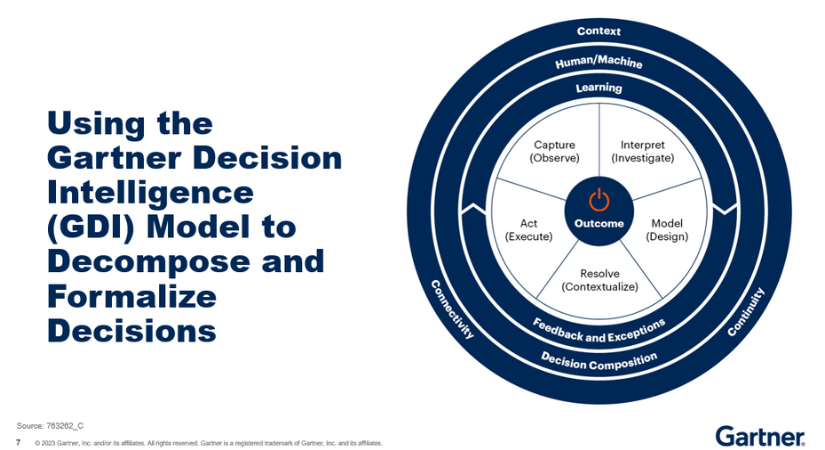
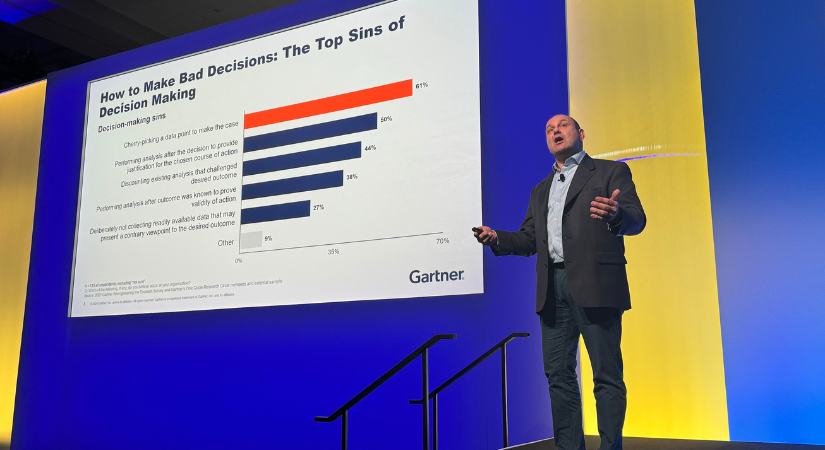
AI software platforms are evolving, with the AI operationalization phase giving way to the next evolution of AI software based on composite AI. In this session, Erick Brethenoux, Distinguished VP Analyst at Gartner, discussed how to build adaptable and resilient systems, organizations should reassemble their decision mechanisms through practical decision intelligence techniques.
Key Takeaways
- “Focusing on making the next decision and successful execution of the decision are top reasons for not tracking results from decisions.”
- “Avoid taking a technology-driven approach to modeling decision-making.
Instead, take a people- and business-driven approach by focusing on desired
business outcomes.” - “Develop decision-making flows as compositions that leverage composite AI (one or more AI techniques) like symbolic techniques and analytics to use the full power of decision-intelligence platforms (DIP’s) knowledge representation capabilities.”
- “Empower and incentivize staff, business and technical alike, to build and refine decision models by leveraging DIPs’ user interface generation capabilities.”
- “Use decision logs and business performance metrics to support auditing, compliance and continuous decision improvement.”
This is a wrap for this year’s conference. Thanks for joining and see you next year!
Media contacts
Matt LoDolce
Gartner
matt.lodolce@gartner.com
Catherine Howley
Gartner
catherine.howley@gartner.com


Latest releases
About Gartner
Gartner (NYSE: IT) delivers actionable, objective business and technology insights that drive smarter decisions and stronger performance on an organization’s mission-critical priorities. To learn more, visit gartner.com.