Analysts providing guidance
- Gartner client? Log in for personalized search results.
Gartner is the world authority on AI
Explore Gartner AI Hub

2,400+
6,000+
AI-related written insights
4,000+
AI use cases and case studies
510,000+
Client interactions
Proactive, objective AI guidance
Gartner client? Log in for complete access.

Gartner is the world authority on AI. This is why.

We sit at the nexus of AI players
We engage with 80K+ business executives, 10K+ IT executives and thousands of technology providers.

We have a unique intelligence advantage
We have access to 1M+ proprietary data points through client interactions, vendor briefings and proposal reviews. We know what’s happening now, what’s next and what that means for your AI success.

We deliver proactive, objective guidance
Our intelligence advantage, combined with our proprietary tools, benchmarks and human-led intelligence, provides comprehensive guidance throughout your AI journey.

We are a world-class user of AI
With over 50 AI applications driving impact across Gartner, we’re accelerating our AI journey and collaborating with C-Level executives to help them do the same.

Experience AI insights firsthand
AI is a critical priority for just about every role in every industry — and is a critical focus at every Gartner conference.
Get AI insights for every function


Behind the AI insights: Expert human intelligence
“By 2030, CIOs expect 75% of IT work will be done by humans augmented with AI, and 25% will be done by AI alone. That means by 2030, 0% of IT work will be done without AI.”
Daryl Plummer
Distinguished Vice President, Chief of Research
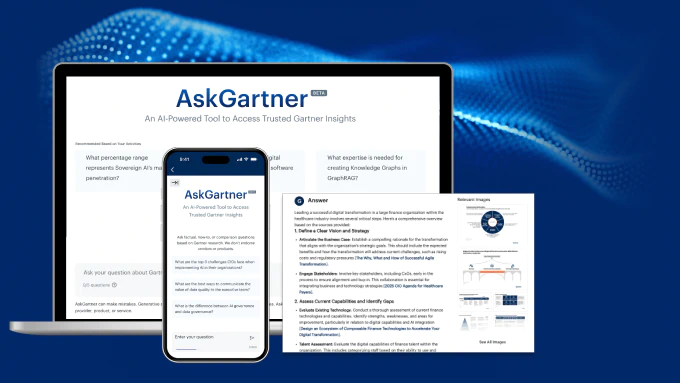
AskGartner
AskGartner is the only AI-powered tool that gives you access to the proprietary Gartner insights trusted by C-Level executives and their teams.
AI strategy, trends and insights FAQs
What is artificial intelligence (AI)?
Gartner defines AI as advanced analytical and logic-based techniques — including machine learning, deep learning, regression analysis and prescriptive analytics — that perform cognitive tasks, such as identifying patterns, predicting outcomes and automating decisions. AI augments human capabilities rather than replacing them, handling routine and complex tasks simultaneously to enhance organizational performance.
What are the latest AI trends for enterprises?
Enterprise AI has matured beyond hype into a portfolio of practical, scaled technologies. Gartner insights identify a broad spectrum of AI innovations spanning infrastructure, operations, governance and business models — all critical to realizing AI at scale. These include agentic AI and autonomous workflows, GenAI expansion and maturation, the convergence of analytics and AI, physical AI and the shift of AI buying power from IT to business leaders.
How can organizations identify and prioritize AI use cases?
Organizations that systematically identify and prioritize AI use cases — anchored to business objectives, feasibility and value — outperform those running disconnected pilots. Gartner emphasizes that the process begins with clear strategic goals, not technology trends. Our clients rely on proprietary AI Use Case Insights to explore, evaluate and prioritize 4,000+ proven AI use cases and real-world case studies tailored to their industries.
How can organizations assess their AI maturity and readiness?
Organizations must evaluate their AI maturity across multiple dimensions — not just technology, but also strategy, governance, people, data and organization structure — to get an honest picture of readiness. Gartner clients have exclusive access to our AI Maturity Assessment, a rigorous diagnostic that produces prioritized actions that drive measurable AI impact.
How can organizations manage AI risk and governance?
Effective AI governance is foundational to scaling AI safely and unlocking its business value. Organizations must move beyond principles and policies to embed governance directly into AI operations, with clear accountability, cross-functional coordination and continuous monitoring across six interconnected pillars: accountability, AI policies, risk and compliance operations, AI-ready data, AI development, and AI deployment and shadow AI.
How can organizations scale AI initiatives?
Scaling AI is not simply about deploying more models or expanding AI use broadly — it’s about delivering sustained business value through aligned strategy, governance, talent readiness and operational discipline. Organizations must shift from asking “Can we do more?” to “Can we deliver better outcomes?”
What are the biggest challenges organizations face when implementing AI?
AI implementation failures are rarely about technology alone. Gartner insights reveal a complex ecosystem of organizational, cultural, data, workforce and governance barriers, many of which compound one another. Misalignment between business opportunities and funding, weak sponsorship, inadequate change management, workforce anxiety and governance gaps are primary failure drivers.
What is the difference between AI, generative AI and agentic AI?
AI is the broadest category, encompassing all intelligent systems — from traditional rule-based automation to machine learning models to today’s most advanced autonomous agents.
Generative AI is a specialized subset of AI focused on creating new content. It generates derived versions of text, images, audio, video, strategies, designs or methods by learning from vast repositories of original source content.
Agentic AI is a fundamentally different design pattern. It’s built on autonomous or semiautonomous software agents that can perceive their environment, make decisions, take actions and achieve complex goals with minimal human supervision.