Traditional measures of value break down when autonomous agents can consume resources at machine scale.
- Gartner client? Log in for personalized search results.
Why data agents change the ROI equation
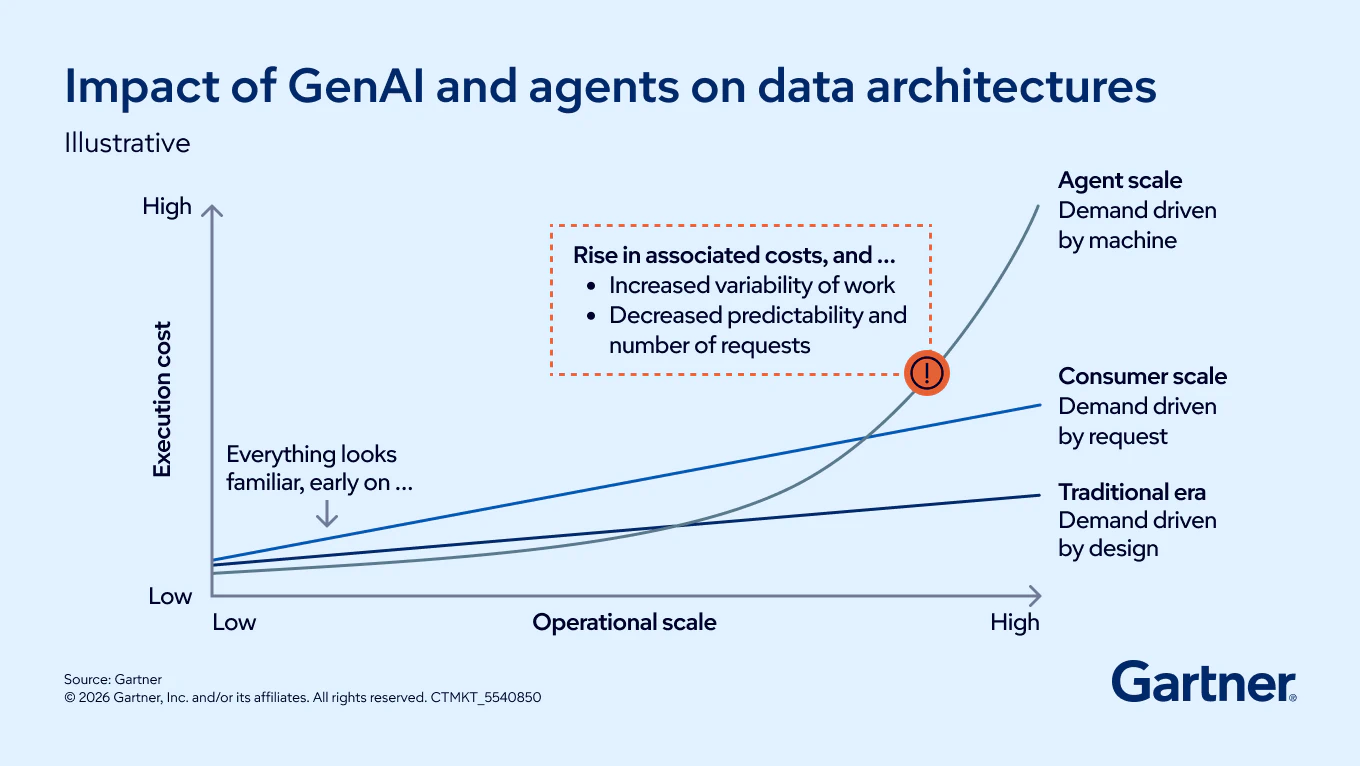
For years, D&A teams could treat consumption as a reasonable proxy for value. More usage often meant greater business impact. Data agents change that equation. Because they can operate autonomously, iterate repeatedly and orchestrate complex workflows, more activity no longer guarantees more value. In fact, the same capabilities that make agents powerful can also erode ROI if consumption grows faster than business impact. As organizations scale agentic AI, they must understand not only what agents cost, but also where additional work begins to produce diminishing returns.
“At some point, the incremental value that an additional iteration provides will be lower than the cost of that iteration. This is where the value of agents erodes with severely negative impacts on ROI,” says Adam Ronthal, Vice President Analyst at Gartner.
You might also like this webinar: Value Is Trapped: Unlocking AI ROI Through Organizational Change
Focus on value before chasing scale
Maximizing ROI starts with understanding which agents create sustainable value and which are most likely to erode it. Cost matters, but cost without context tells only part of the story.
Not all agent activity creates value
Traditional approaches linked consumption to value but that assumption breaks down once agents can operate independently, call other agents and iterate until they reach an objective.
Instead, D&A leaders should evaluate agents based on factors such as input and output tokens, memory requirements, propensity to iterate and expected business impact. Just as importantly, they should assess the business risk of not deploying a given agent. This shift requires a different mindset. More activity is not inherently better. What matters is whether that activity advances business objectives and delivers outcomes that justify the resources consumed.
Iteration is where value is won or lost
Iteration is one of the most powerful capabilities agents bring to data management. It is also one of the biggest sources of ROI risk. Each additional iteration consumes resources. Eventually, there is a point where the value gained from another cycle of work becomes smaller than the cost required to produce it. Once that threshold is crossed, ROI begins to deteriorate.
Agents with a high propensity to iterate require stronger governance because their costs can increase quickly. By contrast, agents with more predictable behavior are less likely to experience uncontrolled cost growth. Understanding where an agent falls on that spectrum helps leaders decide which use cases are ready for deployment and which require tighter oversight.
Start with agents that have bounded risk
The safest early investments are often agents with meaningful business value and well-understood cost boundaries. These deployments allow organizations to gain experience with agentic AI while limiting exposure to runaway consumption.
Higher-impact agents should not automatically move to the front of the queue. Some of the agents with the greatest potential value also have the greatest risk of cost erosion because they are more likely to iterate extensively. Without appropriate guardrails, their expected value may never materialize.
ROI optimization is also not a one-time exercise. Cost, value and impact change over time. Organizations should continuously monitor agent performance, revisit assumptions and adjust priorities as business objectives evolve. The goal is not simply to control spend but to ensure agent activity continues to generate value at a rate that justifies its cost.
Data agent ROI FAQs
How can organizations improve data agent ROI?
Improving data agent ROI starts with evaluating expected value alongside expected cost. Organizations should prioritize agents with strong anticipated business impact, establish guardrails for iteration and continuously monitor performance to ensure costs remain aligned with outcomes.
Why is iteration important for data agent ROI?
Iteration can significantly increase consumption. While iteration often improves results, there comes a point where the additional value created is lower than the cost incurred. Identifying and governing that threshold is critical to maintaining ROI.
Which data agents should organizations deploy first?
Organizations should generally start with agents that offer meaningful value and predictable costs. Agents with limited autonomy and well-bounded consumption provide opportunities to learn from real-world deployments before expanding into more complex use cases.
Attend a Conference
Accelerate growth with Gartner conferences
Gain exclusive insights on the latest trends, receive one-on-one guidance from a Gartner analyst, network with a community of your peers and leave ready to tackle your mission-critical priorities.

Drive stronger performance on your mission-critical priorities.