CMOs face a critical window to transform marketing into an adaptive, AI-driven growth system — or risk losing strategic relevance.
- Gartner client? Log in for personalized search results.
Adaptive Intelligence Marketing: Why CMOs Must Rethink Their Operating Model
By Amy Abatangle | July 22, 2026
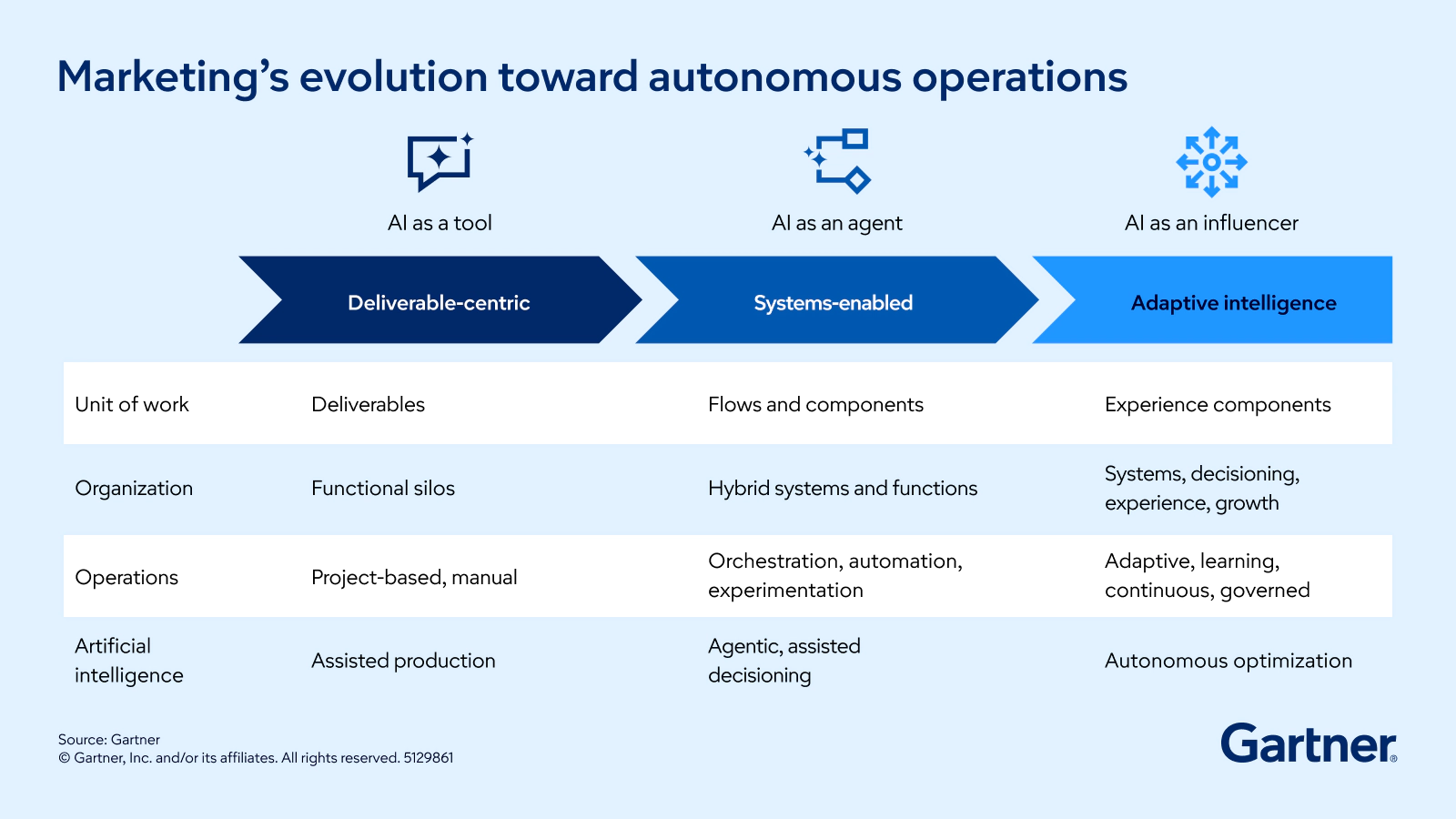
Adaptive Intelligence Marketing: The shift from execution to growth system
The Adaptive Intelligence Marketing (AIM) model marks a fundamental shift in how marketing delivers value. Instead of focusing on campaign execution, AIM positions marketing as an adaptive, governed growth system — one that interprets signals, makes decisions and assembles experiences at scale. This evolution changes marketing’s unit of work, required capabilities and core operating assumptions.
Marketing functions that remain organized around campaigns, channels and manual coordination will struggle to scale agentic AI safely and effectively. Those that proactively reimagine marketing’s operating model — which CMOs most commonly cited as the area needing significant change — will be better positioned to control growth decisions and prepare their organizations for an autonomous business future.
Adaptive Intelligence Marketing: 4 human-led capabilities
AIM is built on four interconnected, human-led capabilities. Together, they enable marketing to sense change, adapt strategy in real time and deliver measurable growth.
Growth and learning system: Driving continuous improvement
The growth and learning system unifies analytics, experimentation and insight-generation to measure the effectiveness of marketing journeys and decision outcomes. By continuously feeding insights back into the system, AIM ensures marketing adapts and aligns with enterprise goals. This feedback loop is essential for ongoing improvement and resilience as AI-driven automation increases.
Decision engine: Interpreting signals and activating strategy
The decision engine interprets real-time customer and operational signals, combining predictive models with live data to determine the next best action for the entire marketing system. Unlike traditional approaches that focus on optimizing individual interactions, AIM’s decision engine decides where to act, invest or engage — driving resource efficiency and strategic alignment. Signals, not just data or insights, trigger governed responses, enabling real-time adaptation.
Experience engine: Assembling and delivering dynamic experiences
The experience engine leverages modular creative and content systems to assemble personalized experiences, adapting to context while maintaining brand and regulatory alignment. Delivery and orchestration systems ensure consistent, relevant experiences across all channels, supporting scale and personalization.
Governed infrastructure: Enabling safe, scalable AI
Governed infrastructure maintains data quality, customer identity and consent, automating workflows to ensure reliable data and content delivery. This foundation is critical for real-time decisions, regulatory compliance and trust — especially as data sources and customer interactions grow exponentially.
How CMOs can prepare for Adaptive Intelligence Marketing
CMOs must fundamentally reimagine the marketing operating model. Start by shifting from campaign-based deliverables to modular, governed experience components — such as message blocks, decision rules and micro-journeys. Invest in composable technology, real-time decisioning engines and a robust feedback-driven learning system. Prioritize staged transformation to avoid overwhelming budgets, and ensure strong governance and cross-functional alignment.
Action checklist for CMOs
Redefine marketing job roles for an AI-driven, autonomous future.
Build a composable martech stack with shared governance.
Align with finance, product, legal and IT on value, constraints and infrastructure.
Stage investments to balance transformation with cost-efficiency.
Prepare for marketing’s evolution from execution to strategic growth intelligence.
What’s next for Adaptive Intelligence Marketing?
Setting your vision is just one critical step in the CMO’s mandate to build an AI-powered marketing organization. According to Gartner, the other steps in this imperative include:
Building new marketing governance frameworks that support the changes AI will bring to people, processes and brand
Identifying and prioritizing marketing’s agentic use cases to deliver the most value
Reprioritizing marketing’s investments in people, partners and technology based on how AI is changing costs and value
Updating roles and structure to support AI integration in a hybrid-human AI team
For more on how Gartner helps drive success on this and other mission-critical priorities for CMOs, speak to us today.
Adaptive Intelligence Marketing FAQs
What is Adaptive Intelligence Marketing (AIM) and why does it matter?
Adaptive Intelligence Marketing is a model that repositions marketing as an adaptive, governed growth system rather than an execution function. AIM matters because it enables marketing to sense changes, make real-time decisions and assemble personalized experiences at scale to ensure relevance and authority as AI automates more tasks.
How does AIM change the marketing operating model?
AIM shifts marketing from organizing around campaigns and channels to modular experience components and governed intelligence layers. This requires new capabilities in growth and learning, decision making, experience assembly and data governance, fundamentally redefining job roles and accountability.
How should CMOs anticipate an AIM-driven future?
CMOs who begin planning for marketing’s future state as an adaptive, governed growth system rather than an execution organization will be better positioned to retain strategic control over growth decisions. They will also prepare their organizations for an autonomous business future.
Attend a Conference
Join Gartner analysts and your peers to accelerate growth
Gather alongside your peers in Denver to gain insight on emerging trends, receive one-on-one guidance from a Gartner expert and create a strategy to tackle your priorities head-on.
7 – 9 Jun 2027
Gartner Marketing Symposium/Xpo™
Denver, CO

Drive stronger performance on your mission-critical priorities.