See what else AI can do for marketing.
- Gartner client? Log in for personalized search results.
The opportunity of AI for marketing decision support
Gartner finds that 81% of marketing leaders evaluate AI-driven automation based on time savings and 68% on cost-efficiency, falling into a productivity trap that yields only marginal cost optimization. CMOs can break free from this trap by deploying AI to support smarter marketing strategy decision making as a core driver of enterprise growth, not just as a tool for incremental savings.
Strategic marketing decision support powered by AI requires a fundamental change in mindset. Marketing organizations should shift from reactive planning tactics to intelligence-driven strategies that connect AI use cases with business goals. This shift allows CMOs to build a competitive edge by using AI to shape strategy, test growth hypotheses and make marketing’s impact more measurable.
You might also like this webinar: CMOs, Align Strategic Planning With Business Goals
AI decision support for governed systems that enable sustainable growth
By building the operating model, data foundations and governance for AI-supported decisions now within the marketing function, CMOs improve the quality, speed and adaptability of their strategic decision-making process. This will not only help make marketing strategy more impactful, but it also will help shift the focus of marketing’s effort from managing tasks to managing outcome-based decisions that drive enterprise growth.
Build the foundations for AI-supported marketing strategy decisions
Effective decision support hinges on defined roles for data stewardship and decision logic. Designate a marketing data owner (if none exists) to be accountable for defining the data roadmap in collaboration with cross-functional peers. The data owner should have responsibility for data quality, model validation and scenario testing. This clarity ensures that marketing teams can trust the outputs of AI systems and act on them confidently, aligning decisions with enterprise growth objectives. Appoint a decision support owner to turn strategy into analytical use cases and approaches along with a cross-functional pod of strategy, data, insights and operations personnel. The pod should prioritize decision support use cases using marketing objectives as input.
Use predictive analytics to create strategic options for greater agility
CMOs should use advanced analytics to test scenarios, validate growth hypotheses and tightly link marketing initiatives to business outcomes. Predictive models help CMOs anticipate market shifts, optimize resource allocation and measure the impact of campaigns in real time. By embedding predictive analytics into decision support systems, marketing organizations become more adaptive and proactive.
Use synthetic data to enhance decision quality
Synthetic data can supplement proprietary datasets, improving the robustness of AI-driven decision support. As Gartner Vice President Analyst Amy Abatangle notes, “Many marketing teams have relied on predictive analytics for years, but synthetic data can amplify and accelerate the insights.” When governed properly, synthetic data helps CMOs overcome gaps in historical data, reduce bias and strengthen scenario planning. This approach enables marketing leaders to make more informed decisions, even in uncertain environments.
Include human oversight to safeguard data quality and competitive advantage
Human oversight is critical to maintaining the integrity of AI-enabled decision support systems. CMOs must ensure that marketing teams regularly audit data sources, review model outputs and challenge assumptions. This vigilance not only mitigates risk but also sustains a competitive advantage as AI becomes increasingly embedded in marketing functions.
Assessing strategic marketing decision support opportunities
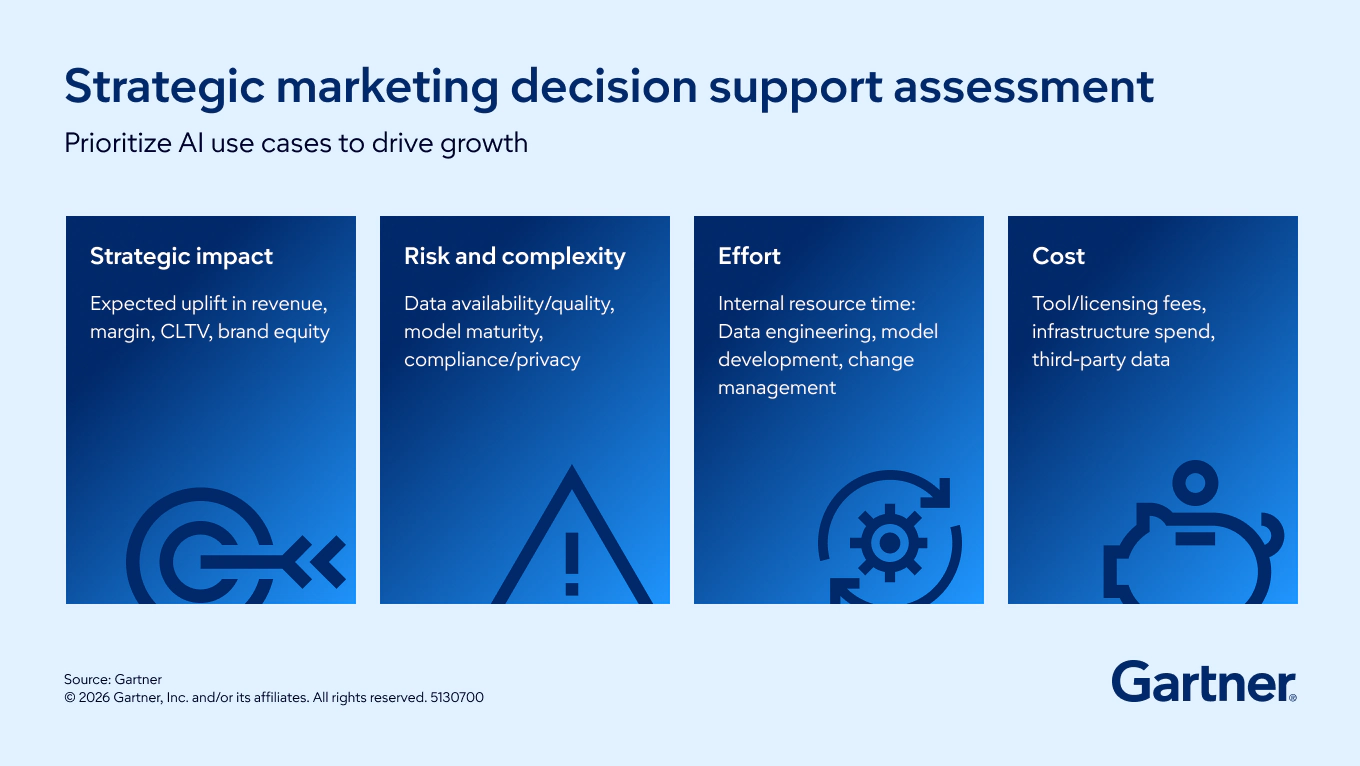
Before scaling AI-powered decision support, CMOs should assess potential use cases through a balanced lens of strategic impact, risk and complexity, effort, and cost. Although AI can help model growth scenarios and surface opportunities, sustainable value depends on clear ownership, high-quality data, documented assumptions and ongoing validation. Evaluating opportunities across these dimensions helps marketing leaders prioritize initiatives that align with business objectives while maintaining accountability, transparency and trust.
AI for marketing decision support: Action steps for CMOs
To use AI for marketing strategic planning, CMOs should take the following steps:
Focus on hypothesis-driven analytics. Start with a key marketing decision tied to strategic objectives and business impact.
Build decision context. Combine quantitative and qualitative data to model realistic what-if scenarios.
Leverage proprietary data. Use unique organizational data to generate differentiated, competitive insights.
Refine and validate. Continuously test for quality and bias to ensure insights are accurate and trustworthy.
By following these recommendations, CMOs position their teams as key drivers of measurable, adaptive growth in the AI era.
What’s next in marketing strategic planning?
Identifying and prioritizing marketing’s agentic use cases to deliver the most value is just one critical step in CMOs’ mandate to build an AI-powered marketing organization.
The other steps in this imperative include:
Building new marketing governance frameworks that support the changes AI will bring to people, processes and brand
Reprioritizing marketing’s investments in people, partners and technology based on how AI is changing costs and value
Setting your vision for AI-powered marketing by defining what an AI-powered team looks like and how that might be different from your current team
Updating roles and structure to support AI integration in a hybrid-human AI team
For more on how Gartner helps drive success on this and other mission-critical priorities for CMOs, speak to us today.
AI for marketing decision support FAQs
What are the key components of governed AI for marketing decision support?
Governed AI for marketing decision support requires clear ownership and accountability for data and decision logic. CMOs must establish frameworks for data stewardship, model validation and scenario testing, ensuring that human oversight safeguards quality and mitigates bias.
How can synthetic data enhance AI-driven decision support quality?
Synthetic data can accelerate and amplify AI’s predictive insights to support test scenarios when customer data sources are limited, nonexistent, regulated or restrictive. However, the use of synthetic data insights requires human oversight and reasoning based on business context and must be tied to growth strategy hypotheses and grounded in proprietary data.
Attend a Conference
Join Gartner analysts and your peers to accelerate growth
Gather alongside your peers in Denver to gain insight on emerging trends, receive one-on-one guidance from a Gartner expert and create a strategy to tackle your priorities head-on.
7 – 9 Jun 2027
Gartner Marketing Symposium/Xpo™
Denver, CO

Drive stronger performance on your mission-critical priorities.