Winning in the AI era requires more than supply chain automation. It requires preparing for supply chain autonomy.
- Gartner client? Log in for personalized search results.
AI adoption alone won’t create competitive advantage
Supply chain leaders are investing heavily in AI and under intense pressure to deliver results, but many organizations still approach the technology with an automation mindset. Rather than rethink how their supply chains operate, how decisions are made and how work gets done, they use AI primarily to improve existing processes. As a result, organizations risk capturing efficiency gains while overlooking the larger opportunity to transform how their supply chains operate.
“Success in this moment is not about implementing AI the fastest, the most or even the best. It’s about preparing your supply chain to compete in the autonomous business era while delivering results now,” says Lindsay Azim, Senior Director Analyst at Gartner.
You might also like this webinar: Build a Supply Chain Network That Withstands Turbulence
The future belongs to autonomous-ready supply chains
The shift from automation to autonomy represents more than a technology upgrade. It is a fundamental change in how supply chains create value in an environment defined by uncertainty, disruption and continuous change.
Organizations that succeed in the autonomous era will redesign operations, decision making and workforce models to work alongside increasingly capable AI systems. Gartner identifies three capabilities that help prepare supply chains for that future while delivering value today.
Build autonomous-ready operations.
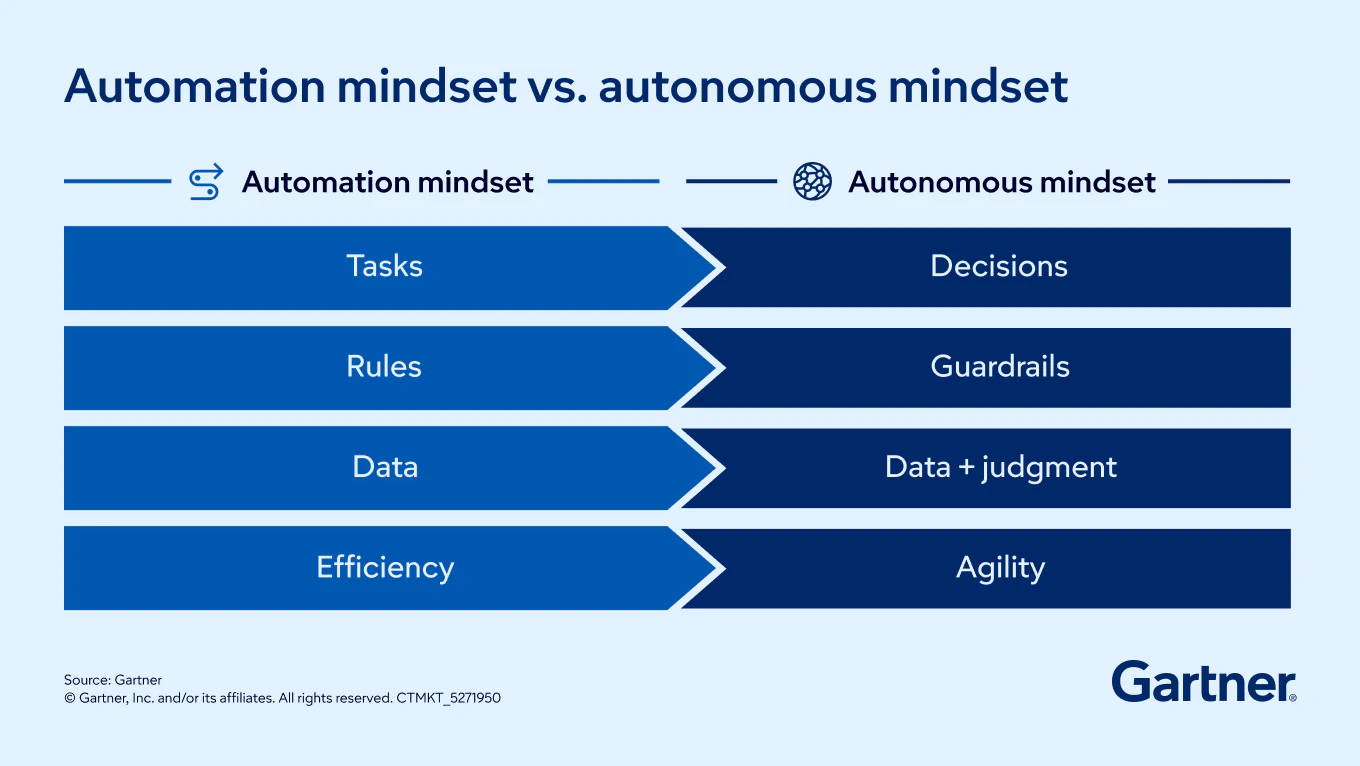
For years, supply chains have operated with an automation mindset. Work is divided into predefined tasks, governed by rules and optimized for efficiency. That approach works well in stable environments but becomes less effective in today’s environment where conditions change rapidly.
An autonomous mindset is fundamentally different. Instead of focusing on individual tasks, it focuses on outcomes. Humans and intelligent agents work together in dynamic workflows that continuously adapt to changing conditions.
CSCOs need to balance two parallel paths to achieve value from AI investments:
Exploitation: Use existing AI capabilities to improve efficiency and deliver near-term results.
Exploration: Redesign workflows and uncover new long-term opportunities enabled by autonomy.
Organizations need both. Focusing only on exploitation risks optimizing yesterday’s operating model for tomorrow’s environment.
Build intelligence around decisions, not technology.
Many organizations are investing heavily in technology stacks for the AI era, but technology alone isn’t enough to support autonomous decision making. Gartner argues that supply chains need a decision stack, not just a tech stack.
“A comprehensive decision stack provides clarity, control and scalability for autonomous operations. It empowers employees, builds trust and enables organizations to realize the full value of AI in supply chain management,” says Azim.
Autonomous systems require context, governance and guidance to make effective decisions. Without that foundation, even advanced AI systems can produce poor outcomes. Technology enables autonomy, but decision quality ultimately determines its value.
A decision stack includes:
Decision maps that define desired outcomes and identify related key decisions
Guardrails that establish controls, compliance requirements and decision rights
Knowledge assets that capture institutional expertise and business context
Decision-grade data that supports decision making in dynamic environments
Organizations that invest in decision intelligence create the clarity, trust and scalability necessary to support autonomous operations.
Build an autonomous-ready workforce.
Preparing for autonomy is not simply a technology challenge. It is also a workforce challenge.
Despite common concerns, Gartner doesn’t view AI as a workforce elimination story. Instead, it’s a workforce evolution story. As machines increasingly handle routine activities, human responsibilities shift toward oversight, judgment, coordination and strategic decision making.
This evolution requires organizations to move beyond narrowly defined specialist roles. Gartner recommends developing versatilists: Employees who can bridge technology and business strategy, oversee AI systems and work effectively across functions.
In an autonomous environment, people remain essential. Human judgment, creativity, ethics and contextual understanding become even more important as autonomous systems take on a larger role in daily operations.
Organizations that prepare employees for human-AI collaboration today will be better positioned to compete in the autonomous business era tomorrow.
Autonomous supply chain FAQs
What is an autonomous supply chain?
An autonomous supply chain uses AI, autonomous systems, data and human oversight to continuously make and execute decisions. Unlike traditional automation, autonomous supply chains adapt workflows and decision-making processes in response to changing business conditions.
How is an autonomous supply chain different from supply chain automation?
Automation focuses on predefined tasks, rules and workflows. Autonomous supply chains focus on outcomes, using humans and intelligent agents to continuously adapt decisions and operations in dynamic environments.
How can CSCOs prepare for autonomous supply chains?
Gartner recommends building three capabilities: autonomous-ready operations, autonomous-ready intelligence and an autonomous-ready workforce. Together, these capabilities help organizations compete in the autonomous business era while continuing to deliver value today.
Attend a Conference
Experience Supply Chain conferences
With exclusive insights from Gartner analysts on the latest trends, sessions curated for your role and unmatched peer networking, Gartner conferences help you accelerate your priorities.
3 – 5 May 2027
Gartner Supply Chain Symposium/Xpo™
Orlando, FL

Drive stronger performance on your mission-critical priorities.