In the AI era, the path to greater productivity runs beyond the IT department.
- Gartner client? Log in for personalized search results.
AI is exposing the limits of IT-centric operating models
Government CIOs are facing a difficult reality. While expectations for productivity, service delivery and modernization continue to rise, resources often do not. At the same time, AI is expanding the role technology plays across the enterprise, making traditional operating models increasingly difficult to sustain.
According to the 2026 Gartner CIO and Technology Executive Survey, 53% of government CIOs identify employee productivity as their top priority, but legacy IT structures have become a productivity bottleneck. It’s not simply about outdated technology, but an operating model designed for a world where technology was largely confined to the IT department.
“In order to evolve to operating models that govern how the enterprise uses technology and AI to achieve mission outcomes, government CIOs must work across the organization with agency leaders, program managers and frontline teams,” says Todd Kimbriel, Vice President Analyst at Gartner, "If the initiative is an IT staff reorganization only, then it is doomed to fail.”
You might also like this webinar: The Future of Government: Harnessing Emerging Trends and Technologies for Mission Impact
Three steps government CIOs should take now
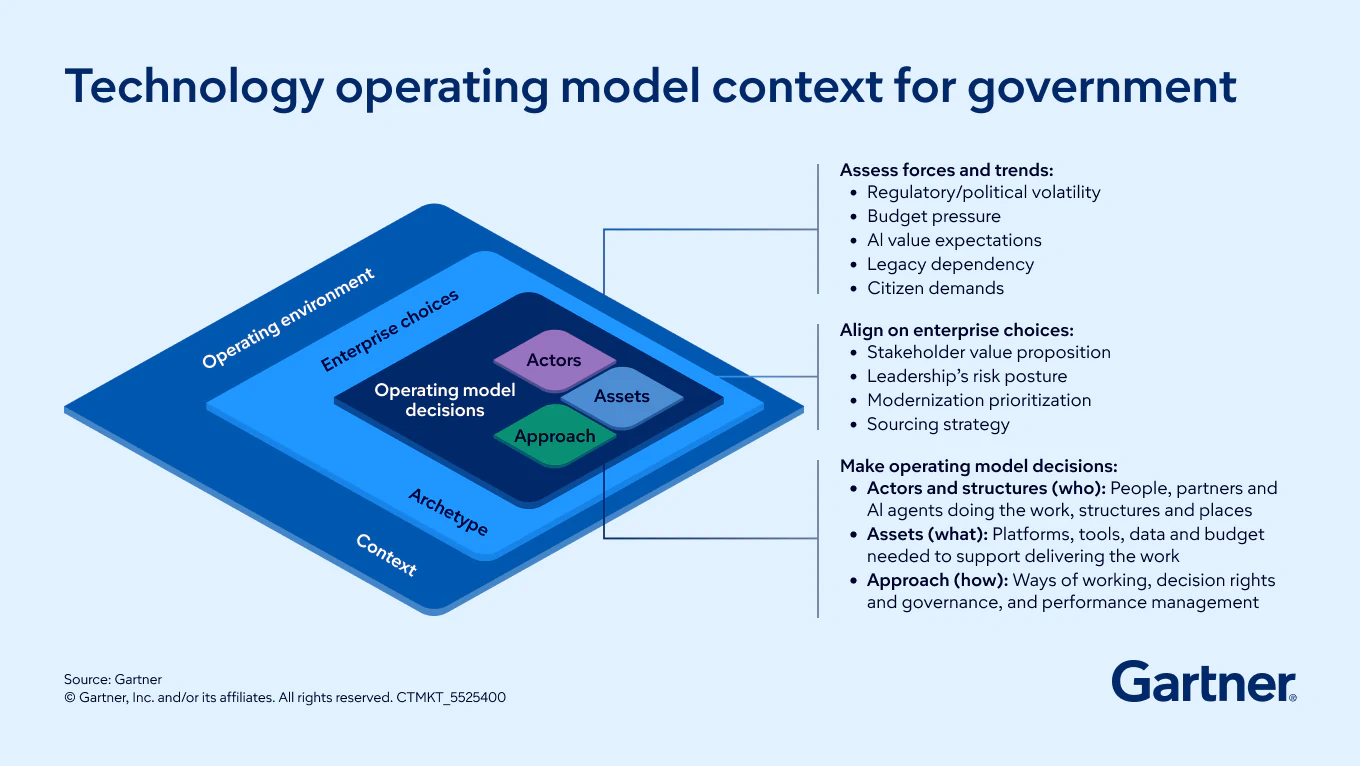
To drive service and productivity transformation, your organization’s technology operating model must adapt to the evolving citizen and political landscape, even if it requires further maximizing the “already-achieved” optimization of current operations. CIOs should take these critical steps:
Assess the reality of your operating environment
Before selecting a new operating model, take the time to understand the current environment your organization operates within.
Government CIOs must account for changing political priorities, regulatory shifts, budget pressures, technical debt and rising citizen expectations. Internal factors such as organizational silos, workforce capabilities, risk tolerance and technology maturity also influence what transformation is achievable.
Technology strategy cannot be developed in isolation. Assess how work gets done across the enterprise and identify the barriers preventing technology from delivering greater value. Organizations that are successfully evolving their operating models are also building narratives that help stakeholders understand the benefits of change and encourage participation.
Align ambition with organizational readiness
Government leaders increasingly expect technology to deliver faster outcomes, but not every organization is prepared to support those expectations. According to Gartner, 86% of government CIOs are doing or planning work that was not anticipated at the start of the year. To combat this, CIOs need an operating model that can adapt quickly to new demands. They must identify the disconnect between the desired operating model and the organization’s readiness to support it. Funding, workforce skills, technology maturity and organizational capacity should guide decisions about what changes are realistic and sustainable. Understanding this gap will help prioritize investments and avoid transformation plans that outpace organizational capabilities.
Choose an archetype that supports future demands
Once you understand your environment and readiness, select the technology operating model archetype that best aligns with organizational goals:
Lean IT, the most common archetype in government, takes a reactive approach to stakeholder demands and focuses on operational metrics.
Amplified IT, which many organizations can work toward to improve outcomes and productivity, leverages new technologies and methods without proportional headcount growth.
Democratized IT, which is more common in the private sector, extends technology development capabilities into the program teams that IT enables.
Dual builder IT, rarely active in government, aggressively extends development capabilities into program teams using a democratized architecture that features composable platforms.
Government organizations that successfully transition to amplified IT models by 2030 will realize significant benefits from applying emerging technologies to meet citizen demand. To support that transition, CIOs should use pilots to validate new approaches, build partnerships with agency leaders and secure buy-in across the enterprise.
Technology operating model FAQs
Why is a technology operating model important for government CIOs?
According to Gartner, a technology operating model defines how work gets done, how responsibilities are aligned and how technology supports mission outcomes. As AI expands across government organizations, these decisions increasingly affect productivity and service delivery.
What technology operating model archetype is most common in government?
Gartner identifies lean IT as the most common archetype in government. It is characterized by a reactive approach to stakeholder demands and a focus on operational metrics.
How can government CIOs prepare for AI through operating model change?
Gartner recommends assessing the operating environment, measuring organizational readiness and selecting the operating model archetype that best aligns with organizational goals and capabilities. The insights emphasize that transformation must extend beyond IT and involve stakeholders across the enterprise.
Attend a Conference
Experience CIO and IT Executive conferences
With exclusive insights from Gartner analysts on the latest trends, sessions curated for your role and unmatched peer networking, Gartner conferences help you accelerate your priorities.
22 – 23 Feb 2027
Gartner CIO Leadership Forum
Phoenix, AZ

Drive stronger performance on your mission-critical priorities.