Traditional metrics capture clicks but increasingly miss where demand is forming.
- Gartner client? Log in for personalized search results.
AI is changing where customer demand forms
Marketing leaders have spent years using traffic, clicks and attribution data as proxies for customer demand. But AI-powered answer engines are changing how customers discover, evaluate and select brands.
Increasingly, customers receive answers without visiting a company website, creating what Gartner describes as “zero-click” experiences. As LLM-mediated journeys absorb more of the discovery process, traditional measurement systems capture a smaller share of how demand forms and influence is built. Demand hasn’t disappeared, but visibility into that demand is becoming harder to maintain.
You might also like this webinar: Exploring Strategic Insights From Gartner’s 2026 CMO Spend Survey
Marketing leaders need a new line of sight into demand
As customer behavior evolves, traditional measurement systems reveal less of the customer journey than they once did.
“Declining organic traffic may reflect a measurement failure, not a performance failure,” says Joseph Enever, Senior Director Analyst at Gartner.
Revenue, conversions and traffic remain essential measures of business outcomes. However, they increasingly describe outcomes more effectively than the customer behaviors that lead to them.
Without adapting measurement approaches, CMOs risk misdiagnosing performance declines, misallocating investment and losing visibility into brand influence as answer engines increasingly mediate customer journeys.
The new signals marketing leaders need
“LLM-mediated customer journeys fundamentally reshape how CMOs need to think about brand health. Brand health is a reflection of being recognized and trusted by customers, as well as by answer engines,” says Joseph Enever.
Answer engine visibility tools offer signals that don’t appear in traditional web analytics reports. To understand how brands perform in these environments, marketers need visibility into how AI platforms represent, reference and recommend their organizations.
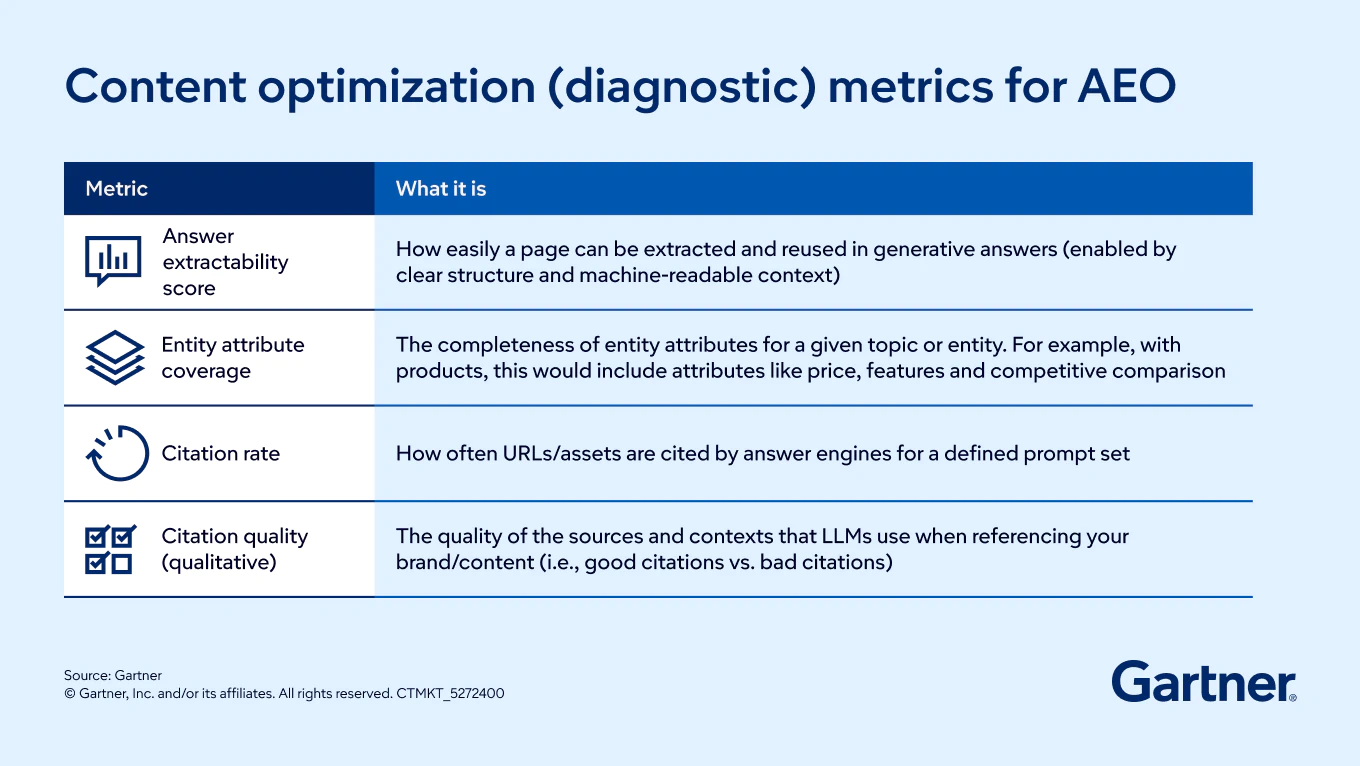
Gartner recommends incorporating visibility metrics such as:
- Share of Answer to understand how frequently a brand appears in AI-generated responses
- Citation Presence to assess whether answer engines reference a brand’s content when generating answers
- Brand Mention Frequency and Sentiment to evaluate how a brand is portrayed across AI-generated experiences
- AEO-Influenced Conversions to better understand the impact of answer engine visibility on downstream business outcomes
These metrics do not replace traditional marketing measures. They help provide insight into a brand’s presence in answer engines, where customer behavior increasingly occurs, often without generating clicks.
Why hybrid measurement will win
The future of marketing measurement is not about abandoning established performance metrics.
Traffic, conversions, revenue and customer acquisition cost remain critical indicators of business performance. They increasingly describe outcomes rather than the full path customers take to reach those outcomes.
Gartner recommends a dual-track measurement model that pairs these established business metrics with the AI-era visibility indicators discussed above. This helps preserve executive confidence while improving visibility into AI-mediated customer journeys.
Organizations that adopt both approaches will be better positioned to understand performance as customer behavior continues to evolve.
The goal is visibility
The emergence of answer engines does not create a need for endless new dashboards or measurement frameworks. It creates a need for visibility.
As AI-mediated journeys absorb more of the discovery process, marketing leaders need new ways to understand where influence is being established and how customer demand is developing. Organizations that rely exclusively on click-based measurement risk creating blind spots at exactly the moment customer behavior is changing most rapidly.
These metrics matter because they help provide insight into how a brand’s answer engine visibility impacts customer demand signals, as the customer journey evolves.
Marketing measurement FAQs
How is answer engine optimization (AEO) changing marketing measurement?
Answer engines increasingly satisfy customer intent without requiring a visit to a brand’s website. As a result, traditional click-based metrics provide less visibility into how customers discover and evaluate brands, creating measurement blind spots for marketing leaders.
What metrics should marketers track for AEO journeys?
Gartner recommends incorporating metrics such as Share of Answer, Citation Presence, Brand Mention Frequency, Sentiment and AEO-Influenced Conversions, alongside traditional performance measures, to better understand visibility and influence within AI-mediated customer journeys.
Why should CMOs adopt a hybrid measurement model?
A hybrid measurement model combines traditional outcome metrics with AI-era visibility signals. This helps preserve confidence in established business measures while providing greater visibility into customer demand that no longer generates traditional click signals.
Attend a Conference
Join Gartner analysts and your peers to accelerate growth
Gather alongside your peers in Denver to gain insight on emerging trends, receive one-on-one guidance from a Gartner expert and create a strategy to tackle your priorities head-on.
7 – 9 Jun 2027
Gartner Marketing Symposium/Xpo™
Denver, CO

Drive stronger performance on your mission-critical priorities.