AI is not reducing the need for software engineers. It’s reshaping how engineering teams are structured to deliver more innovation, agility and business value.
- Gartner client? Log in for personalized search results.
Why AI is making team size less important than team design
Many leaders assume that AI-driven productivity gains will allow them to reduce engineering headcount. Gartner insights point to a different outcome. As AI agents take on more routine technical work, software engineering teams will become smaller, more autonomous and more focused on delivering specific products and features. At the same time, organizations will increase the number of teams they operate to meet growing business demand for innovation.
Gartner predicts that by 2030, software engineering teams will shrink in size and increase in number. Rather than functioning as a cost optimization strategy, this shift reflects a new operating model designed to combine human creativity with AI-enabled productivity. “AI agents embedded in teams are increasingly able to autonomously handle many routine technical tasks, enabling engineers to focus on advanced problem-solving, product design and innovation,” says Aliyah Camacho, Principal Analyst at Gartner. As a result, the organizations that benefit most from AI will not simply automate development work. They will redesign engineering organizations to help small, highly capable teams move faster.
You might also like this webinar: Tiny Teams: New Organizational Structures for AI-Native Software Engineering
What leaders should do to prepare for tiny teams
The tiny teams model changes how organizations structure talent, define roles and support software delivery. To succeed, leaders must prepare both their workforce and their operating model for a future where AI amplifies individual capability.
Build teams around outcomes, not job titles
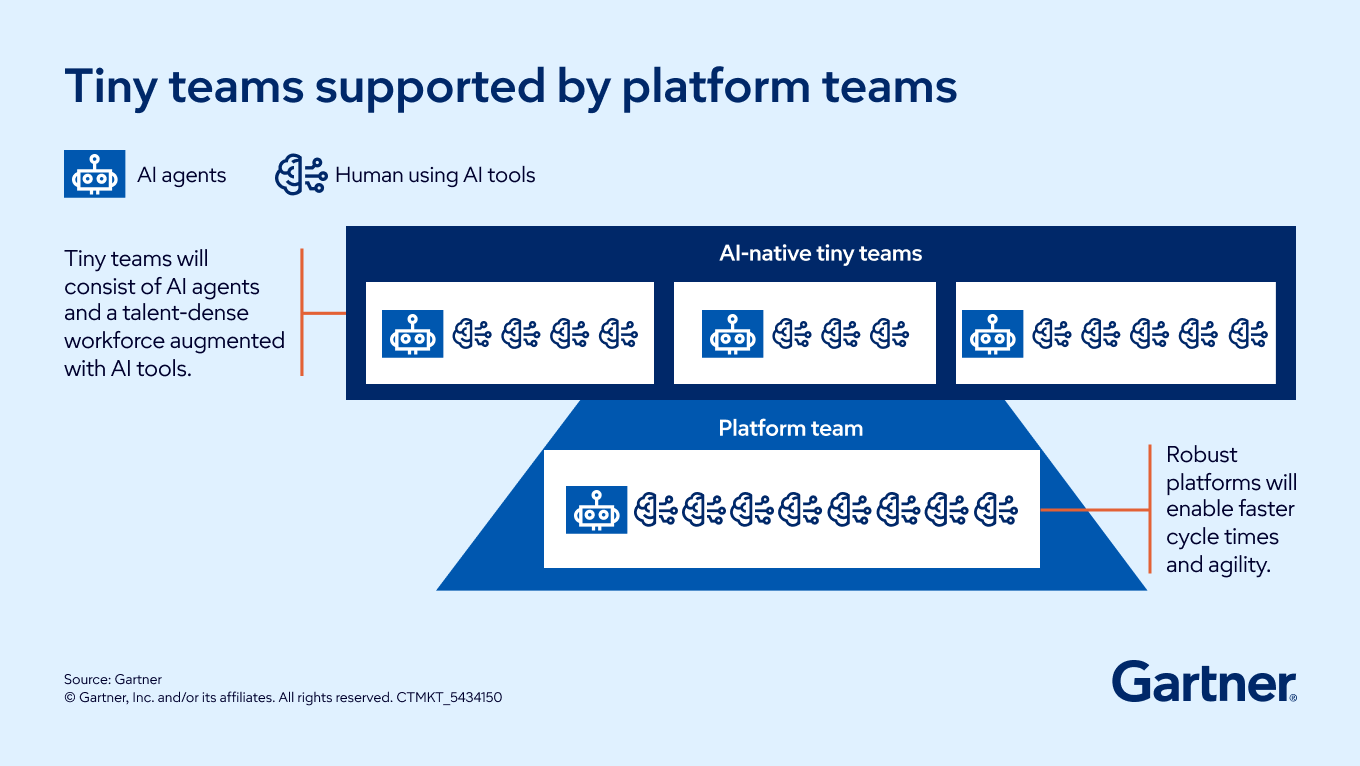
A tiny team is AI-enhanced, autonomous and accountable for the success of a product or feature set. While many tiny teams today consist of four to five members, some already operate with as few as two or three people. In this model, traditional role boundaries begin to disappear. Team members take on a broader range of responsibilities that can include understanding business goals, contributing to product design and overseeing AI agents alongside software development work.
Invest in skills before changing team structures
Tiny teams depend on people who can operate effectively across a wider range of responsibilities. As a result, workforce development becomes a critical requirement, not an afterthought. Software engineering leaders should hire multiskilled developers with strong AI capabilities and expand engineers’ responsibilities to help them develop broader expertise. Experiential learning opportunities, peer-based learning and rotational programs can help employees build the skills needed to succeed in a tiny teams environment.
Leaders should also avoid treating smaller teams as a reason for reducing junior hiring. Slowing junior recruitment can weaken knowledge transfer, restrict the internal talent pipeline and increase reliance on expensive senior talent. Instead, organizations should continue developing junior engineers through apprenticeship and shadowing models that support long-term talent growth.
Strengthen platform engineering to scale innovation
Tiny teams can only operate effectively when supported by robust platform engineering capabilities. Without that foundation, small teams risk spending too much time managing infrastructure, tooling and operational complexity. As organizations adopt more tiny teams, platform teams become increasingly important because they provide the shared capabilities that enable speed, consistency and scale. Key benefits include:
- More time for innovation with reusable AI capabilities and automated workflows
- Faster delivery through self-service access to tools and infrastructure
- Less complexity with standardized approaches to security and governance
- Greater scale and consistency across a growing number of smaller teams
- More team autonomy without sacrificing quality or control
Tiny teams FAQs
What are tiny teams in software engineering?
Tiny teams are AI-enhanced, autonomous teams that are fully accountable for the success of a product or feature set. Many tiny teams currently consist of four to five people, though some may operate with as few as two or three members as AI capabilities and employee skills mature.
Will tiny teams reduce software engineering headcount?
No. The tiny teams model is not a cost optimization tactic. It represents a restructuring of engineering organizations to better leverage AI and human expertise. Gartner finds that 75% of software engineering leaders expect engineering headcount to remain the same or grow.
Why are platform engineering teams important for tiny teams?
Platform engineering teams provide the reusable AI capabilities, automated workflows and self-service tools that enable tiny teams to focus on innovation and complex problem solving. These platforms help improve speed, consistency and governance while reducing the operational burden on individual teams.
Attend a Conference
Accelerate growth with Gartner conferences
Gain exclusive insights on the latest trends, receive one-on-one guidance from a Gartner analyst, network with a community of your peers and leave ready to tackle your mission-critical priorities.

Drive stronger performance on your mission-critical priorities.