Software engineering leaders must take co-ownership of the AI FinOps discipline, partnering with IT procurement teams to actively manage budgets, usage patterns and commercial negotiations.
- Gartner client? Log in for personalized search results.
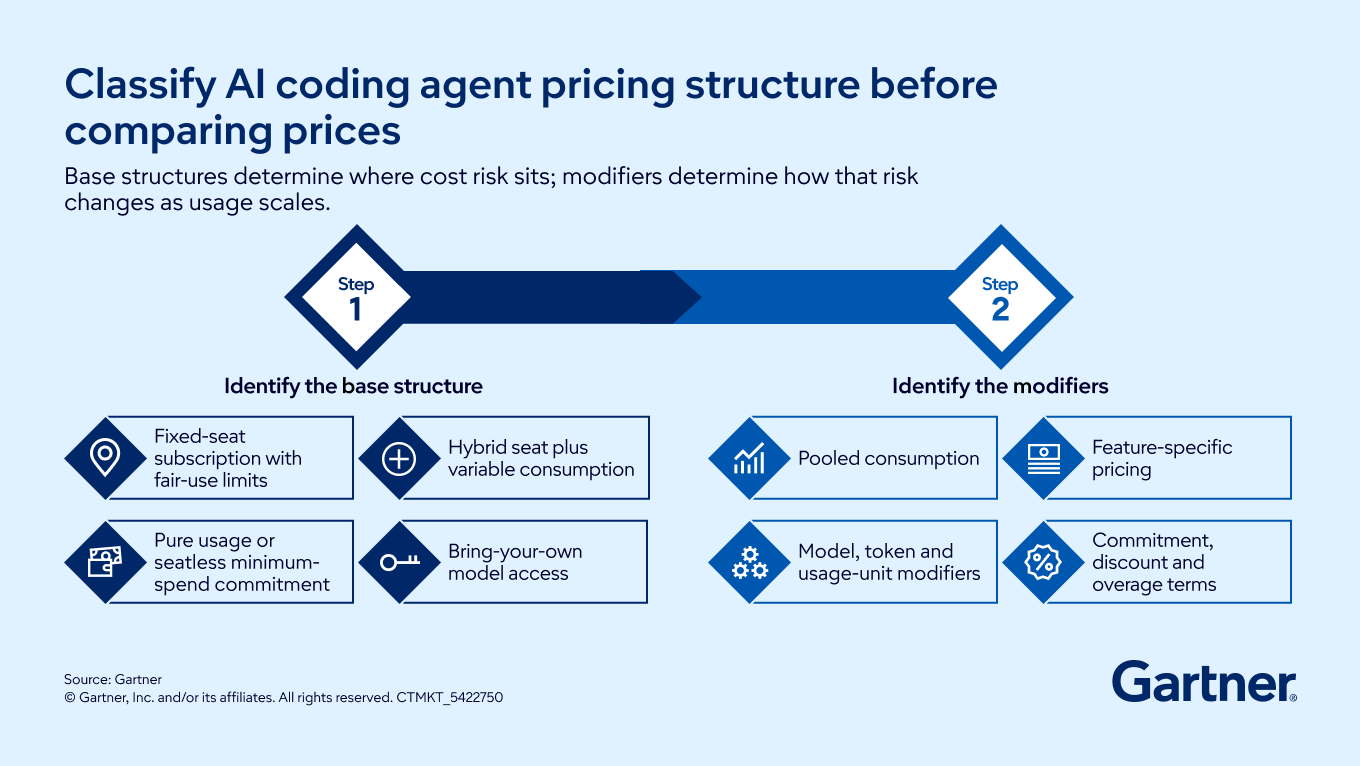
Google’s pricing changes reinforce a broader AI FinOps shift
Google’s Gemini Enterprise pricing changes reflect an industrywide shift toward AI consumption governance and reinforce the need for software engineering leaders to take shared responsibility of AI FinOps with IT procurement leaders.
Most organizations are struggling to adapt to changing pricing models, as AI coding agent usage varies significantly across developers, teams and projects.
Take co-ownership of AI FinOps. Software engineering leaders must partner with IT procurement teams to shape vendor negotiations, budgeting decisions and consumption governance for AI coding agents to avoid token-based cost overruns.
Build budget models based on actual consumption patterns. Monitor token usage, segment developers by consumption behavior, and use cost analytics to determine whether user-based licensing, consumption pricing or a hybrid model delivers the best outcome.
Note: This is Gartner’s first take on the announcement of Google Gemini Enterprise pricing model changes.
Google follows the leaders on consumption-based pricing but with bigger discounts
On August 26, 2026, Google introduced several changes to Gemini Enterprise pricing and cost management. The changes also apply to its AI coding agent, Google Antigravity, which is now included within Gemini Enterprise subscriptions. The pricing changes include:
User-based licensing with pooled quotas
Consumption-based pay-as-you-go pricing
Flexible savings plans that provide discounted pricing (10% to 20%) in exchange for spending commitments
Cost management capabilities, including budget estimation, anomaly detection, centralized reporting and spend controls.
This signals a predictable but definite shift in the responsibilities of software engineering leaders
It also brings Google in line with industry pricing trends. User-based licensing and consumption-based pricing are already common among AI coding vendors, such as Anthropic, OpenAI and Microsoft GitHub. However, Google is offering bigger discounts than the industry players for its savings plan. Software engineering leaders should share the responsibility of AI FinOps and select the best deal for their teams.
Software engineering leaders must co-own the responsibility of AI FinOps with IT procurement
Software engineering remains one of the largest sources of enterprise AI token consumption. Gartner has received 5,000+ inquiries since March 2026 on rising AI token costs. In some cases, organizations report that AI coding costs for highly active users approach or exceed the monthly cost of a software engineer.
As AI coding adoption grows, software engineering leaders are under increasing pressure from executives to either reduce AI costs or demonstrate measurable business value. Technical optimization practices, such as model routing, prompt optimization, context pruning and agent governance, remain important. However, their implementation can be complex, and they address only part of the challenge.
Google Gemini Enterprise pricing changes reinforce the importance of optimizing budgets, selecting the right pricing models and handling negotiations as vendors shift toward flexible pricing models. IT procurement teams alone won’t be able to make optimal decisions on their Google AI dev tooling budget because software engineering leaders have a deeper understanding of AI token consumption across their teams.
Use monitoring to build the right budget model
Software engineering leaders adopting Antigravity should work with platform teams to establish continuous monitoring of AI coding agent usage. Use consumption monitoring to segment developers into three categories:
Normal users: Developers still building AI habits and primarily using AI for quick questions or limited assistance. Typical monthly budget range: $1 to $200.
Mainstream users: Developers using AI consistently within IDEs and developer workflows. Typical monthly budget range: $200 to $500.
Power users: Developers building agentic workflows or executing high-volume autonomous tasks. Typical monthly budget range: $2,500 to $3,500.
Estimating these segments helps establish budget baselines while maintaining sufficient spending buffers to avoid constraining productivity. Budget decisions should also incorporate expected business value and the strategic importance of individual initiatives. Google’s centralized visibility, anomaly detection and cost management capabilities provide the foundation for this discipline.
A hybrid approach provides the best balance between cost control and developer productivity
For many organizations, the optimal answer won’t be a pure user-based licensing model or a pure consumption-based model since budget requirements vary across engineering teams. A hybrid approach often provides the best balance between cost control and developer productivity. Organizations that cannot consistently meet commitment thresholds should avoid overcommitting to savings plans. Instead:
Use user-based licensing for normal and mainstream users and quota pooling to address the increased credit limit of mainstream users.
Use consumption-based pricing with fixed spending limits for power users and only approve additional limits based on business use case justification.
Partner with IT procurement to negotiate the most favorable hybrid pricing arrangement.
Continuously monitor usage patterns and adjust budgets as adoption patterns evolve.
Attend a Conference
Experience Applications conferences
With exclusive insights from Gartner analysts on the latest trends, sessions curated for your role and unmatched peer networking, Gartner conferences help you accelerate your priorities.
1 – 2 Mar 2027
Gartner Digital Workplace Summit
San Diego, CA

Drive stronger performance on your mission-critical priorities.