Newsroom

Conference Updates

ORLANDO, Fla., May 9, 2023

Gartner Supply Chain Symposium/Xpo Americas: Day 2 Summary

We are bringing you news and highlights from the Gartner Supply Chain Symposium/Xpo, taking place in Orlando this week. Below is a collection of the key announcements and insights coming out of the conference.

On Day 2 from the conference, we are highlighting sessions on how to improve scenario planning, an overview of intralogistics smart robots and how to select winning products for the circular economy. Be sure to check this page throughout the week for updates.

Key Announcements

Break the Cycle of Chaotic Reaction: Build Your Scenario Planning Muscle

Presented by Cristina Carvallo, Senior Director Analyst, Gartner

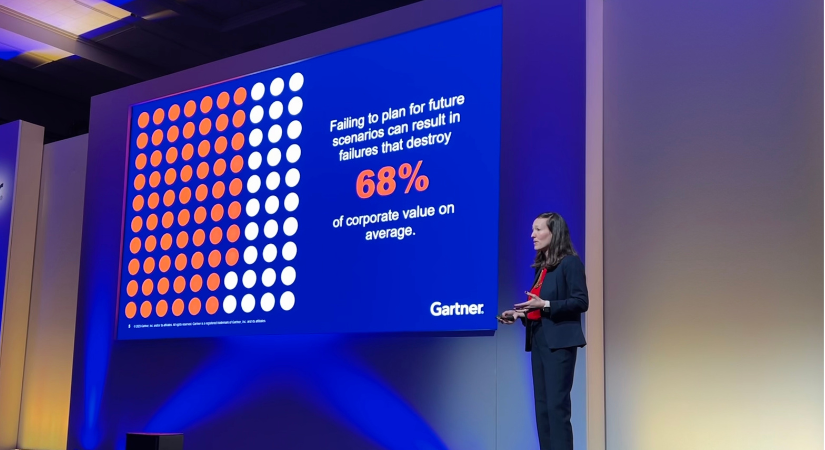
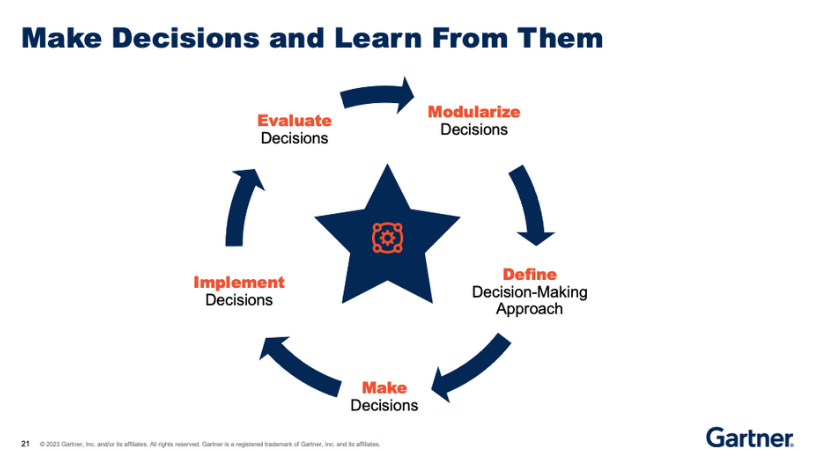
With 74% of organizations frequently surprised by risk events, and scenario planning failures that can result in 68% of corporate value lost on average, it’s clear business leaders need improved frameworks to make decisions and learn from them. In this session, Cristina Carvallo, Senior Director Analyst with Gartner, shared the proven mental tools that chess grandmasters use to tackle the complex and varied decisions they face and illuminate lessons for more effective scenario planning.

Key Takeaways

  • “Improving scenario planning involves breaking down complexity, evaluating decisions more flexibly, and learning from the outcomes of the decisions made.” 

  • “Break problems down into smaller chunks; by ‘modularizing’ decisions to better identify and recognize patterns, which in turn reduces complexity.” 

  • “Scenario planning based strictly on a rational decision making model won’t work for all types of decisions. This fails to account for all of the variables involved, including the importance, clarity, complexity and timeframe of when a decision needs to be made.” 

  • “Organizations must have a process in place for “training” their decision making muscle by monitoring and validating the effectiveness of their decisions.” 

  • “Scenario planning requires a cultural shift; we need to refocus planning from eliminating uncertainty to managing uncertainty. Shifting the mindset from one number to one plan.”

Intralogistics Smart Robots: What’s Your Flavor of the Day?

Presented by Dwight Klappich, VP Analyst, Gartner

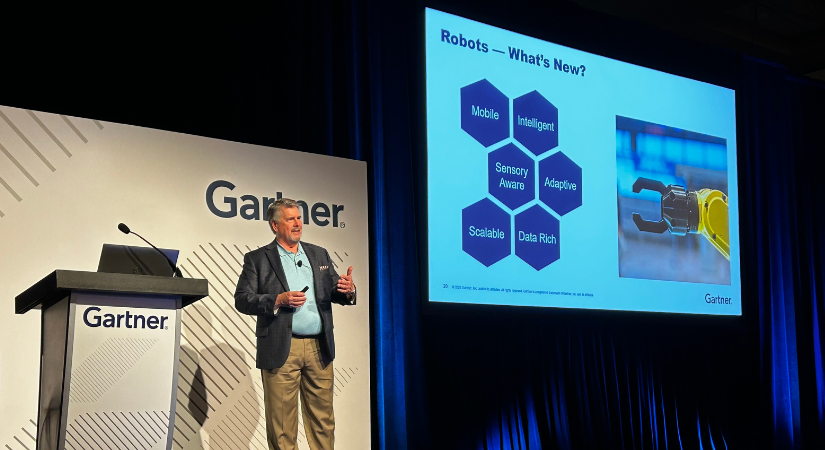
With 96% of companies planning to or already using robotics in their operations, ubiquitous cyber-physical automation is not a matter of “if,” but “when” and “what kind?” In this session, Dwight Klappich, VP Analyst with Gartner, charted the coming exponential growth in intralogistics smart robot deployments and demystified the key criteria for logistics leaders in selecting the right types of robotics from dozens of different categories and use cases. 

Key Takeaways

  • “The two greatest obstacles to achieving organizations’ supply chain objectives are labor and controlling costs; a lack of labor availability is the key motivator for initiating or expanding intralogistics smart robot fleets.” 

  • “Intralogistics smart robots are the class of smart robots that orchestrate and perform work within the four walls of a site and can be mobile or stationary, operating autonomously or collaboratively with humans or other robots.”

  • “By 2026, 75% of large enterprises will have adopted some form of intralogistics smart robots in their warehouse operations.” 

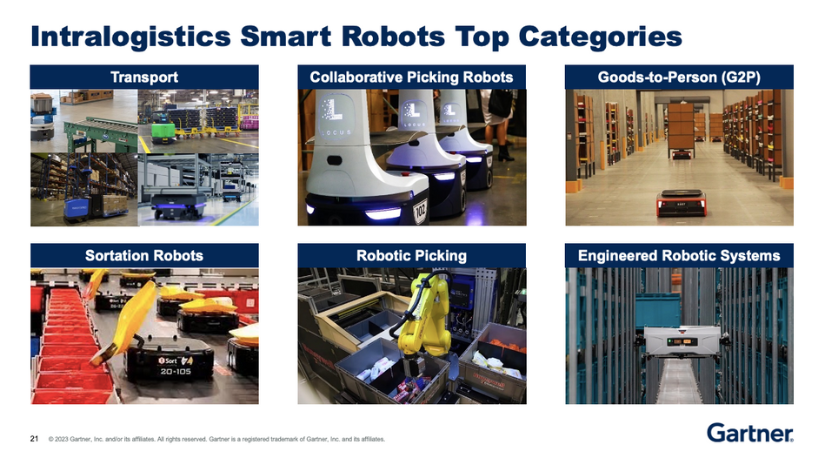
  • “Gartner is tracking around 34 different categories and subcategories of intralogistics robots. However, there are six categories most important to know from a logistics perspective: Transport, Collaborative Picking, Goods-to-Person, Sortation, Robotic Picking and Engineered Robotic Systems.” 

  • “Categories such as collaborative picking and mobile goods-to-person robotics highlight how robotics will complement and augment human work, not replace it.” 

  • “Logistics leaders should analyze their workflows and identify where their pipelines are most stressed: Receiving, inventory management, putaway, picking and shipping can all leverage specific categories of smart robots that are the best fit to do that specific job.”

Strategies to Select Winning Products for the Circular Economy

Presented by Sarah Watt, VP Analyst, Gartner

Applying conventional supply chain wisdom, which relies on linear thinking, has been counterproductive in circular ecosystems. In this session, Sarah Watt, VP Analyst with Gartner, shared three mental models for leaders to shift their thinking on to find success in the circular economy.

Key Takeaways

  • “76% of leaders expect circular economy practices to drive an increase in profitability between now and 2025.” 

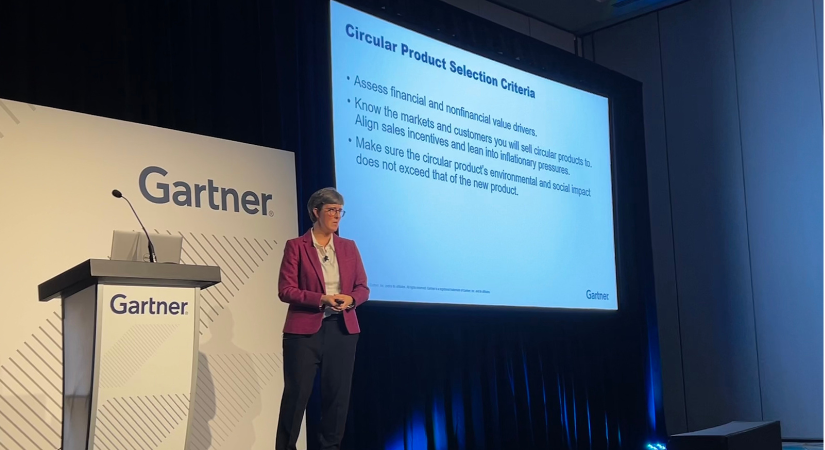
  • “When assessing potential products for the circular economy, supply chain leaders need to challenge three mental models. First, they need to challenge the perception of value, second they need to address concerns around cannibalization of market share, and third they need to proactively manage circular product environmental impact.” 

  • “Circular product strategies can enable benefits such as: increasing customer loyalty and enhancing raw materials security.” 

  • “Clarity is needed around channels, markets, and consumers that circular products will be sold to. If this activity is undertaken poorly, there is a real risk that circular products will cannibalize market share.” 

  • “Supply chain leaders need to proactively minimize environmental impacts arising from circular product and material flows.” 

  • “52% of leaders have already realized a reduction of negative environmental impacts from applying circular economy practices today.”

It’s not too late to join the conference!

Tune back in tomorrow for more updates from the conference.

About Gartner

Gartner, Inc. (NYSE: IT) delivers actionable, objective insight that drives smarter decisions and stronger performance on an organization’s mission-critical priorities. To learn more, visit gartner.com.

Media Contacts

It's not too late to join the conference

Latest Releases