ORLANDO, Fla., October 28, 2026
Gartner Theme: The AI-Shaped Organization: From Roles to Value Creation
December 08 2026
ORLANDO, Fla., October 28, 2026
Analysts Introduce New Enterprise Framework for Strategic Workforce Planning in the AI Era at Gartner HR Symposium/Xpo in Orlando
By 2029, 30% of employees who were terminated and replaced by AI will be rehired, often at a higher cost, as organizations struggle to align workforce decisions with evolving business needs, according to Gartner, Inc.
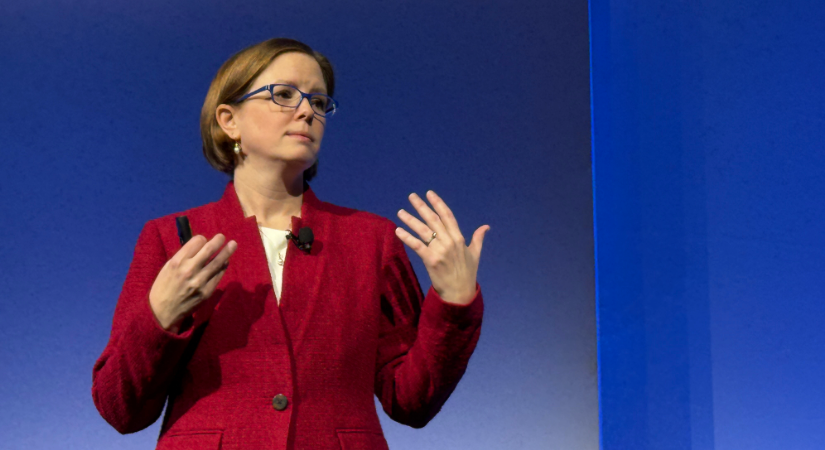
At Gartner HR Symposium/Xpo in Orlando, Caitlyn McDonough, Vice President Analyst at Gartner, shared the current talent risks threatening businesses.
“Many organizations are making AI and workforce decisions in the wrong order,” said Caitlyn McDonough, Vice President Analyst in the Gartner HR practice. “They decide how many people to let go before they understand what it will take to get work done. The goal should be to understand what work matters most to the strategy, how that work is changing, and the right mix of people and technology needed to deliver business outcomes.”
According to a July 2026 Gartner survey of 297 CHROs, only 19% of organizations have workforce planning practices that effectively help leaders understand how work is changing, account for AI’s impact, and realign talent strategies with business goals. Yet organizations with effective workforce planning are 1.4 times more likely to exceed revenue goals and 1.5 times more likely to exceed cost goals.
During Gartner HR Symposium/Xpo, taking place here through today, McDonough shared a new enterprise framework for strategic workforce planning.
Most workforce planning is bottom up. Leaders consider today’s jobs, skills, and headcount, and assess how AI could change them. But just because AI can do something, doesn’t mean it will. As AI costs continue to rise, organizations are increasingly concentrating AI investments in areas that drive strategy.
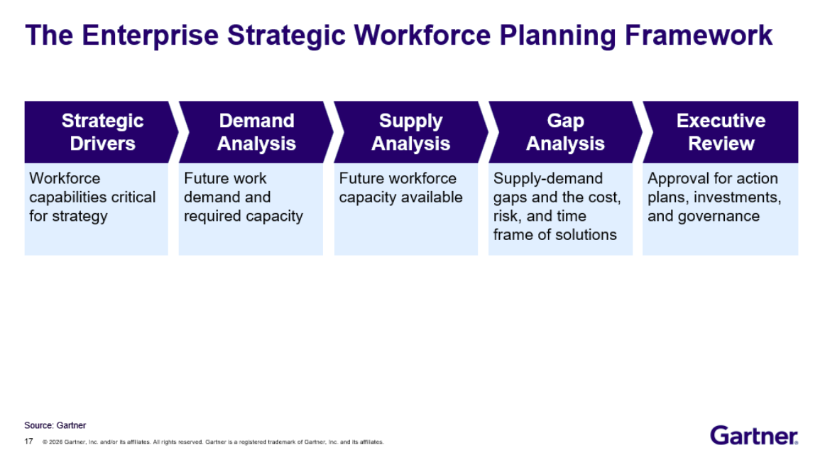
Gartner has created a new framework that considers the enterprise strategy first and aligns workforce decisions to the work required to achieve strategic goals.
There are five planning phases:
Source: Gartner (October 2026)
A key differentiator of the framework is forecasting future work demand. It helps organizations break work down into measurable components so they understand what work will be done in the future, how much, and the share of work that will be performed by humans and AI.
Enterprise strategic workforce planning ultimately enables CHROs to tell the CEO and board what work and workforce capabilities are most important to strategy, what type of workforce they will need in the future, and what will it take to deliver the workforce.
Rather than attempting an enterprise-wide rollout from the outset, CHROs should partner with leaders to pilot the framework for 1-2 business capabilities and then scale their approach based on lessons learned.
“To prepare for an AI-driven future, leaders should stop planning for the workforce they have and start planning for the workforce their strategy requires.,” said McDonough. “When organizations shift the focus from jobs to work and work demand, they avoid costly workforce missteps and allocate resources more effectively.”
Gartner HR Symposium/Xpo is where CHROs and their leadership teams gather each year to reimagine their strategies through the lens of Gartner’s research-driven insights and expert advice on leadership and learning, employee experience, culture and change, talent acquisition and workforce planning, and HR technology. Gartner HR Symposium/Xpo is being held October 26-28 in Florida and November 16-17 in Sydney. Follow news and updates from these events on LinkedIn using #GartnerHR.
The Gartner HR practice brings together the best business and technology insights across Gartner to offer individual decision makers strategic business advice on the mission-critical priorities that cut across the HR function. Additional information is available at http://www.gartner.com/en/human-resources/human-resources-leaders. Follow news and updates from the Gartner HR practice on X and LinkedIn using #GartnerHR.
Gartner is an indispensable partner to C-Level executives and technology providers as they implement AI strategies to achieve their mission-critical priorities. The independence and objectivity of Gartner insights provide clients with the confidence to make informed decisions and unlock the full potential of AI. Clients across the C-Level are using Gartner's proprietary AskGartner AI tool to determine how to leverage AI in their business. With more than 2,500 business and technology experts, 6,000 written insights, as well as more than 4,000 AI use cases and case studies, Gartner is the world authority on AI. More information can be found here.
Mary Baker
Gartner
mary.baker@gartner.com
Gerri Weinberger
Gartner
gerri.weinberger@gartner.com


Gartner (NYSE: IT) delivers actionable, objective business and technology insights that drive smarter decisions and stronger performance on an organization’s mission-critical priorities. To learn more, visit gartner.com.