AI advancements continue to accelerate. To keep pace, marketers must establish a strategic roadmap for how marketing will adapt now, in the midterm and in the future.
- Gartner client? Log in for personalized search results.
CMOs: Develop a Strategic Roadmap Built on 3 AI Milestones
By Nicole Greene and Leah Leachman | December 3, 2025
Create a marketing strategy that grows with AI
Marketing is driving GenAI adoption, but many CMOs remain focused on short-term efficiency gains — risking brand differentiation. The solution is a roadmap spanning short-, mid- and long-term horizons, guiding how to use customer data, empower employees and govern AI-driven work. This approach ensures agility and competitiveness as customer and business needs evolve.
Before you get started
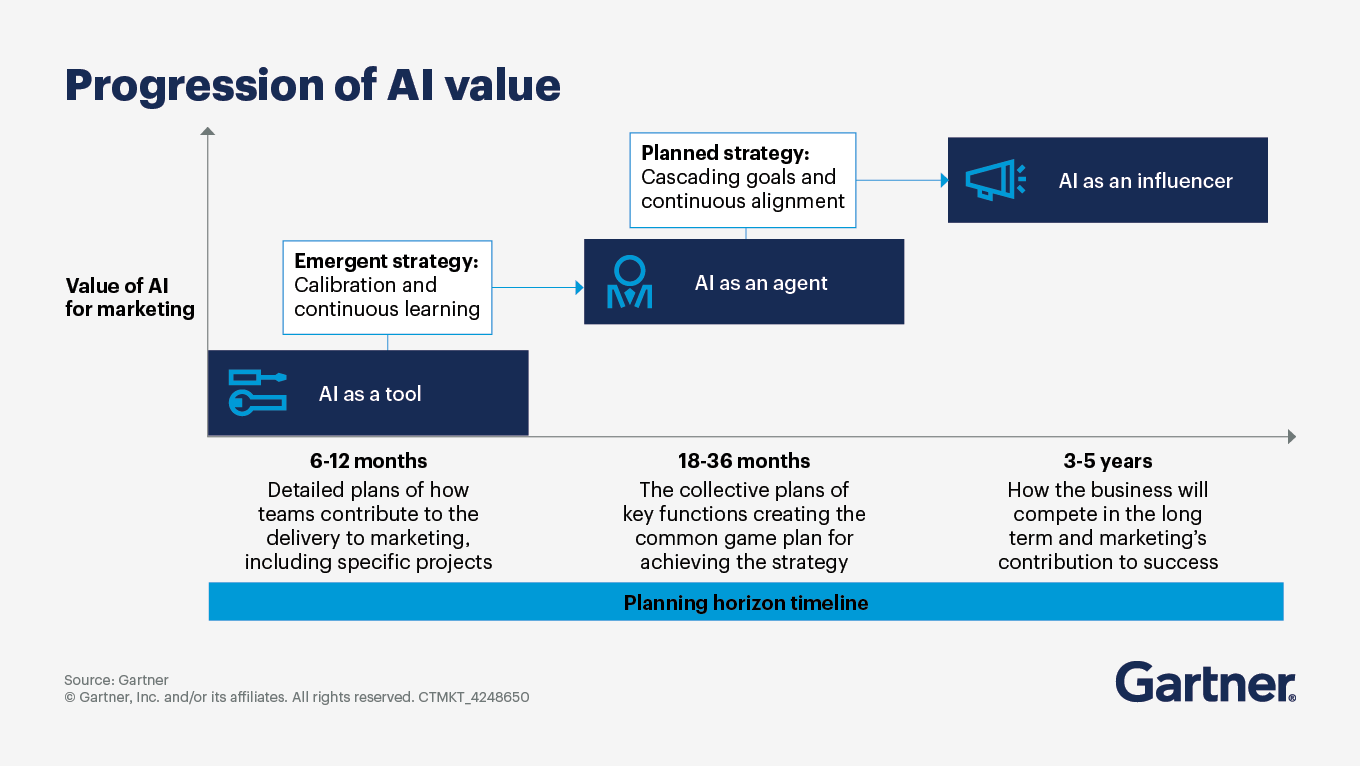
Assess your current state and identify vulnerabilities to AI disruption. Your organization’s AI maturity will shape marketing’s evolution — progressing from AI as a tool, to an agent and ultimately an influencer. Since cultural readiness and technical capacity vary, organizations should adopt best practices and guardrails, using frameworks like the Gartner three stages of AI implementation for agile planning.
Stage 1: AI as a tool
AI as a tool: Building the foundation for value
Most organizations are still in the early stages of AI adoption, using it primarily as a tool to reduce manual work and improve internal efficiency. At this point, AI planning is company-centric, focused on productivity and operational gains rather than customer-facing transformation. While short-term wins matter, success depends on managing this new productivity effectively and preparing for cultural change. The goal is to move quickly from efficiency to effectiveness — proving value now while laying the groundwork for future impact.
Key operations and strategy priorities
Prioritize low-risk internal use cases aligned with existing KPIs and demonstrate value to leadership.
Upskill employees and provide guidance; 88% of employees want more AI guidance, yet only 7% of organizations offer support.
Appoint GenAI ambassadors to host open forums, fostering trust and adoption.
Partner with tech and operations leaders to explore tools that automate repetitive tasks.
Establish human review panels to validate AI outputs before they reach customers.
What you need to get ahead
AI productivity alone won’t elevate marketing’s value to the business. Use efficiency gains to create space for strategic initiatives — such as improving engagement, increasing customer lifetime value and driving qualified leads. Align new capacity with broader business goals and maintain transparency about how AI uses customer data, to build trust and mitigate risk.
Stage 2: AI as an agent
As AI moves into the agent phase, its role shifts from simple automation to acting on behalf of customers and employees. This stage is about using AI to create smoother, more personalized experiences and uncover insights that make decision making easier. Success here means focusing on your most important customers, improving data quality and introducing AI agents into customer journeys to reduce friction and complexity.
Key operations and strategy priorities
Prioritize customer-centric use cases by identifying target segments and personas so AI learns from, and creates assets for, the right audiences.
Integrate AI agents into customer journeys to handle repetitive or overwhelming tasks, making decisions easier and reducing effort for customers.
Ensure high-quality first-party or synthetic data to support personalization and compliance when real data is limited by privacy rules.
Optimize metadata and unstructured data so AI agents can adapt based on relevant inputs for both employees and customers.
Establish governance and oversight through cross-functional collaboration to enforce standards for fairness and trust.
What you need to get ahead
Marketing needs to meet customers where they are, helping them cut through overwhelming choices with AI-driven insights and personalized experiences. Building strong customer understanding through refined personas is critical, as these guide how AI agents learn and act. Organizations that invest in this capability will be better positioned to deliver differentiated, compelling experiences as AI becomes more autonomous.
Stage 3: AI as an influencer
AI as an influencer sits in the long-term planning horizon, but the shift toward autonomy is coming fast. Soon AI will influence decisions and even make purchases on behalf of customers. This will introduce machine customers and AI assistants into buying journeys, requiring marketers to rethink strategies for both human and machine audiences. Preparing now means anticipating new roles, new interactions and new ways to build trust.
Key operations and strategy priorities
Identify potential machine-customer scenarios by working with product, sales, customer experience (CX), and data teams.
Plan for new demands like handling automated requests and creating content optimized for machine evaluation.
Adopt a composable martech stack to stay flexible and adapt quickly to evolving requirements.
Invest in skills development for emerging roles that manage machine-driven interactions.
Establish governance and ethics to ensure privacy, consent and transparency in all machine-human exchanges.
What you need to get ahead
Start with pilot use cases or simple transactions or touchpoints where customers might delegate decisions to AI. Map journeys that mix human and machine interactions, and build trust through transparency and proactive risk management. In a world of machine customers, speed and reliability will set your brand apart.
AI strategic roadmap for marketing FAQs
What is a machine customer?
A machine customer is a nonhuman economic actor that obtains goods or services for payment, acting on behalf of humans or organizations. Machine customers represent a growth megatrend that will surpass the significance of digital commerce.
How can an organization assess vulnerability to AI disruption?
Use internal audits or a maturity assessment like the Gartner Marketing Score. Focus on activities involving data analysis, operations management and marketing leadership.
Attend a Conference
Join Gartner analysts and your peers to accelerate growth
Gather alongside your peers in Denver to gain insight on emerging trends, receive one-on-one guidance from a Gartner expert and create a strategy to tackle your priorities head-on.
7 – 9 Jun 2027
Gartner Marketing Symposium/Xpo™
Denver, CO

Drive stronger performance on your mission-critical priorities.