The next phase of AI success depends on organizational change rather than technology.
- Gartner client? Log in for personalized search results.
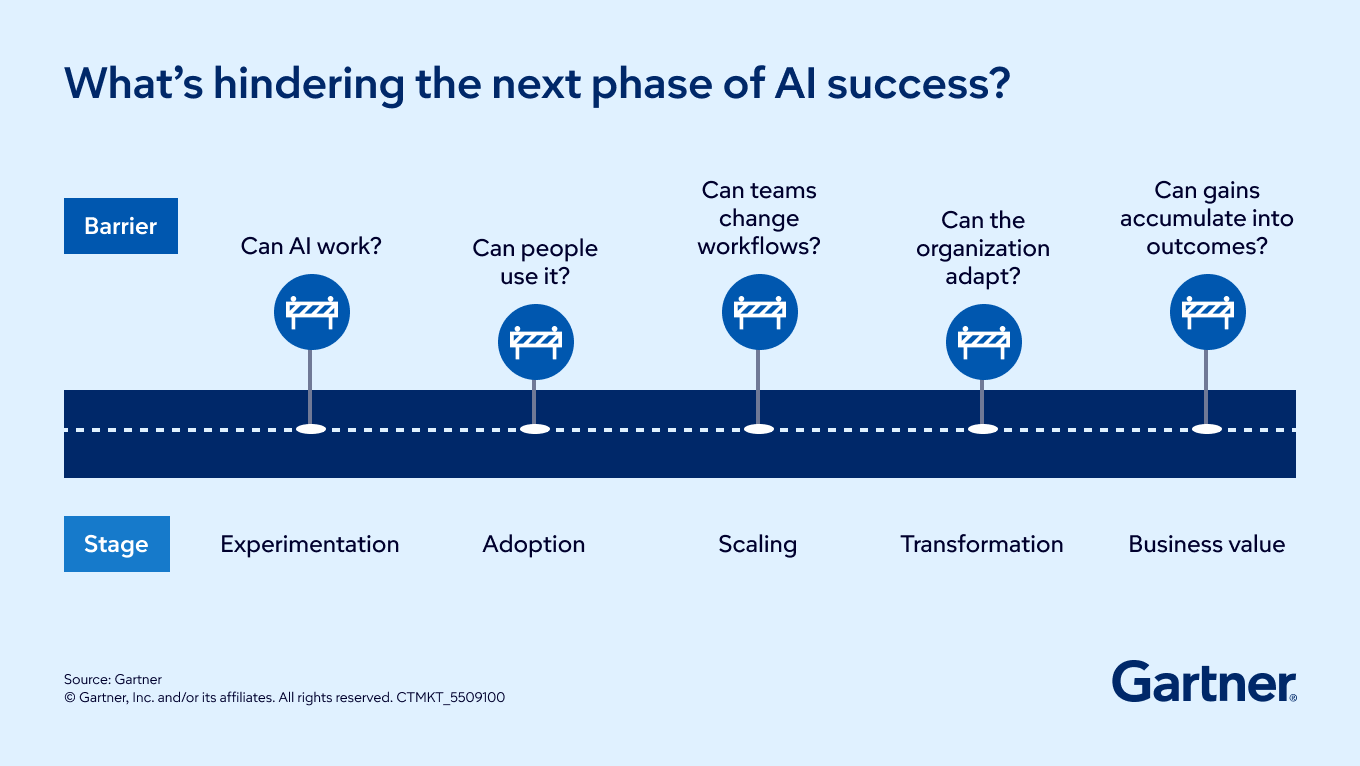
AI adoption is no longer the problem
Implementing new technology is often easier than changing the behaviors, processes and decisions that determine how work gets done. While marketing teams have embraced AI with remarkable speed, technology adoption and organizational transformation are not the same thing.
“Marketing organizations are rapidly moving beyond AI experimentation and discrete time savings. The challenge is now connecting isolated efficiencies into workflows and processes that produce meaningful gains,” says Joseph Enever, Vice President Analyst at Gartner.
For many CMOs, that shift marks the beginning of a different challenge. Demonstrating value through pilots and use cases is no longer enough. What matters next is whether the organization can turn isolated successes into a new way of working.
You might also like this webinar: How CMOs Can Lead AI Transformation to Adaptive Intelligence Marketing
AI transformation is an organizational challenge
Many marketing organizations have already demonstrated that AI can create value. Extending those gains across workflows, teams and operating models introduces a new set of barriers that many leaders underestimate.
Scaling AI requires organizational change
A successful pilot proves AI can work. However, scaling AI use cases requires marketing organizations to fundamentally change how work gets done. What succeeds in a controlled environment often becomes more difficult when teams must adopt new workflows, decision processes and operating norms at scale. The gap between proving value and operationalizing value is where many transformation efforts stall.
AI activity does not guarantee business value
AI activity is easy to mistake for AI transformation. Organizations can launch use cases, expand experimentation and increase adoption without materially changing business outcomes. The real test is whether individual gains accumulate into measurable value across the organization. When they do not, leaders are left with more AI activity than AI impact.
Technology moves faster than organizational change
Most barriers to AI transformation appear unrelated: adoption, scaling, governance, value realization and new operational demands. In reality, they stem from a common underlying tension. AI capabilities evolve rapidly, while organizations must adapt roles, processes and operating models to keep pace. This mismatch helps explain why many marketing organizations move quickly from experimentation to adoption, yet struggle to achieve transformation at scale. The organizations that create the most value from AI may not be those that adopt it first but those that adapt to its transformational effect the fastest.
FAQs
What is the biggest challenge in marketing AI transformation?
Many marketing organizations have already moved beyond AI experimentation. The greater challenge is scaling AI across the organization, realizing business value and addressing the organizational barriers that emerge as transformation efforts mature.
Why do AI pilots often fail to become enterprise transformation?
A successful pilot demonstrates that AI can work in a specific environment. Broader transformation requires changes to workflows, governance, operating models and ways of working across the organization.
How can CMOs improve AI value realization?
Organizations must look beyond adoption metrics and focus on whether AI-driven gains are producing measurable business outcomes. Realizing value at scale requires addressing challenges related to scaling, governance, impact and organizational change.
Attend a Conference
Join Gartner analysts and your peers to accelerate growth
Gather alongside your peers in Denver to gain insight on emerging trends, receive one-on-one guidance from a Gartner expert and create a strategy to tackle your priorities head-on.
7 – 9 Jun 2027
Gartner Marketing Symposium/Xpo™
Denver, CO

Drive stronger performance on your mission-critical priorities.