With limited budgets and rising expectations, CMOs must make sharper decisions to fund growth and AI transformation.
- Gartner client? Log in for personalized search results.
CMO Spend in 2026: Redefining Marketing Investment Under Constraint
By Ewan McIntyre and Rachel Dooley | June 25, 2026

CMOs face a sharpening set of trade-offs in 2026
In 2026, CMOs are operating in a sharply constrained environment defined by rising expectations, limited budget growth and accelerating pressure to deliver AI-driven transformation. Although marketing budgets have increased by 1.3% since 2025, this gain falls well short of enterprise ambition. Meanwhile, CMOs are facing intensifying pressure from leaders who expect them to drive AI transformation and deliver enterprise growth at a scale that 73% of CMOs describe as “high,” “very high” or “overly ambitious.”
As the gap widens between those who effectively deploy AI and those who lag behind, CMOs must actively rebalance investments toward innovation and adaptability. Those who fail to act risk losing strategic relevance — and becoming targets for future budget cuts.
You might also like this webinar: Exploring Strategic Insights From the Gartner 2026 CMO Spend Survey
The strategy behind CMO spend in 2026
CMOs are facing a trilemma: delivering more with limited resources, meeting higher expectations and addressing an urgent mandate for AI transformation. The path forward? A clear set of actions needed to manage risk and build sustained competitive advantage.
The state of marketing budgets in 2026
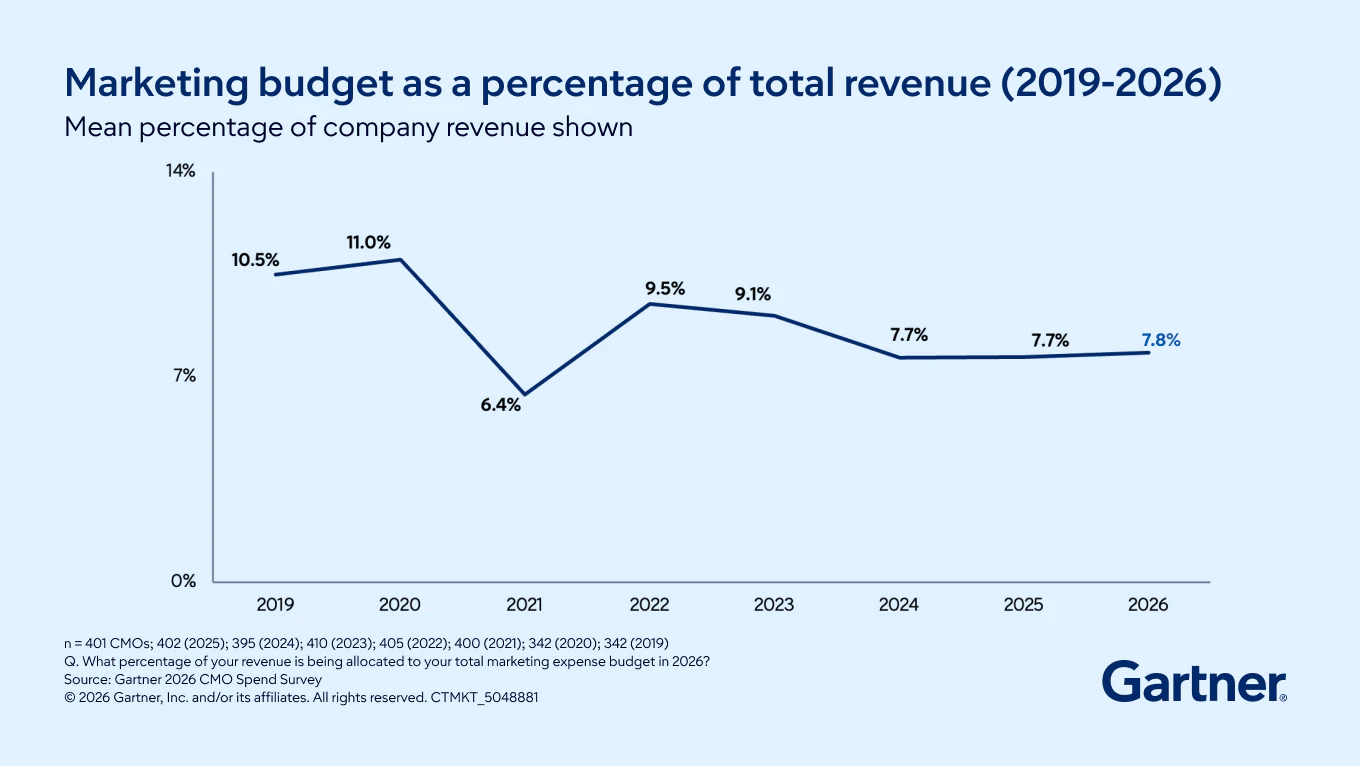
Marketing budgets have been on a plateau since 2022, with today’s average budget at just 7.8% of company revenue — which is 18% lower than the mean budget allocation just four years ago. This imbalance is already impacting performance, with fewer CMOs reporting that they are exceeding their targets and more falling short across acquisition, retention and ROI. As pressure intensifies, many organizations are slipping into a defensive posture at precisely the moment when bold action is required.
What should CMOs do?
Embed the trilemma into strategy: Manage investments as a portfolio across near-term performance, growth and future readiness, with clear targets for each.
Pressure-test all investments: Reset the bar for funding by evaluating programs against current market realities and expected return.
Make deliberate sacrifices: Eliminate low-value legacy spend and automate routine work to unlock the capital and agility needed to compete.
Marketing’s AI investments and capabilities
CMOs are investing heavily in AI, with 15.3% of budgets allocated to it. However, only 30% report mature AI readiness needed to scale effectively, leaving many stuck in early-stage execution. CMOs reporting mature AI readiness stand apart by operating as true AI strategists. They pull ahead by combining stronger capabilities, greater agility and sustained innovation, proving that advantage comes from how AI is operationalized, not just how much is spent.
What should CMOs do?
Become a competent AI strategist: Elevate AI fluency and close capability gaps.
Adopt an outcome-led approach: Define how AI delivers measurable value and align investments accordingly.
Reposition AI as a growth engine: Move beyond viewing AI as only an efficiency tool.
Focus on core capabilities to scale AI: Prioritize data foundations, process maturity and governance over fragmented tools and one-off pilots.
Investment trends in channels and resources
In 2026, CMOs are shifting spend toward paid media — now 31.4% of budgets — funded by cuts to agencies. Investment is increasingly focused on digital channels and customer acquisition, while loyalty and retention investment declines. These trade-offs may boost short-term performance but risk weakening long-term growth, especially as limited budget agility slows response to change.
What should CMOs do?
Build budget flexibility: Move to always-on, portfolio-based funding that shifts with performance.
Protect offline channels: Maintain investment in events and sponsorships that deliver differentiated brand experiences.
Refine measurement: Capture full-funnel impact beyond last-click attribution.
Rising uncertainty in tech and talent
CMOs face growing complexity as consumption-based martech pricing expands and AI talent gaps persist. While these models offer flexibility, they also introduce cost volatility and operational strain, forcing difficult trade-offs across resources.
What should CMOs do?
Rebalance AI investment toward people: Prioritize skills, training and hybrid teams to unlock AI value.
Manage consumption-based pricing: Monitor usage, renegotiate contracts and add controls to reduce cost volatility.
What’s next in CMO budget and strategy?
Reprioritizing marketing’s Investments in people, partners and technology is just one critical step in the CMO’s mandate to build an AI-powered marketing organization. According to Gartner, the other steps in this imperative include:
Building new marketing governance frameworks that support the changes AI will bring to people, processes and brand.
Identifying and prioritizing marketing’s agentic use cases to deliver the most value.
Setting your vision for AI-powered marketing by defining what an AI-powered team looks like and how that might be different from your current team.
Updating roles and structure to support AI integration in a hybrid-human AI team.
For more on how Gartner helps drive success on this and other mission-critical priorities for CMOs, speak to us today.
CMO spend FAQ
What is the CMO trilemma in 2026?
CMOs must simultaneously manage constrained budgets, rising growth expectations and pressure to deliver AI-driven transformation, with limited ability to optimize all three.
How should CMOs prioritize AI investments?
CMOs should focus on outcome-driven use cases, strengthen foundational capabilities and align AI investments to measurable business value rather than experimentation alone.
What differentiates an “AI strategist” CMOs from everyone else?
CMOs who move like an AI strategist combine higher investment with stronger process maturity, better data foundations and greater adaptability, enabling them to scale AI more effectively.
What is the most important shift CMOs must make in 2026?
CMOs should move from incremental optimization to deliberate reallocation — making disciplined trade-offs to fund innovation, build AI capability and sustain long-term growth.
Attend a Conference
Join Gartner analysts and your peers to accelerate growth
Gather alongside your peers in Denver to gain insight on emerging trends, receive one-on-one guidance from a Gartner expert and create a strategy to tackle your priorities head-on.
7 – 9 Jun 2027
Gartner Marketing Symposium/Xpo™
Denver, CO

Drive stronger performance on your mission-critical priorities.