An effective data, analytics and AI strategy connects investments to measurable enterprise outcomes.
- Gartner client? Log in for personalized search results.
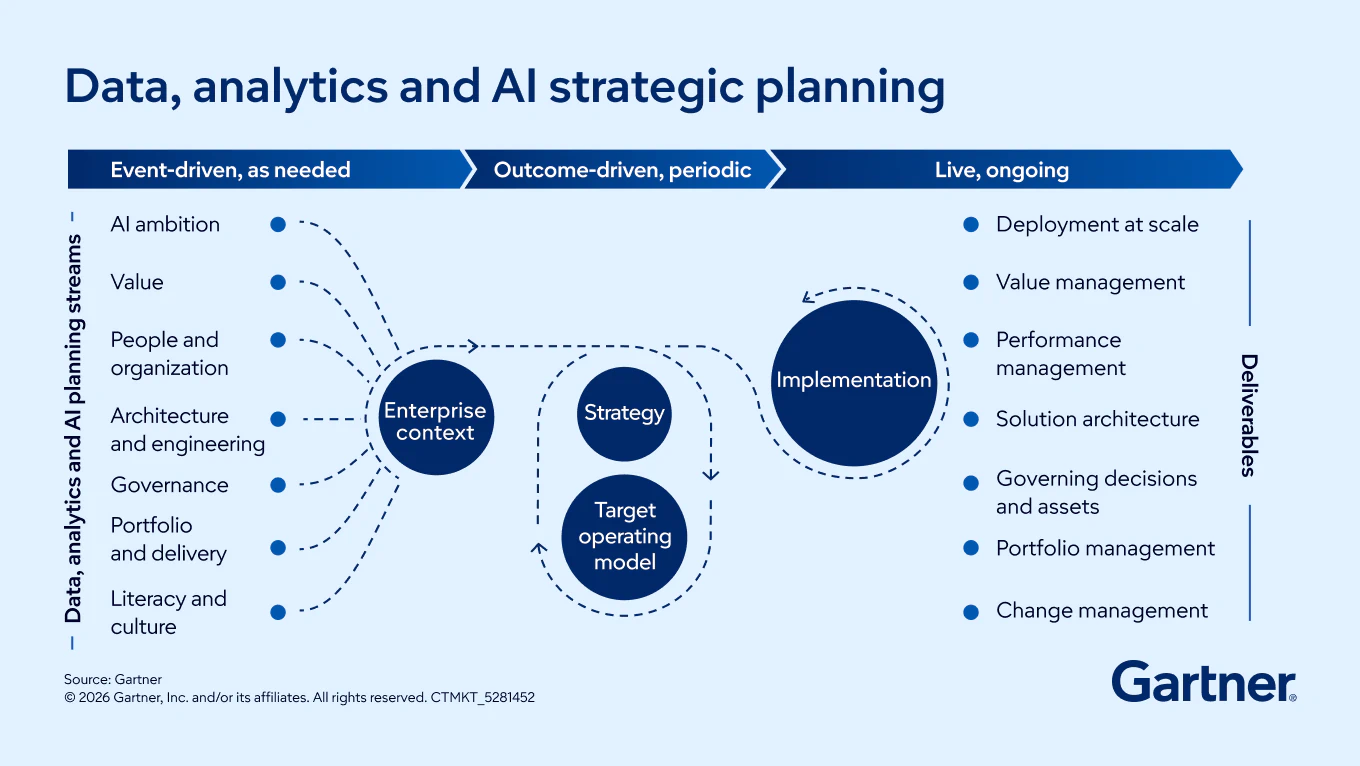
Strategic planning for data, analytics and AI initiatives
A successful data, analytics and AI (D&A/AI) strategy must be tightly aligned with business priorities and designed to adapt as those priorities evolve. Gartner finds that approximately 40% to 50% of D&A leaders struggle to deliver measurable business results on a wide range of mission-critical priorities, such as managing business costs, improving customer experience or increasing employee productivity. Michael Gabbard, Senior Director Analyst at Gartner, notes, “Data and analytics (D&A) leaders need to be simultaneously intentional and flexible in their strategic planning.”
You might also like this webinar: Data and Analytics 2030: The Vision for an AI‑Native Enterprise
Aligning D&A/AI with enterprise goals
Any effective D&A/AI strategy includes a clear understanding of enterprise goals and reflects the opportunities and challenges of the enterprise operating model.
Establishing enterprise context for D&A/AI
Gartner recommends beginning by mapping D&A/AI initiatives directly to overarching business priorities. This ensures that investments and activities are relevant and actionable. Leaders should communicate transparently and engage stakeholders proactively — even through constructive conflict — to show how D&A and AI investments drive enterprise success. You’ll know that stakeholders understand and value your message when they repeat and advocate your intentions and outcomes to others.
Developing the strategy
Once enterprise context is established, Gartner finds it is critical to define strategic intentions by setting specific goals and metrics. These guide decision making and enable leaders to track progress. It is critical to link D&A/AI activities directly to enterprise value, rather than treating them as isolated technical projects. When the strategy is linked to measurable business outcomes and actionable guidance, it will attract executive support and drive accountability.
Leaders should prioritize investments based on potential business impact and continuously update the strategy to respond to changing needs. Proactive stakeholder engagement is essential for maintaining alignment and relevance across the organization.
Designing and refining the operating model
A well-defined operating model is central to delivering value from D&A/AI initiatives. Leaders should design a target operating model that defines how work is executed across teams to deliver value. This model clarifies roles, responsibilities and workflows, helping organizations scale their D&A/AI efforts efficiently. Operations can be summarized with slide briefs, D&A capability maps, customer maps or value chain diagrams to demonstrate how work is interconnected and relies on shared capabilities.
Implementing feedback loops for continuous improvement and flexibility
As execution always involves uncertainty, it’s important to incorporate feedback loops to refine the strategy and operating model based on real-world outcomes and stakeholder input. By incorporating feedback, organizations can adapt quickly and ensure their D&A/AI initiatives remain effective. Gartner recommends maintaining flexibility throughout the planning and execution process with operating models that can be continuously updated as business needs evolve.
AI, data and analytics are increasingly critical to improving government performance and service delivery. Learn how public sector leaders are building modern operating models that drive better decisions, greater efficiency and measurable outcomes.
Data, analytics and AI strategy FAQs
How should data, analytics and AI strategy be aligned with business goals?
Gartner finds that mapping D&A/AI initiatives directly to enterprise priorities ensures relevance and maximizes business impact. Leaders should communicate intentions transparently and proactively engage stakeholders.
What are the key phases of a robust data, analytics and AI strategy?
According to Gartner, the four key phases are establishing enterprise context, developing a strategy, designing a target operating model and implementing feedback loops for continuous refinement.
Why is flexibility important in data, analytics and AI strategic planning?
Gartner recommends maintaining flexibility so that the strategy and operating model can be continuously updated to respond to changing business requirements and maximize sustained outcomes.
Attend a Conference
Accelerate growth with Gartner conferences
Gain exclusive insights on the latest trends, receive one-on-one guidance from a Gartner analyst, network with a community of your peers and leave ready to tackle your mission-critical priorities.

Drive stronger performance on your mission-critical priorities.