Permanent disruption requires general counsel to enable growth while managing risk at the speed of business.
- Gartner client? Log in for personalized search results.
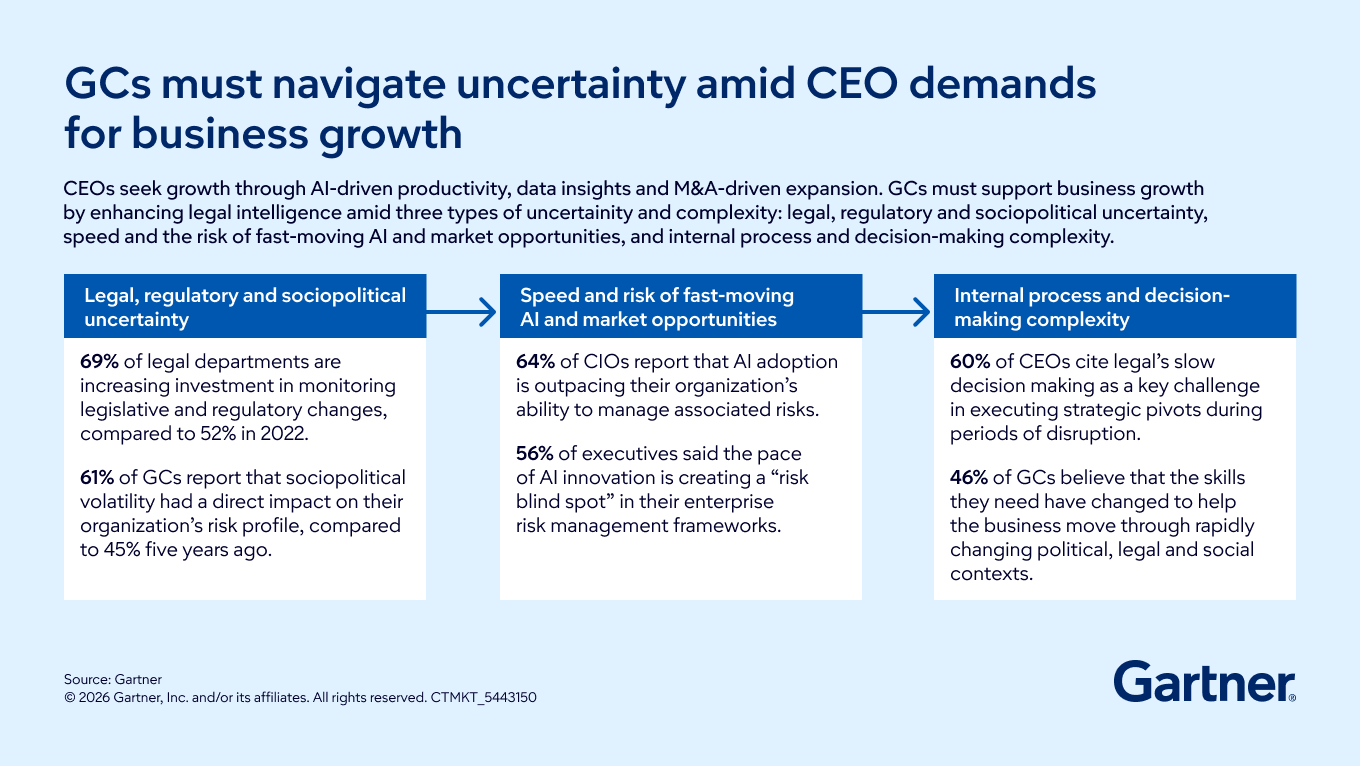
The traditional GC role is no longer enough
The general counsel (GC) role has reached an inflection point. Macroeconomic volatility, AI-driven business models and regulatory uncertainty have created a level of complexity that traditional legal operating models were not designed to address. As CEOs pursue growth through AI, data-driven insights and strategic expansion, legal departments face increasing pressure to support the business without slowing it down.
At the same time, legal functions must contend with growing uncertainty. According to the Gartner 2024 CEO and Senior Business Executive Survey, 60% of CEOs cite slow legal decision making as a key challenge in executing strategic pivots. The result is a growing tension: Businesses need legal guidance more than ever, yet many leaders still view legal as an obstacle to execution during periods of rapid change.
“GCs cannot ask the business to slow down; they must manage risk at the speed of innovation,” says Chris Audet, Vice President Analyst at Gartner.
GCs can no longer treat disruption as a series of isolated events. They must operate as though disruption is the norm, redesigning governance, risk management and legal service delivery accordingly.
You might also like this webinar: 5 Ways General Counsel Must Evolve Their Leadership in 2027
How GCs can evolve for permanent disruption
To remain effective amid ongoing disruption, GCs must rethink how legal contributes to business success. Gartner highlights several shifts that can help legal departments support growth while strengthening risk management.
Shift from crisis response to organizational resilience
Many legal departments still structure teams, workflows and priorities around responding to individual events. Gartner warns that this approach creates blind spots when disruption becomes continuous rather than episodic.
Instead, GCs should build what Gartner calls “disruption response IQ” by identifying common response patterns across different types of disruptions. This allows legal teams to anticipate issues, refine their response capabilities and become more effective with each new challenge.
The goal is to create adaptive systems that prioritize resilience rather than risk containment alone. By learning from recurring disruptions, legal departments can respond more efficiently while continuing to support business objectives.
Make governance operate at the speed of business
As AI adoption accelerates and business environments change rapidly, governance structures must evolve. The challenge is to create governance systems that can identify emerging risks quickly enough to keep pace with continuous change.
GCs cannot simply add more oversight layers to existing processes. They must work with cross-functional risk leaders to develop continuous risk monitoring approaches that support faster decision making. Gartner recommends empowering frontline risk owners to act on key risks while establishing clear escalation triggers and decision criteria.
Embedding risk guidance directly within business workflows allows organizations to monitor and manage risk in real time rather than relying on periodic reviews. This shift enables governance to become more adaptive as business conditions evolve.
Remove decision bottlenecks that slow strategic execution
According to Gartner, legal departments often underestimate their contribution to decision complexity and strategy-to-execution gaps. During periods of disruption, stakeholders increasingly rely on legal guidance, creating chokepoints precisely when organizations need to move quickly.
To address this challenge, GCs should codify risk tolerance, clarify escalation pathways and encourage appropriate risk ownership across the business. At the same time, they should streamline legal and compliance processes through standardized workflows, automation and clear guidance.
Gartner also emphasizes the need for GCs to establish AI governance rules, processes and oversight mechanisms that balance AI use with business needs and risk appetite. Done effectively, this allows legal to become a strategic enabler of innovation rather than a barrier to execution.
General counsel priority FAQs
Why is GC priority changing amid permanent disruption?
According to Gartner, AI-driven business models, regulatory volatility and ongoing disruption are forcing GCs to move beyond traditional risk containment. Legal departments must support growth, accelerate decisions and manage risk at the speed of innovation.
What is the biggest GC priority in a disruptive business environment?
Gartner indicates that GCs must evolve into proactive strategic enablers by simplifying decision making, supporting AI-driven innovation and delivering legal services at the speed of business while maintaining appropriate risk oversight.
How can GCs improve effectiveness as a business partner?
Gartner recommends building disruption response IQ, evolving governance structures to support continuous risk monitoring and streamlining legal processes that create decision bottlenecks. These actions help legal functions contribute more effectively to business outcomes.
Attend a Conference
Join Gartner analysts and your peers to accelerate growth
Gather alongside fellow leaders in Grapevine, TX to gain insight on emerging trends, receive one-on-one guidance from Gartner experts and create a strategy to tackle your priorities head-on.
5 – 6 Oct 2027
Gartner Enterprise Risk, Audit & Compliance Conference
Grapevine, TX

Drive stronger performance on your mission-critical priorities.