Poor organizational design is preventing AI from delivering strategic value.
- Gartner client? Log in for personalized search results.
Why more intelligence isn’t creating better decisions
Marketing leaders are frustrated. Although their organizations invest heavily in AI, data, analytics and research, they still struggle to turn intelligence into actionable and differentiated insights. More information is not automatically creating more strategic clarity. One root cause is a disconnect between the teams responsible for generating intelligence. “Disparate teams — customer insights, market research and marketing analytics — prevent CMOs from leveraging all data sources and AI's powerful ability to synthesize information into effective and actionable recommendations,” says Sally Witzky, Vice President Analyst at Gartner.
You might also like this webinar: Humans, Machines and the Marketing Org: How AI Rewrites Roles, Workflows and Culture
AI is exposing a marketing operating model problem
AI improves an organization’s ability to analyze, connect and synthesize information. But it also exposes weaknesses in organizational structures that were never designed to support unified intelligence. The challenge is no longer generating more intelligence, but ensuring it can move across the organization to inform decisions.
Fragmented intelligence produces fragmented decisions
Many marketing teams separate customer insights, market research, competitive intelligence and analytics into independent teams. Each function generates valuable information. Yet when those teams operate in isolation, leaders often receive disconnected recommendations rather than a coherent strategic perspective. According to Gartner, lack of collaboration between insights and analytics teams creates inefficiencies, reduces effectiveness and increases competitive risk. Fragmented intelligence structures make it harder to identify patterns, connect signals and generate differentiated recommendations that support growth.
AI amplifies the cost of organizational silos
AI’s greatest strength is not simply data analysis. It is the ability to synthesize information from multiple sources and transform it into actionable insights. That creates a growing challenge for organizations operating in silos. “The problem of having disparate microteams only gets worse with time and the increased ability for AI to synthesize data from all sources for ongoing insights infusion,” says Sally Witzky. A fragmented insights structure hinders strategic, data-driven marketing because information remains distributed across disconnected teams. As a result, organizations struggle to generate the unified perspective required to support faster, more informed and objective decision making.
Growth depends on turning intelligence into action
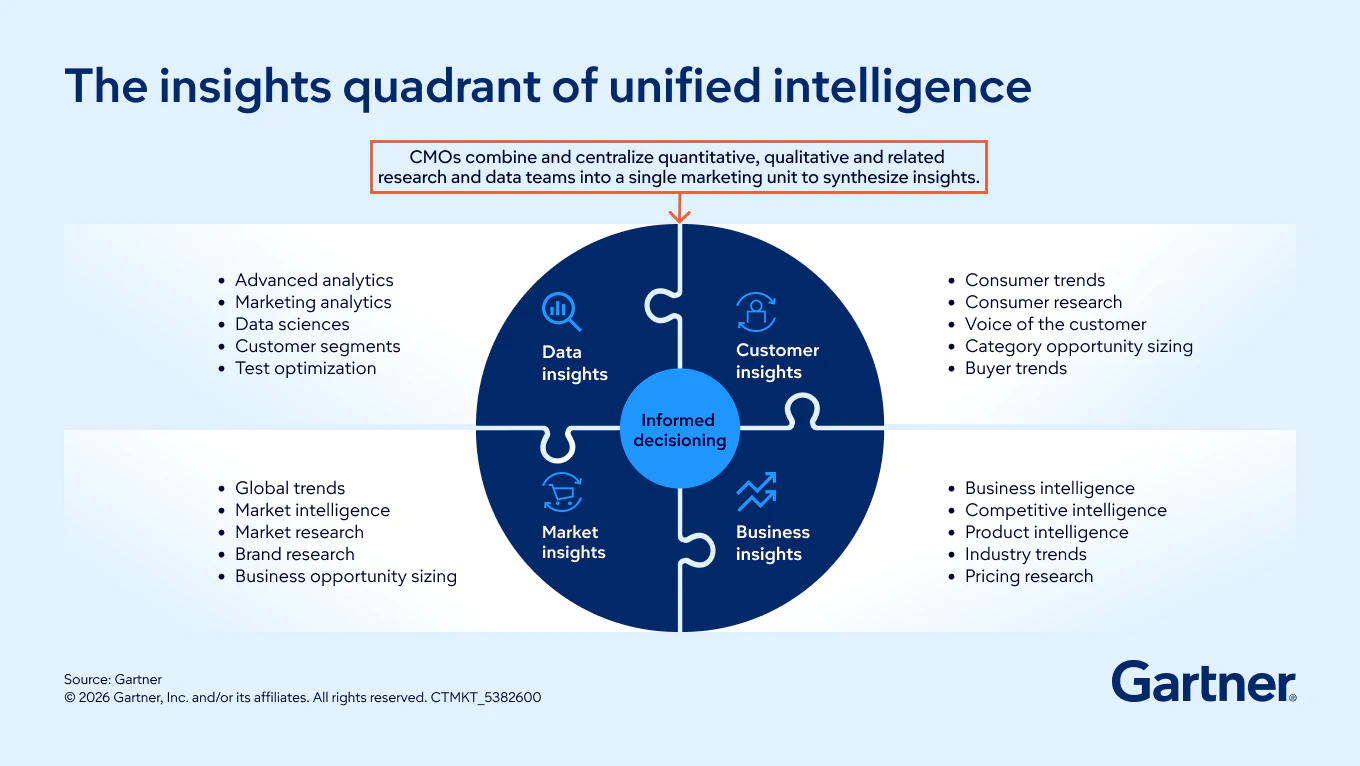
The ability to turn intelligence into action is becoming a greater competitive advantage than collecting intelligence itself. Marketing teams should be centralizing customer insights, market research, marketing analytics and competitive intelligence under a unified insights leader. The objective is not organizational efficiency alone. It is creating a single intelligence function capable of synthesizing inputs, generating differentiated recommendations and embedding insights into campaigns and strategic decision making. “Most importantly, a central insights unit can fully leverage AI to do much of the work and focus the human intelligence toward consulting with business partners and strategist to drive growth, lead innovation and enhance the customer experience,” says Witzky.
Marketing org structure FAQs
Why aren’t more marketing insights creating better decisions?
According to Gartner, fragmented insights, research and analytics teams often generate disconnected and biased recommendations. Without a unified intelligence function, organizations struggle to synthesize information into strategic direction and action.
How does AI affect marketing organization structure?
AI increases the value of synthesis across multiple information sources. Organizations that operate with fragmented intelligence teams may struggle to realize the full value of AI because information remains dispersed rather than integrated.
Why are CMOs centralizing insights teams?
Gartner recommends centralizing customer insights, market research, competitive intelligence and marketing analytics under one leader. Centralization enhances data synthesis and facilitates the integration of synthetic data, thereby strengthening collaboration across teams. This unified approach enables organizations to generate broader, actionable insights and recommendations, ultimately supporting AI-driven growth initiatives.
Attend a Conference
Join Gartner analysts and your peers to accelerate growth
Gather alongside your peers in Denver to gain insight on emerging trends, receive one-on-one guidance from a Gartner expert and create a strategy to tackle your priorities head-on.
7 – 9 Jun 2027
Gartner Marketing Symposium/Xpo™
Denver, CO

Drive stronger performance on your mission-critical priorities.