AI transformation requires new routines, not just new tools.
- Gartner client? Log in for personalized search results.
The biggest barriers to AI adoption across the supply chain
People naturally fall back on familiar behaviors, especially during periods of uncertainty and change. That tendency is creating a major obstacle for supply chain leaders trying to scale AI adoption. “Regardless of the quality of training programs or the sophistication of AI tools, human adoption remains the primary limiting factor for AI success,” says Corwin Hee, Senior Director Analyst at Gartner.
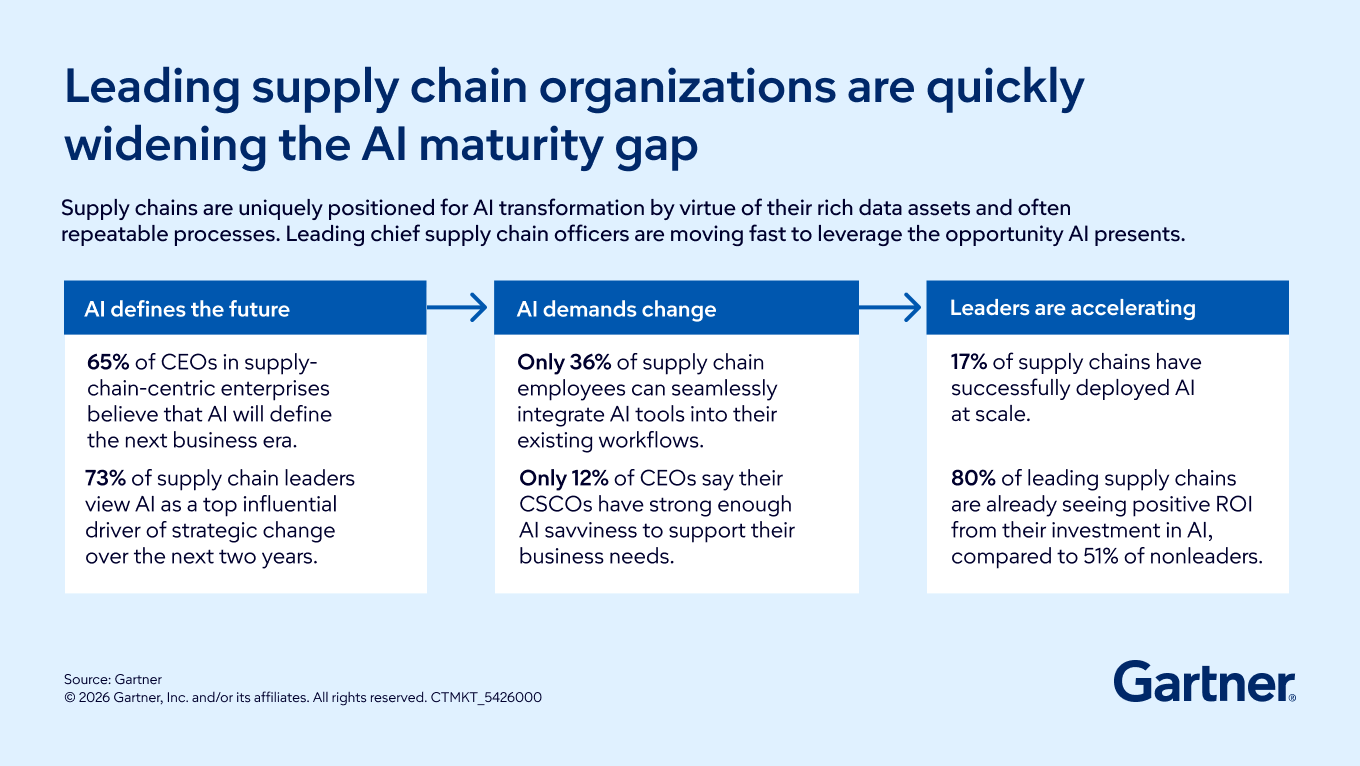
According to Gartner, only 17% of organizations have successfully deployed AI at scale, and human adoption remains the primary limiting factor for success. More than half of organizations in the 2025 Gartner AI Adoption in Supply Chain Survey report difficulty integrating AI into existing operations because they are attempting to layer AI onto workflows and technologies that were never designed for it.
You might also like this webinar: Building AI as the Foundation for Supply Chain Competitive Advantage


Supply chain AI transformation requires new ways of working
Successful supply chain organizations intentionally create new habits that make AI the default way work gets done.
Create new cues for AI-first behaviors
Habits begin with cues. To encourage AI adoption, connect AI to everyday workflow frustrations rather than abstract technology training.
Gartner recommends anchoring AI learning to “work frictions” that make tasks unnecessarily difficult. When employees see how AI helps solve real problems, adoption rates increase because the technology becomes associated with immediate value rather than organizational mandates.
Organizations can reinforce these cues through collaborative learning experiences such as flipped-classroom models, where employees bring real workflow challenges into training sessions and actively brainstorm how AI can help address them. This creates a direct connection between AI adoption and business outcomes.
Make AI the default routine
Changing habits requires changing routines. Rather than treating AI as an optional tool, Gartner recommends redesigning workflows so AI becomes the default path for routine activities. As AI becomes embedded in documentation, dashboards and everyday decision-making processes, employees are more likely to integrate it into their work.
Strengthen these new routines through peer learning cohorts and regular opportunities for employees to share how they use AI in practice. When employees see peers successfully incorporating AI into their work, adoption becomes more normalized and sustainable. Gartner also recommends linking AI skill development to career growth and performance conversations, reinforcing the role AI plays in future success.
Reinforce AI adoption through visible rewards
New habits remain fragile unless organizations reinforce them. According to Gartner, recognition programs, visible rewards and public celebration of AI success help employees sustain new behaviors over time. Examples include AI-focused awards, town hall recognition and opportunities to showcase successful use cases.
Supply chain leaders should also clearly communicate how AI-created capacity will be reinvested into higher-value work. Employees are more likely to embrace AI when time savings lead to more strategic, creative and fulfilling responsibilities rather than uncertainty about their future role. Reinvesting that capacity completes the habit loop and helps transform short-term adoption into lasting behavioral change.
AI adoption FAQs
Why do so many AI initiatives struggle after deployment?
According to Gartner, human adoption remains the primary barrier to AI success. Many organizations deploy AI into workflows and routines that were not designed to support it, making it difficult for employees to change established behaviors.
Why is AI adoption a habit problem?
Gartner finds that people naturally fall back on familiar routines. Successful AI adoption requires organizations to intentionally reshape cues, routines and rewards so AI becomes part of everyday work rather than an occasional tool.
How can CSCOs improve AI adoption?
CSCOs should create AI-first habits by connecting AI to real workflow challenges, redesigning routines so AI becomes the default path and reinforcing adoption through visible rewards and recognition.
Attend a Conference
Experience Supply Chain conferences
With exclusive insights from Gartner analysts on the latest trends, sessions curated for your role and unmatched peer networking, Gartner conferences help you accelerate your priorities.
3 – 5 May 2027
Gartner Supply Chain Symposium/Xpo™
Orlando, FL

Drive stronger performance on your mission-critical priorities.