Create a balanced network that performs today and adapts tomorrow.
- Gartner client? Log in for personalized search results.
Move from trade-offs to balance in supply chain network design
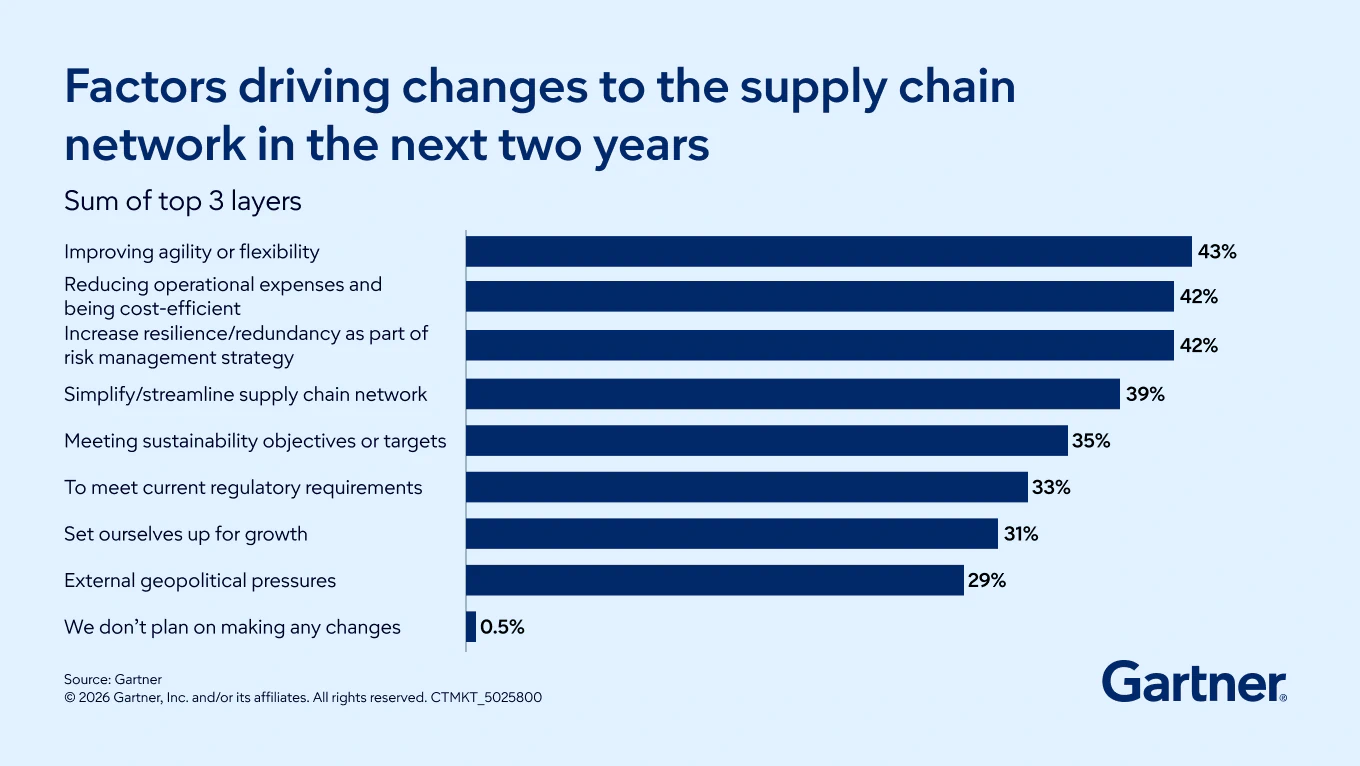
Supply chain network design is at a crossroads. Historically, organizations relied on a cost-effective one-size-fits-all approach, but that no longer works as well in today’s volatile environment. In response, many supply chain leaders are now recalibrating their networks to emphasize resilience and agility, but favoring any single objective introduces new trade-offs. While overweighing cost optimization limits flexibility, overfitting to resilience can erode competitiveness and increase redundancy. The implication is clear: cost, resilience and agility must now be balanced, not traded off. To enable this shift, move from static designs to principle-driven network strategies that evolve as conditions change.
You might also like this webinar: Build a Supply Chain Network That Withstands Turbulence
A supply chain network that performs well over the long term balances objectives beyond cost. The below framework helps leaders design a more balanced network that remains effective in today’s volatile supply chain landscape.
Build a resilient, adaptive supply chain network
Define supply chain network design principles
When redesigning a supply chain network, consider both business goals and changes in the operating environment. Strong organizations clearly prioritize objectives such as cost, service and agility for each business segment, using input from across functions to understand trade-offs and future needs. At the same time, supply chain leaders should factor in shifts in company strategy and external uncertainty, like growth plans, tariffs and geopolitical risk. These inputs are then combined into network principles — simple, flexible guidelines that help teams make consistent decisions across different parts of the organization. The principles then shape a high-level network blueprint that provides direction while allowing for change.
Develop a network transition plan
A clear adaptable roadmap should translate strategic objectives and principles into actionable steps forward. Developing one is a critical step in implementing future-state network strategy and can be accomplished through a structured two-step process.
Step 1: Prioritize network change initiatives
Prioritize network initiatives based on their expected impact, feasibility and alignment with business goals. Evaluate each initiative using not only cost savings but also measures such as resilience and agility. Use insights from network analytics to identify which changes are most critical and strategically aligned.
Step 2: Sequence changes based on internal and external factors and constraints
Sequence initiatives in a logical order by accounting for dependencies and practical constraints across the network. Consider factors such as labor availability, supplier capacity, regulations and internal resource readiness when determining timing. Align implementation with external conditions and operational realities, such as lease expirations or facility performance, to minimize cost and disruption.
Conduct scheduled reviews to reprioritize, as necessary
Establish a regular cadence — at least annually and after major events — to review and reprioritize your network strategy based on updated conditions. This involves validating original assumptions, quantifying any gaps and assessing their impact on the network design. In most cases, the outcome is not a full redesign but targeted adjustments, such as reordering initiatives or investments, while the overall strategy remains intact.
What to do next to redesign your supply chain network
Relentless shifts in cost expectations are redefining how supply chains generate enterprise value, creating new opportunities for CSCOs to engineer profitable performance while navigating evolving mandates. That shift represents the starting point of a broader journey CSCOs must lead to fully deliver on the mission‑critical priority of engineering profit amid shifting cost mandates.
The steps in that journey include:
Aligning with the enterprise on strategic intent — including, where needed, cost model restructuring by proactively partnering across the business and making informed trade‑offs across the operational network, workforce and strategic levers to address evolving cost expectations
Applying existing or investing in new technologies to expand and improve cost management, harnessing advanced tools that enhance visibility, predictive insights and margin‑focused decisions to drive profitable growth across the end‑to‑end supply chain
Enhancing C‑Level perceptions of supply chain as a profitable growth partner by demonstrating supply chain’s direct contribution to margin improvement, competitive advantage and enterprise value creation
Planning and executing profitable performance that optimizes across cash, cost, service and growth, aligning with business leaders on operating plans that balance financial outcomes, risk and reliability while meeting customer experience and growth commitments
Responding to top‑down cost improvement mandates by collaborating with the C‑suite to rapidly interpret shifting expectations, prioritize savings opportunities and clearly communicate their impact while safeguarding service levels and future capabilities
Supply chain redesign FAQs
What are supply chain network design principles?
They are simple, flexible guidelines that help organizations make consistent decisions about the end-to-end supply chain network. These principles act as guardrails, ensuring day-to-day decisions stay aligned with long-term strategy.
What does it mean to balance multiple objectives?
It means designing a network that manages costs while maintaining the flexibility to respond to disruptions and adapt to change. Rather than optimizing for a single objective, leaders must work to balance all three.
How do you prioritize supply chain network changes?
Leaders prioritize initiatives based on impact, feasibility and alignment with business goals. This typically includes evaluating both financial and strategic benefits.
Attend a Conference
Experience Supply Chain conferences
With exclusive insights from Gartner analysts on the latest trends, sessions curated for your role and unmatched peer networking, Gartner conferences help you accelerate your priorities.
3 – 5 May 2027
Gartner Supply Chain Symposium/Xpo™
Orlando, FL

Drive stronger performance on your mission-critical priorities.