Supply chain leaders must design decisions that work within uncertainty rather than wait for it to subside.
- Gartner client? Log in for personalized search results.
When uncertainty outlasts decisions
Most supply chain leaders would rather postpone a major decision than commit to one based on uncertain assumptions. For decades, that instinct often worked because uncertainty was temporary. However, many organizations are now finding that uncertainty persists longer than the decisions themselves.
“Trade and tariff changes, geopolitical disruption, demand volatility, supply constraints, technology adoption and cost pressures can all affect decisions about sourcing, capacity, inventory, network design and transformation investments. Yet many organizations still treat these uncertainties as assumptions to monitor rather than as factors that should shape the decision itself,” says Kevin Miceli, Director Analyst at Gartner.
As a result, assumptions that once remained stable throughout execution may now change before implementation is complete.
You might also like this webinar: Build a Supply Chain Network That Withstands Turbulence
Persistent uncertainty changes the nature of decision making
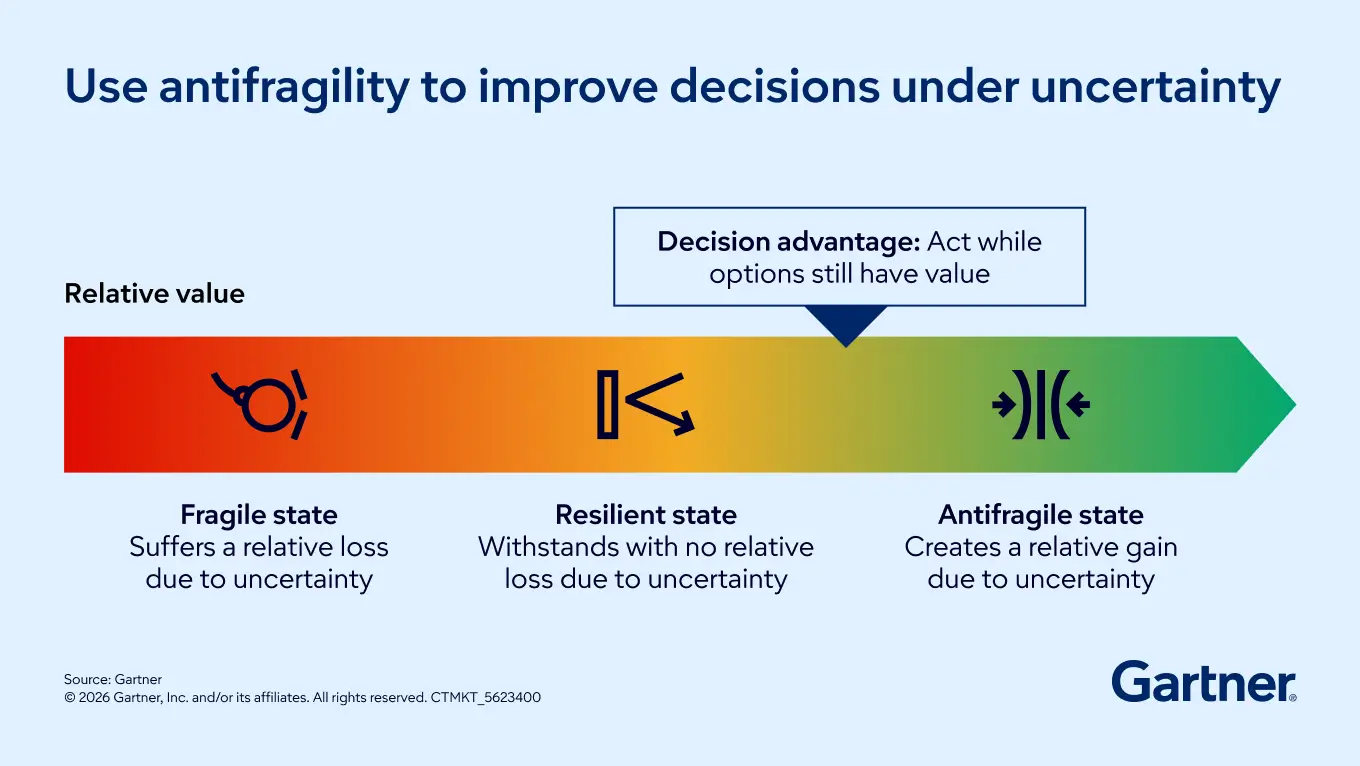
When assumptions can change before execution, competitive advantage comes less from predicting the future correctly and more from building decisions that remain effective across multiple futures. Rather than optimizing for a single expected outcome, supply chain leaders benefit from understanding how decisions perform as conditions evolve.
Build decisions around assumptions, not predictions
Under persistent uncertainty, the most dangerous part of a decision is often the assumptions hidden inside it. Supply chain leaders should start by identifying the assumptions that determine whether a decision succeeds or fails. A network redesign may assume transportation costs remain stable. A sourcing strategy may assume tariffs remain unchanged. A capacity investment may assume demand follows expected growth patterns.
Organizations that explicitly identify and test these assumptions gain a clearer view of where decisions remain viable and where they become vulnerable. Decision quality increasingly depends on understanding which assumptions matter most.
Test decisions across futures, not forecasts
Many organizations rigorously test products, technologies and processes before deployment but apply less discipline to strategic decisions. The objective is to make decisions that remain effective as assumptions evolve. Leaders can evaluate decisions against multiple futures, including demand shifts, trade disruptions, rising costs and capacity constraints, to understand where they remain effective and where they become vulnerable.
Preserve flexibility where uncertainty matters most
Persistent uncertainty does not require organizations to keep every option open. In fact, attempting to maintain flexibility everywhere can slow execution and dilute resources. The more effective approach is selective flexibility: preserving options in areas where uncertainty could materially change outcomes while committing decisively where conditions are more stable.
For example, leaders may lock in network investments while maintaining alternative sourcing strategies or preserve multiple supplier options while standardizing other parts of the supply chain. Effective decision making comes not from maximizing flexibility, but from applying it deliberately where uncertainty has the greatest potential impact.
Frequently asked questions
How does persistent uncertainty change supply chain decision making?
Persistent uncertainty increases the likelihood that key assumptions change before decisions are fully executed. As a result, leaders benefit from focusing on decision resilience, assumption management and flexibility rather than relying exclusively on forecast accuracy.
Why isn’t better forecasting enough?
Forecasts remain important, but persistent uncertainty can cause underlying assumptions to change before decisions are fully implemented. Organizations gain advantage when decisions can remain effective across multiple potential futures rather than depend on a single forecast proving correct.
What is selective flexibility?
Selective flexibility is the practice of preserving options only in areas where uncertainty could materially affect outcomes while committing decisively in areas that are more stable. This approach helps organizations balance adaptability with execution speed and resource discipline.
Attend a Conference
Experience Supply Chain conferences
With exclusive insights from Gartner analysts on the latest trends, sessions curated for your role and unmatched peer networking, Gartner conferences help you accelerate your priorities.
3 – 5 May 2027
Gartner Supply Chain Symposium/Xpo™
Orlando, FL

Drive stronger performance on your mission-critical priorities.