Marketing Predictions for 2026

Introduction

AI has significantly transformed the nature of marketing’s role inside the function and across customer experiences. The 2026 Mainstream Marketing Predictions highlight five pivotal shifts CMOs must prepare for, from agentic AI transforming journeys to ambient devices redefining brand discovery.

These predictions provide near-term signals (1–3 years) and practical actions to protect trust, reorganize teams, and prioritize investments. Use them to inform quarterly planning and your long-term roadmap so you can move faster, spend smarter, and outpace competitors.

Key Findings

  • AI agents will evolve into persistent digital concierges, seamlessly spanning marketing, sales, and support. This shift will collapse traditional channel strategies and redefine how campaigns are executed.

  • The share of social content at the top of the search engine results page (SERP) more than doubled between 2024 and 2025, with AIO sources now accounting for the majority of the top three organic search results, further underscoring the importance of social content to overall brand visibility and relevance.

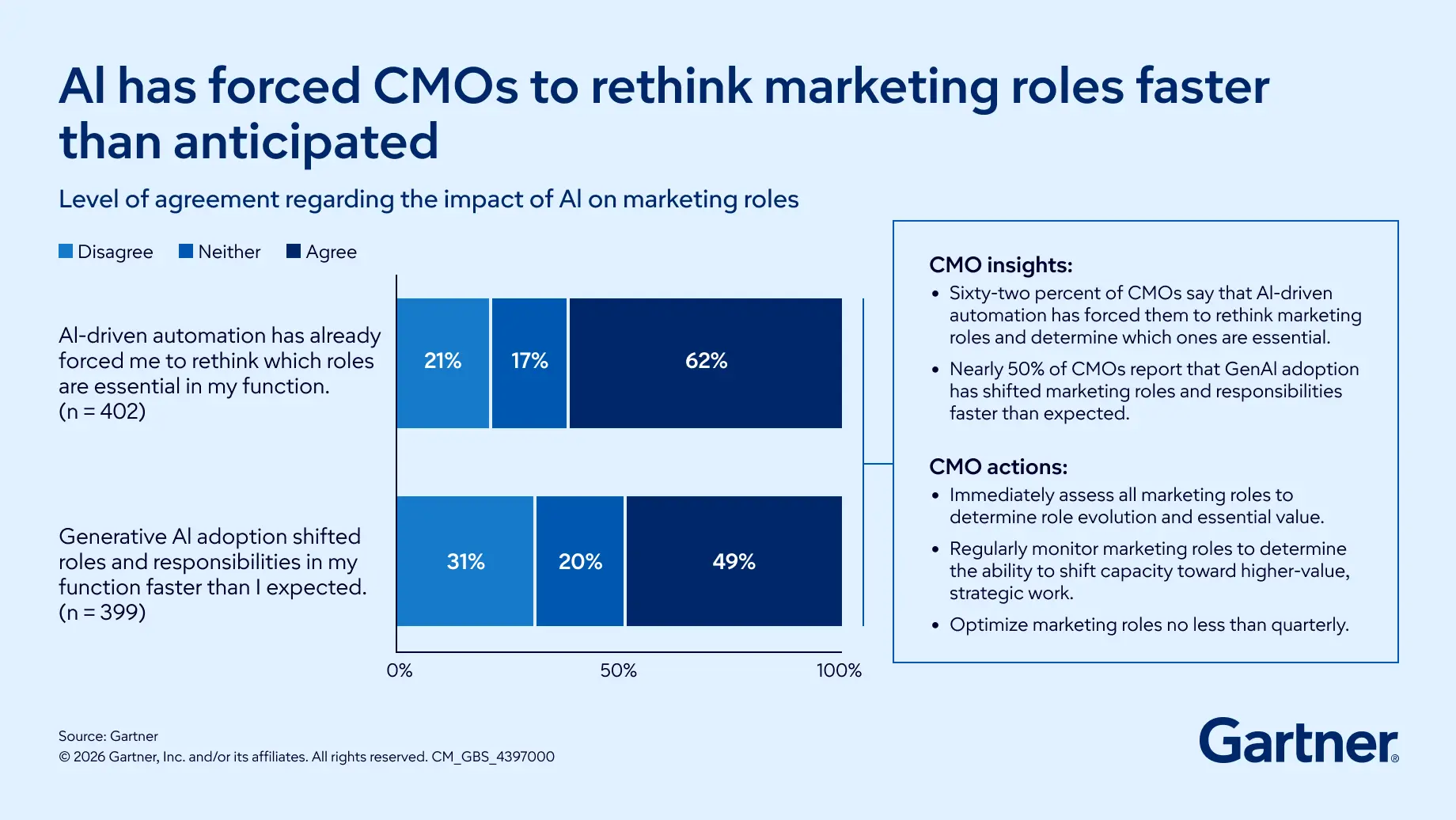
  • Sixty-two percent of CMOs say that AI-driven automation has already forced them to rethink essential roles, and flatten organizational structures to accommodate hybrid human and agent job roles.

  • Many ambient IoT devices are projected to integrate capabilities like real-time image and video analytics, enabling improved personalization through the use of contextual cues. GenAI is being tightly infused with the main platforms/operating systems that run personal tech devices to integrate these capabilities.

  • Marketers are betting big on B2C agentic commerce solutions, but consumers are not so sure: nearly two-thirds think GenAI-powered shopping tools, whether provided by retailers or by GenAI platforms, will make biased shopping recommendations.

Recommendations

  • Prepare to enable agentic systems by having data, content, and context governance in place now, to interact with customers securely and ethically in the future. This includes accounting for the total cost of ownership of each agent.

  • Secure social strategy in changing AI search-powered environments by investing in clear signals of authenticity, such as third-party verification, transparent content labeling, and ongoing monitoring of creator engagement quality to ensure trust, regulatory compliance, and sustained brand alignment.

  • Begin to apply the principles of composability over the next two quarters and schedule time to make small, incremental organizational and operational changes to avoid having to conduct a major restructure.

  • Take ownership over how customer data is managed and communicate transparently about the use of AI to engage customers, offering clear opt-outs and data usage policies to bridge the trust gap.

  • Encourage rationality within the organization. The potential of agentic commerce is exciting, but the audiences most ready to adopt may not represent the most important customer targets for the business.
Strategic Planning Assumption(s)

  1. By 2028, 60% of brands will use agentic AI to facilitate streamlined one-to-one interactions, collapsing channel-technology architectures and redefining customer journeys.

  2. By 2027, brands will allocate 50% of their influencer marketing budget to content and creator authenticity initiatives to optimize engagement and monetization in AI search environments.

  3. By 2028, 50% of CMOs will shift to a fully composable marketing organizational structure, with AI-dependent teams working in a self-reliant resource ecosystem.

  4. By 2028, 30% of consumer brand experiences will be delivered through ambient smart devices, fundamentally reshaping brand engagement strategies.

  5. By 2030, less than 10% of e-commerce revenue will originate from GenAI-powered shopping tools for consumer use due to limited adoption.

Analysis

What You Need to Know

The agentic-driven marketing function has arrived, and the conditions it presents are as promising as they are precarious. CMOs must strike a balance between creating space for experimentation and demonstrating tangible results to the enterprise.

The 2025 Gartner Marketing Transformation Survey revealed that two-thirds (65%) of CMOs believe AI will dramatically change the role of the CMO within two years. Gartner’s mainstream marketing predictions for 2026 to 2030 (see Figure 1) provide signals for how CMOs and their organizations will need to reinvent their operating models, team composition, and customer journeys to deliver value to both customers and the business as an AI-powered function.

This year’s marketing predictions, if they come to fruition, will make trust-building and adaptability crucial cornerstones of CMO strategy for the next five years. CMOs and their teams will need to be flexible enough to make frequent adjustments to their operations and customer engagement strategies, while maintaining robust governance structures to ensure data accuracy and authenticity are maintained.

Marketing Prediction 1

By 2028, 60% of brands will use agentic AI to facilitate streamlined one-to-one interactions, collapsing channel-technology architectures and redefining customer journeys.

Analysis by: Suzanne Schwartz, Nicole Greene

Key Findings:

  • Fifty-six percent of U.S. consumers agree they will or already have embraced AI, up from 48% in 2023.

  • Over half of marketing technology leaders are currently piloting AI agents.

  • Multichannel marketing vendors now offer conversational APIs for unified channel access, real-time interactions (email, mobile), and dynamic experiences. These features will improve the ability for data and business processes to be accessed by agents in the future.
  • Gartner forecasts that the AI apps and agent space will grow from $83.6 billion dollars in 2024 to $512 billion in 2029, a five-year CAGR of 43.7%.

Market Implications:

AI currently optimizes omnichannel experiences by analyzing behavior to recommend content, automate tasks, and guide next best actions, thereby enabling personalized interactions that let organizations respond to customer needs with unprecedented agility. In the future, AI agents will facilitate one-on-one interactions, including automating orders, proactively notifying customers of product or service updates, and customizing financial recommendations across payment options and investment guidance.

As AI agents become more autonomous, they will learn from each interaction to deliver even more refined future customer engagements. As a result, marketing will shift from rigid, app-specific martech interfaces to AI agent-driven protocols that orchestrate customer engagement. The quality of API data will bridge martech systems (e.g., CDPs, CMS, personalization engines, multichannel hubs, adtech). These fluid, agent-centric architectures will replace costly legacy integrations and redefine the roles of marketers. Instead of launching campaigns, marketers will oversee autonomous systems that build and optimize personalized experiences across journeys and channels.

The agentic AI evolution not only changes how humans interact with machines, but it also enables intelligent machine-to-machine communications. This paves the way for machine customers — nonhuman economic actors, such as smart appliances, connected cars, and virtual assistants — to make purchasing decisions based on rules and data, often buying just-in-time on behalf of humans or organizations. According to the Gartner Hype Cycle for Emerging Technologies, 2025 over time, trillions of dollars are expected to be controlled by machine customers, further upending human-customer journeys.

Already, search marketing (SEO and SEM) is being disrupted by answer engine optimization (AEO), reshaping what were once website-driven buying journeys into conversations. While concerns about brand visibility and customer access in AEO remain, these integrated systems offer opportunities to simplify journeys and meet customer needs more efficiently — if experiences are embedded and data are shared. Future interactions may see AI agents escalating a chat to a voice call or generating real-time content on a site, all within a personalized context. These agents will then evolve into persistent digital concierges, seamlessly spanning marketing, sales, and support. This shift will collapse traditional channel strategies and redefine how campaigns are executed.

CMOs face a fragmented and evolving vendor and provider landscape, offering a growing range of marketing-specific solutions. Understanding the range of agentic capabilities from basic automation to more advanced, semiautonomous systems will support informed, context-appropriate investment decisions. Not every problem requires an AI agent to solve it.

Recommendations:

  • Prepare for personalization at a new scale by having data, content, and context governance in place now, enabling agentic systems to interact with customers securely and ethically in the future.

  • Track customer journey changes on a weekly basis if you are not already doing so. This means tracking channel KPIs, such as website visits, click-through rates, qualified leads, and search results, to understand how your customers’ buying journeys are evolving. Begin socializing changes in these metrics with the C-suite now so that everyone understands the impact.

  • Account for the total cost of ownership of each agent. Vendor pricing models and data management costs are key drivers of cost variability. Unpredictable runaway costs from API and LLM usage will be a barrier to approval of efforts where value is hard to quantify.

  • Request transparent pricing from vendors, especially for integrated platforms with agentic components.

  • Upskill your team to be strategists first and specialists second. Which platforms initiate campaigns will become less and less important as agentic systems take over that work. Instead, marketers who can evaluate and guide agents based on business acumen, analytic skill sets, and AI and GenAI fluency will be required.

Marketing Prediction 2

By 2027, brands will allocate 50% of their influencer marketing budget to content and creator authenticity initiatives to optimize engagement and monetization in AI search environments.

Analysis by: Claudia Ratterman

Key Findings:

  • The share of AI overviews containing social media links grew nearly 200% since October 2024.6

  • The share of social content at the top of the SERP has more than doubled in the past year, rising from 11.2% to 21.7% for users.6 AIO sources now make up the majority of the top three organic search results, further amplifying the importance of social content.6

  • Seventy-eight percent of consumers say that, as AI-generated content becomes widespread, the explicit labeling of AI-generated content is very important or the most important thing.7

  • Social commerce is projected to reach $1.64 trillion by 2030,8 with traffic to retail sites from GenAI sources growing dramatically.9

Market Implications:

The increasing use of AI in content creation and curation, combined with the greater visibility of social-originated content in search results, is amplifying the reach and influence of active creators and brands. It is also heightening the brand risks associated with multimedia deepfakes and the spread of disinformation on social media, thereby making content authenticity verification a top priority, particularly for brands that work with influencers.

In recent years, social algorithms have primarily rewarded engagement volume. Now, emerging AI-powered search and recommendation systems increasingly prioritize content authenticity, provenance, and trust signals, placing verified, high-trust creator content at the forefront of user discovery.10

Brands and social teams must respond by adjusting their spending and strategy, with a heightened focus on verifying the identities of external creators, especially influencers and partners whose content appears in brand-owned or affiliated channels and is surfaced in AI-powered search. Social teams must also strengthen their capabilities in detecting, demoting, and debunking deceptive or fake content, regardless of its source, to address the broader risks associated with misinformation and manipulated assets.

This verification process should leverage enhanced influencer marketing platform (IMP) capabilities, such as automated identity checks, AI-powered content provenance analysis, and third-party credential validation. Additionally, brands should implement internal vetting protocols and ongoing monitoring to ensure that creator partnerships meet evolving standards for authenticity, regulatory compliance, and brand alignment. Brands should also invest in robust content verification tools to ensure all published assets are authentic and nondeceptive. To address this requirement for verification, staffing and operational models are also likely to evolve, with increased emphasis on roles and processes dedicated to authenticity.

First, organizations will place greater emphasis on operational roles focused on authenticity verification, implementing processes and technologies to confirm creator identity, validate content provenance, and ensure regulatory compliance. In parallel, social and content teams will need to adapt their approach by prioritizing authentic styles of communication and content creation, emphasizing storytelling, community engagement, and developing relatable assets that foster trust and transparency.

Traffic to retail sites from GenAI sources has grown dramatically, further accelerating the shift toward shoppable, social-originated content.As algorithms reward posts that drive meaningful engagement, both robust authenticity verification and the cultivation of authentic creator voices will be critical. Strong creator-brand alignment, transparent practices, and investment in both verification and creative talent will be essential for sustained ROI in this evolving monetization landscape.

Recommendations:

  • Adopt clear labeling conventions to differentiate between “fully human-generated,” “AI-assisted/human-curated,” and “fully AI-generated” content, aligning with emerging regulatory and platform standards. Audit existing content and tag clearly to differentiate types of content. This transparency is critical for building trust and ensuring compliance as AI-generated content becomes more prevalent.

  • Prioritize disclosure when the use of AI is material to the audience’s understanding or trust, rather than blanket labeling. This aligns with evolving The Coalition for Content Provenance and Authenticity (C2PA) standards and regional regulatory trends focused on preventing deception rather than simply identifying AI involvement (for more, see It’s Time to Adopt C2PA Content Certification Standards).

  • Invest in clear signals of authenticity, such as third-party verification, transparent content labeling, and ongoing monitoring of creator engagement quality to ensure trust, regulatory compliance, and sustained brand alignment.

  • Monitor regional and vendor-specific disclosure mandates, and remain agile in adapting verification and labeling practices to local requirements and platform standards.

  • Test and adopt new monetization models, such as affiliate partnerships, shoppable modules, and agentic commerce integrations with platforms like Shopify.

Marketing Prediction 3

By 2028, 50% of CMOs will shift to a fully composable marketing organizational structure, with AI-dependent teams working in a self-reliant resource ecosystem.

Analysis by: Sally Witzky, Alexandra Bellis, and Jay Wilson

Key Findings:

  • Sixty-two percent of CMOs say that AI-driven automation has already forced them to rethink their team’s essential roles.11

  • CMOs expect their teams to take on more work. As a direct result of AI-driven time savings, marketers are expected to experiment with new ways to use AI tools (64%), accept more complex and strategic work (62%), and increase individual output (58%).11

  • Forty-nine percent of CMOs report that they need to make significant changes to their marketing team’s composition and skills over the next two years.11

  • Over the next year, 37% of CMOs say they plan to create new AI-focused roles, and 34% plan to reallocate staff to very different work.11

  • CMOs report that the top three most important skills for the marketing team two years from now are: digital dexterity (48%), strategy (33%), and critical thinking (29%).11

Market Implications:

CMOs will soon embrace dynamic, composable marketing organizational structures that leverage technological innovation and exceptional cross-functional collaboration. AI-dependent teams must be both collaborative and adaptive within a self-reliant resource ecosystem. Yet, individual contributors will work independently due to the nearly do-it-all-yourself ability created with AI assistance at their techno-fingertips. It is this convergence of dependence, interdependence, and independence that will help CMOs focus on increasing the value contribution per person to reimagine marketing.

Divisions between teams and competencies will blur. The marketing org chart will morph into and reassemble itself as an entirely new, outcomes-based collective with the principles of composability:

  • Modularity to scale and flex within a constant state of change.

  • Autonomy to reduce dependencies, increase self-reliance and gain speed rapidly.

  • Discovery to adapt and learn to promptly create value and realize opportunities.

  • Orchestration to enact organization recomposition in the process of ongoing interactions.

  • Interoperability to exchange data and insights and seamlessly integrate martech.

An AI-dependent marketing organization is in perpetual forward motion and applies the core principles of composability to the foundations of its structure, scaling resources and capitalizing on business value. The organizational structure will flatten, collapse, become increasingly conflated and look more like a diamond than a pyramid.12 Hybrid human and agent job roles are evolving to deconstruct and reform, redistributing some responsibilities while assuming others of greater value. Roles must create sustainable value, which may require adding, reconfiguring, consolidating or eliminating tasks grouped into new role definitions.

Now is the time for CMOs to embrace rapid change and composability. Sixty-two percent of CMOs have already been compelled to reassess essential marketing roles due to AI-driven automation (see Figure 2). Self-reliant marketers are leveraging AI agents and AI-enabled martech to rapidly increase the speed at which they can execute strategies and content.

The future belongs to CMOs who go beyond integration and unification — those who build adaptive, innovative, and ethical marketing organizations that can thrive in a constantly disrupted world. A world in which marketers — and customers — have an instantaneous all-access pass to nearly everything they seek.

Recommendations:

  • Assess all marketing roles and tasks for impact from automation and increased productivity; shift capacity to higher-value work and automate or eliminate lower-value activities. Increasing and redefining value creation is essential to every role.

  • Make frequent, incremental changes to organizational structure and operations to stay ahead of shifting business priorities and avoid disruptive, large-scale restructures, especially if your organization has recently implemented a redesign.

  • Consolidate and simplify marketing capabilities using composability principles, centralizing insights generation and eliminating duplication to build a more agile, efficient, and adaptable team. Reshape the marketing organization because 100% of the workforce (all levels not just the lower layers) will be impacted.

  • Proceed optimistically yet cautiously to capitalize on growth opportunities. As digital dexterity and AI literacy increase, augmented AI-enabled marketers will normalize. CMOs must mitigate the risks yet understand that greater quantity and higher quality of the output can create more opportunities for net-new human jobs.

Marketing Prediction 4

By 2028, 30% of consumer brand experiences will be delivered through ambient smart devices, fundamentally reshaping brand engagement strategies.

Analysis by: Suzanne Schwartz, and Nicole Greene

Key Findings:

  • Internet of Things (IoT) devices, which include a variety of smart devices, such as wearables and smart home devices, and ambient intelligence devices like smart tags and sensors, are becoming more available and decreasing in cost, despite low adoption among consumers today.

  • The data produced by IoT devices is currently being used to generate value for enterprises. AI is accelerating this transformation by making it easier to extract insights from the data collected.

  • AI in the cloud will support the higher performance necessary to process the large volume of data from ambient smart devices to generate intelligence, make decisions and take action based on customer behaviors in real time.

  • Brand interactions will be mediated through devices operating without explicit user commands. This is the foundation for “invisible analytics” that deliver valuable insights without overt user involvement, placing a premium on incidental discoverability where customers will connect with brands based on behaviors rather than active search and discovery.

Market Implications:

The combination of AI everywhere, emerging wireless connectivity, processing, display and sensor technologies, will enable marketers to deliver messages at unprecedented speed and scale. In other words, every step you take, every move you make will be tracked, data collected, and processed by AI.

At the same time, changes to how people connect to technology and each other will redefine how consumers interact with brands. Today’s consumers are able to conduct seamless, context-driven purchase and product research, as well as buying journey interactions over an active, deliberate search process. Within these journeys they are already beginning to leverage AI to improve shopping efficiencies, fill out online forms, and create memes, paving the way for new brand interactions.13 Some consumers are implicitly opting into data collection that can be used for ambient experiences in the future.

As of 2025, many ambient IoT devices are projected to integrate capabilities such as real-time image and video analytics, enabling improved personalization through contextual cues. GenAI is being tightly infused with the main platforms or operating systems that run personal tech devices to integrate these capabilities. These emerging technologies will have an impact far beyond mainstream device categories (i.e., smartphones). Adoption and differentiation of the technologies are expected in emerging categories, including head-mounted displays (HMDs), other wearables, smart home devices and the broader IoT. While consumer usage rates of voice-activated smart speakers have plateaued in the past five years at around a quarter of consumers, other voice interfaces will see greater adoption.14,15,16,17 Voice will be a critical component of brand discovery through purchase, facilitating immediate, hands-free engagement and supporting real-time personalization. Visual search enhances engagement by bridging the physical and digital worlds, allowing consumers to scan physical items for immediate brand information and offers.

Brands will collect and process behavioral customer data by connecting an ecosystem of advanced devices with ambient smart devices, allowing brands to deliver real-time contextual engagement. For example, smart packaging communicating inventory levels or promotional offers directly to consumers, enhancing brand recall. This proliferation of sensor data from ambient devices paves the way for advanced analytics and AI-driven insights. This continuous data flow presents unparalleled opportunities for personalization, but also raises significant concerns regarding privacy and data security.

The pervasive nature of ambient invisible intelligence requires careful management to ensure user consent and data protection, as tracking objects may imply tracking the people using them. Some devices will remain on tracked objects after they leave the supply chain and enter the hands of consumers. For example, smartphones can already read Bluetooth tags to help manage supply chains. Having this technology on consumer smartphones will open up new use cases allowing consumers to interact directly with tags, such as enabling applications like product provenance validation and new forms of marketing.18

Ambient smart devices are not just a technological innovation, but a foundation for the next generation of brand discoverability and customer journeys.

Recommendations:

  • Optimize content for AI-driven search and multimodal interfaces. Ensure content meets traditional SEO and AEO criteria, while also being easily extracted and interpreted by the AI models utilized in voice and visual search. Brands must optimize images, videos, and multiformat content and prepare for multimodal interactions (fusion of voice, visual inputs, and tactile interactions) to secure enhanced discoverability within ambient ecosystems.

  • Prioritize investments in AI technologies and robust IoT infrastructure capable of processing and integrating data from multiple sensor points in real time. This allows brands to leverage “invisible analytics” in the cloud where AI will analyze, decide and trigger actions in real time.

  • Champion strong security and compliance frameworks. Given the continuous collection of data by the connection of IoT, including smart and ambient devices, CMOs must take ownership over how customer data is managed and communicate transparently about the use of AI to engage customers, offering clear opt-outs and data usage policies to bridge the trust gap.

  • Develop journeys for human customers, machine customers and combinations of both. Focus on the customer journey by integrating ambient, voice, and visual strategies that align with real-time user needs. As AI agents become autonomous, CMOs must rethink the brand-customer relationship to include machine customers, preparing to meet their rule-driven requirements while maintaining emotional connection and differentiation for human customers.

Marketing Prediction 5

By 2030, less than 10% of e-commerce revenue will originate from GenAI-powered shopping tools for consumer use (including those housed on B2C brand-owned platforms and those housed within GenAI platforms), due to limited adoption.

Analysis by: Kate Muhl

Key Findings:

  • Few true digital agents that can act autonomously for consumers have materialized, but when asked about theoretical digital agents that could make decisions and purchases autonomously on their behalf, consumers are highly skeptical.

  • Trust is the biggest barrier to agentic shopping adoption by consumers: whether the agentic shopping experience is housed in a tool from a retailer, or housed within a GenAI platform, consumers expect both to give them biased shopping recommendations at similarly high rates (see Figure 3).7

  • Consumers do not think that there is a type of company out there that can be trusted to make an AI tool that benefits consumers. In fact, consumers’ most trusted potential tool-producer would be research-based institutions like universities, not large companies.

  • The segment of consumers most positive about agentic technologies still are not ready to fully embrace agentic commerce platforms. These agentic adopters make up only 13% of the U.S. population.1

Market Implications:

For years, Silicon Valley has promised consumers AI-powered autonomous digital agents that will shop and handle tasks on their behalf.19 To date, few true digital agents that can act autonomously for consumers have materialized. Most agentic commerce development has focused on back-end innovations that can act autonomously, but in service of platforms, retailers and payments providers. While these innovations offer consumers convenience and lower friction customer experiences, they are not agents for consumers per se.

The recently announced partnership between Walmart and OpenAI to offer consumers the ability to shop from Walmart without leaving ChatGPT is an important step in the direction of consumer-facing GenAI-powered shopping tools. Making purchases directly on a GenAI platform are likely to feel similar to the consumer to social commerce platforms (where the consumer does not leave the platform to purchase). Consumers may ultimately use the two types of platforms for different purposes, but social commerce represents less than 7% of e-commerce sales after a half decade of investments by brands.20

Truly consumer-aligned agentic commerce is not yet widely available, so arguably, consumers have not had the opportunity to be delighted or disappointed in the technology. But when considering the theoretical possibility of a digital agent, consumers are lukewarm at best. And that is primarily driven by a lack of trust. Consumers do not seem to think that there is an organization out there that can be trusted to make an AI tool that benefits consumers. In fact, consumers’ most trusted potential tool-producer would be research-based institutions such as universities.

Even the segment of consumers most positive about agentic technologies are not ready to fully embrace agentic commerce platforms. Gartner research identified agentic adopters (13% of U.S. population) as a distinct cohort of consumers.1 The group is defined by their openness to allowing AI agents to act on their behalf in some way. But only 54% of the most agentic-friendly minority of U.S. consumers say that they would allow AI to complete a purchase automatically when the AI tool recognizes something it thinks they want or need.1

Consumers do not yet distinguish between trust in GenAI shopping tools that are offered directly by brands on their own sites and apps, and GenAI shopping tools that exist within GenAI chatbots. To them, both are highly suspect. Retailers and B2C brands without the market power and scale of Walmart should exercise caution in pursuing either path: do not put your budgetary eggs in this basket if you are primarily a B2C brand looking to gain a revenue stream. Instead, organizations deciding to move ahead with consumer-facing agentic offerings (either on their own channels or in partnership with GenAI platforms) should expect that return on investment may come in other forms besides revenue, such as gaining relevance with agentic adopters. But even when a brand’s cost to entry is low, risk to the brand may still be high. Impressing agentic adopters may mean alienating everyone else.

Recommendations

  • Work first to establish consumer trust by introducing noncommerce AI tools as a part of your brand experience, so that consumers begin to associate your brand with the benefits of these lower-risk AI tools.

  • Encourage rationality within the organization. The potential of agentic commerce is exciting, but the consumers who are most ready to adopt may not represent the most important consumer targets for the business. CMOs are well-positioned to help manage organizational expectations.

  • Prioritize feature development around lower-stakes shopping tasks. In these early days, even GenAI enthusiasts preferred to make final decisions for themselves, so brands should avoid language that hints at that eventuality, and focus instead on discovery and research over transactions.

  • Focus positioning and messaging around time- and attention-savings benefits. Agentic adopters value convenience, enjoyment and relaxation. Agentic commerce already promises to deliver on all three. Seize the brand opportunity to align agentic commerce with personal freedom.

Explore more