Newsroom

Conference Updates

NATIONAL HARBOR, May 20, 2024

Gartner CFO & Finance Executive Conference: Day 1 Highlights

We are bringing you news and highlights from the Gartner CFO & Finance Executive Conference 2024, taking place this week in National Harbor, MD. Below is a collection of key announcements and insights coming out of the conference.

On Day 1 of the conference we are looking at what questions CFOs should be asking when planning for AI, three common mistakes when trying to shorten the accounting close, three discussions CFOs need to have around generative AI, and how to build leadership competencies for the future of finance.

Key Announcements

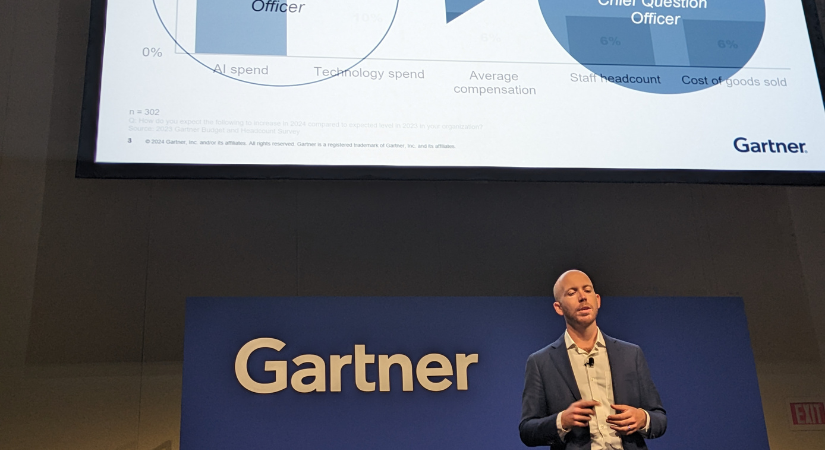
Questions CFOs Should Ask When Planning for AI

Presented by Marco Steecker, Senior Director, Research

Most organizations are currently undergoing planning discussions around the risks and opportunities of AI. In this session, Marco Steecker, Senior Director, Research at Gartner, discussed how finance function leaders should be thinking about AI, and how they can add the most value to the planning process. 

Key Takeaways

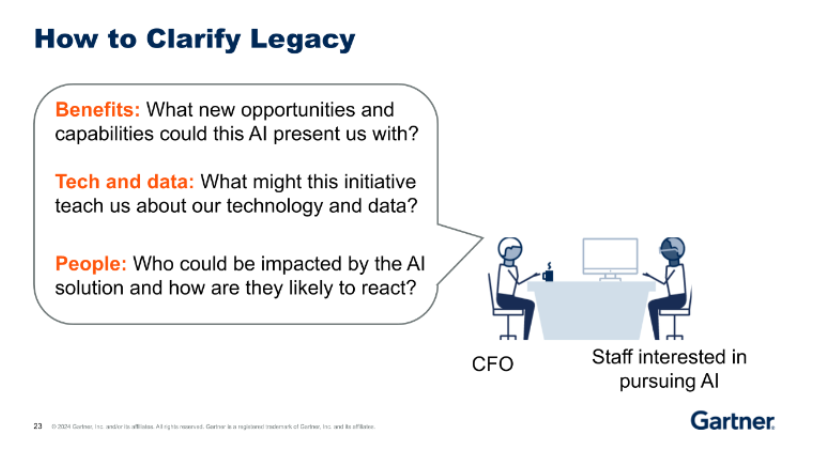
  • There are four main areas in which CFOs should try to understand the potential legacy of an AI pilot: benefits, technology, data and people.

  • When it comes to the benefits, CFOs should ask about the opportunities and capabilities that the AI will present to help unearth potential secondary impacts beyond the initial benefits the solution presents.

  • With regards to technology and data, CFOs should press AI project sponsors on how they imagine the technology will evolve over time. Even if the answers to these questions are only directionally accurate, they highlight how participants are thinking about what will happen to the technology stack over time as a consequence of the implementation of the AI.

  • CFO’s must also ask who will be impacted by the AI solution to connect the dots between changes in workflows and potential future changes to roles and responsibilities, as well as to anticipate potential pushback and areas where additional change management will be necessary.

Three Common Mistakes in Shortening the Accounting Close and How to Avoid Them

Presented by Mallory Barg Bulman, Senior Director, Research

Controllers are almost always looking to shorten the close period. Yet most find it difficult because controllership functions tend to have capacity constraints, and an increase in speed tends to lower accuracy and exhaust accountants. In this session, Mallory Barg Bulman, Senior Director, Research at Gartner, explained how to avoid three common mistakes that controllers make when trying to speed up their close times.

Key Takeaways

  • A Gartner survey of approximately 500 accountants conducted in July 2023 found that when capacity gets tighter, accountants go from making one error a month to several errors a week.

  • Trying to improve close times by just adding more work for accountants both burns out staff and adds risk for the business.

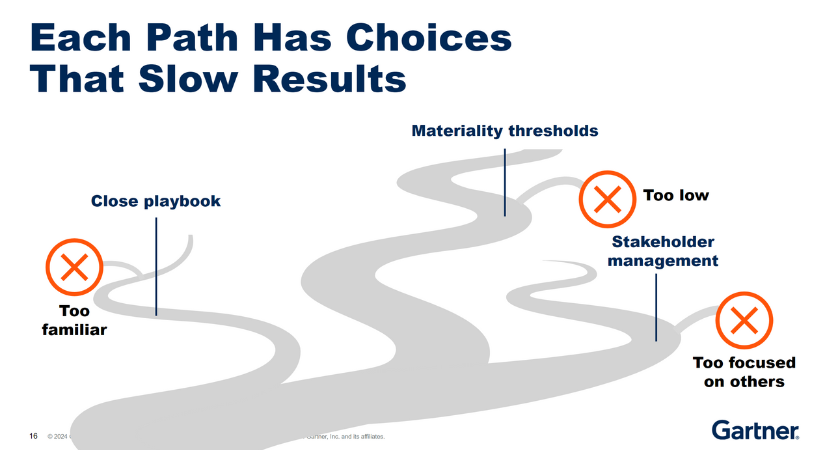
  • Most companies try to improve close times via three paths, and tend to make similar mistakes in each path:

    1) Building a close playbook:  Close playbooks often codify the exact set of processes and controls that are already taking too long, without properly accounting for overheads such as reports created, meetings, calls and presentations, or properly evaluating how essential certain controls are.

    2) Establishing materiality thresholds: Materiality thresholds are routinely set too low, wasting time on work that will not make any difference to the decisions of the end user of a financial statement.

    3) Managing stakeholders: forty-six percent of accountants report stopping high value work during the close to manage low value ad hoc requests from stakeholders. The solution is not more policies but to get better at understanding upstream partner goals to get ahead of potential disruption in the close period.

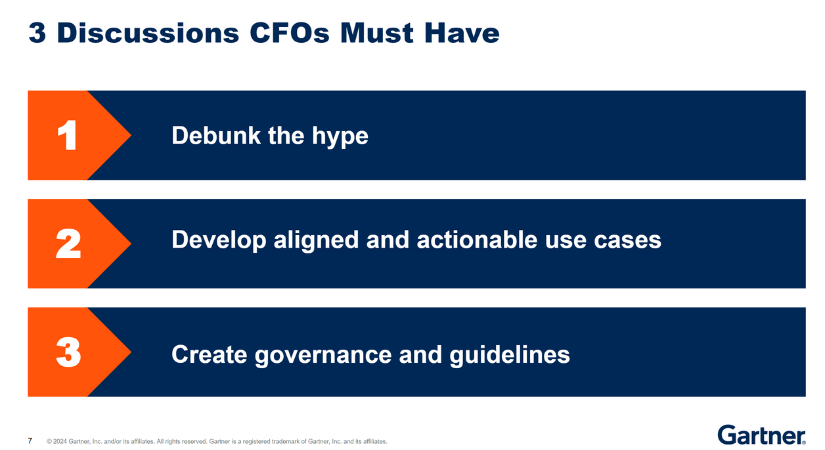
3 Discussions CFOs Must Have on Generative AI

Presented by Ash Mehta, Senior Director Analyst

Generative AI has a lot of potential, but it also has a lot of dangers. In this session, Ash Mehta, Senior Director Analyst at Gartner, explored three conversations CFOs need to have to ensure they reap the rewards and mitigate the risks of this exciting technology.

Key Takeaways

  • First, CFOs should address the misconceptions and assumptions about generative AI by discussing with their CIO, and Chief Data Officer what the technology is, and is no, capable of, and what biases it may contain.

  • Second, CFOs need to speak with their peers, other executives as well as operational and business unit leaders to focus on use cases that have three clear attributes: aligned to corporate strategy; responsible - aware of potential dangers, shortcomings and prejudice; and actionable - technically feasible.

  • Third, CFOs should talk with Legal, HR and Audit colleagues and create governance and guidelines that will mitigate the risks of using generative AI in an organization.

  • CFOs should use these three targeted conversations to educate themselves, their leadership and their teams about generative AI, and then start gradually with pilot use cases that augment existing capabilities while investing in governance mechanisms, risk mitigation practices and developing an ethical framework.

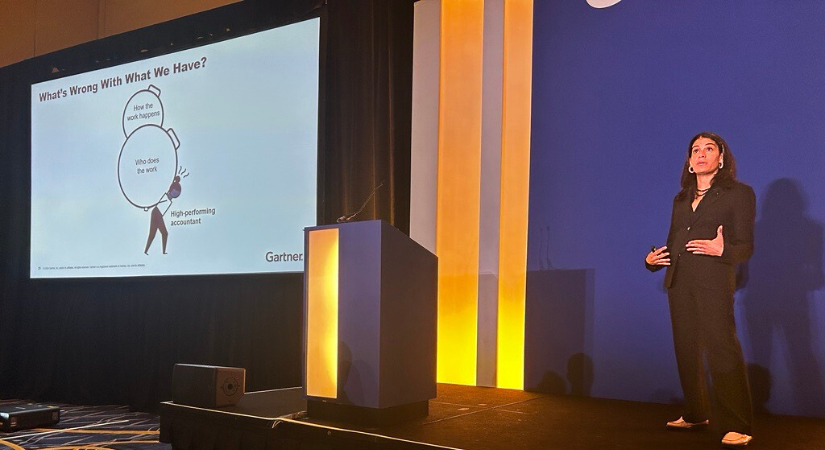
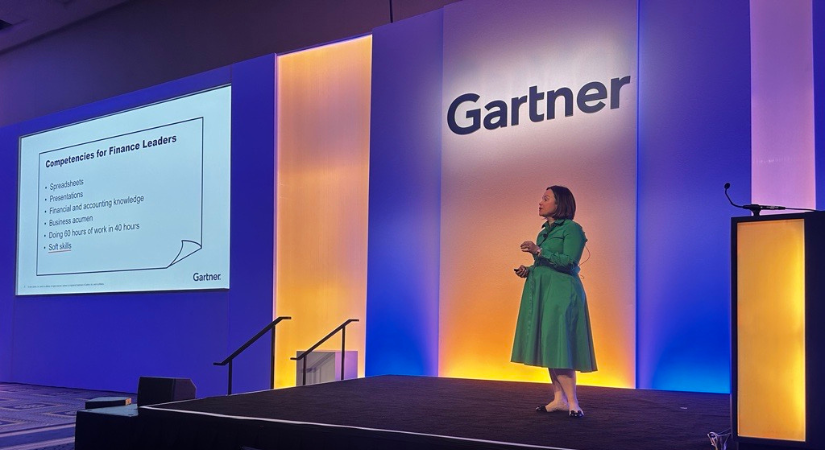
Building Leadership Competencies for the Future of Finance

Presented by Shannon Cole, Senior Director Analyst

Half of CFOs Gartner surveyed said that issues of attracting and retaining talent are in the top 3 concerns for what keeps them up at night. In this session, Shannon Cole, Senior Director Analyst at Gartner, discussed the traits finance leaders will need to emphasize to attract and retain the best analytical minds, and those with digital skills to build out or improve finance function capabilities.

Key Takeaways

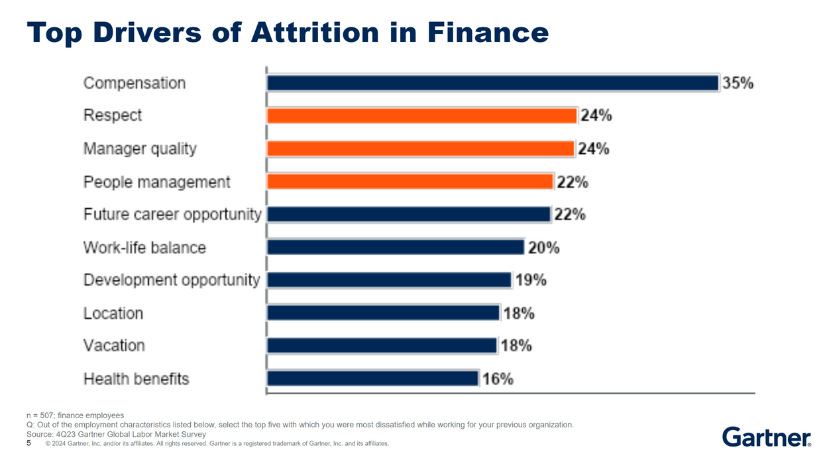
  • Issues relating to management make up three of the top five attrition drivers in finance employees.

  • Good management practices are a competitive advantage. They fortify a CFO’s ability to retain their best people. They prevent leaders from having to pay the premium to replace someone who leaves.

  • Fewer than 20% of CFOs Gartner surveyed felt that competencies relating to people management, such as empowering others or driving collaboration, are in the top 3 of what they consider most important for leadership.

  • When CFOs don’t feel that interaction competencies - the ones that measure their ability to interact with others -- are important, it’s no surprise that they have the hardest time filling critical finance transformation leader and finance technology leader roles, which require strong interaction competencies.

  • CFOs should accept that the profiles for any individual with people management responsibility should be based on a set of clearly defined competencies for people management.

Tune in tomorrow for more updates from the conference.

It’s not too late to join the conference!

About Gartner

Gartner, Inc. (NYSE: IT) delivers actionable, objective insight that drives smarter decisions and stronger performance on an organization’s mission-critical priorities. To learn more, visit gartner.com.

Media Contacts

It's not too late to join the conference

Latest Releases