CFOs face rising demands that make distributed accountability essential for enterprise success.
- Gartner client? Log in for personalized search results.
When nothing feels like business as usual, CFOs become trusted advisors
Driven by professional duty and a desire to be strategic, many CFOs take on growing demands that can compromise decision speed and judgment. The 2026 Gartner Annual CFO Survey highlights three main factors adding to the unsustainability of the CFO role: Accelerating AI ambitions, rising board and investor demands and new personal upskilling requirements. High levels of trust from peer executives and boards compound these pressures.
Gartner Vice President Analyst Emily Riley explains, “stakeholders increasingly turn to CFOs as trusted advisors who are in the best position to effectively wrangle the CEO and board’s buy-in at critical moments.” Much of the role’s expansion now comes from outside traditional finance responsibilities. Because these activities are less defined and harder to delegate, CFOs can quickly get stretched thin. Rather than simply reducing involvement, CFOs must focus on decision quality over quantity and enable other leaders to take greater ownership through stronger coordination, governance and decision support.
CFO effectiveness requires distributing decisions to avoid time overload
Overextended CFOs are at risk of becoming bottlenecks when speed is crucial for competitiveness. Mental fatigue leads to inconsistent risk taking and decision biases, which can significantly impact enterprise performance. The margin for error is razor-thin in today’s environment.
Default accountability is a testament to CFOs’ reliability, but unsustainable
The 2026 Gartner Board of Directors Survey found that boards trust CFOs to lead through volatility more than any other CEO direct report. This reputation is earned through reliability and an enterprisewide perspective. However, stepping into accountability vacuums can lead to CFOs feeling crushed by responsibility. CFO turnover rates hit a new high in 2025, and the average age of those leaving for board positions or retirement reached a six-year low. The cost extends beyond turnover, as cascading decision bottlenecks and lower-quality decisions result from mental fatigue.
The CFO workload problem starts with scope creep
CFO responsibilities are expanding, while reporting structures remain stable or narrow. Some organizations have narrowed CFOs’ formal remit to avoid spreading them thin, but shedding functional ownership allows CFOs to redirect time to areas of increasing importance rather than making workloads more sustainable. Several key areas are stretching already-busy CFOs in new ways.
Accelerating enterprise AI ambitions
CFOs are pressured by CEOs and boards to oversee AI, viewing it as core to success. Only 10% are responsible for AI execution beyond finance, but involvement in AI governance impacts financial performance. CFOs who proactively shape AI strategy and governance see better results and financial lift from AI spending. Delegating AI strategy to direct reports is difficult, as discussions require CFO-level visibility and influence.
Rising board and investor demands
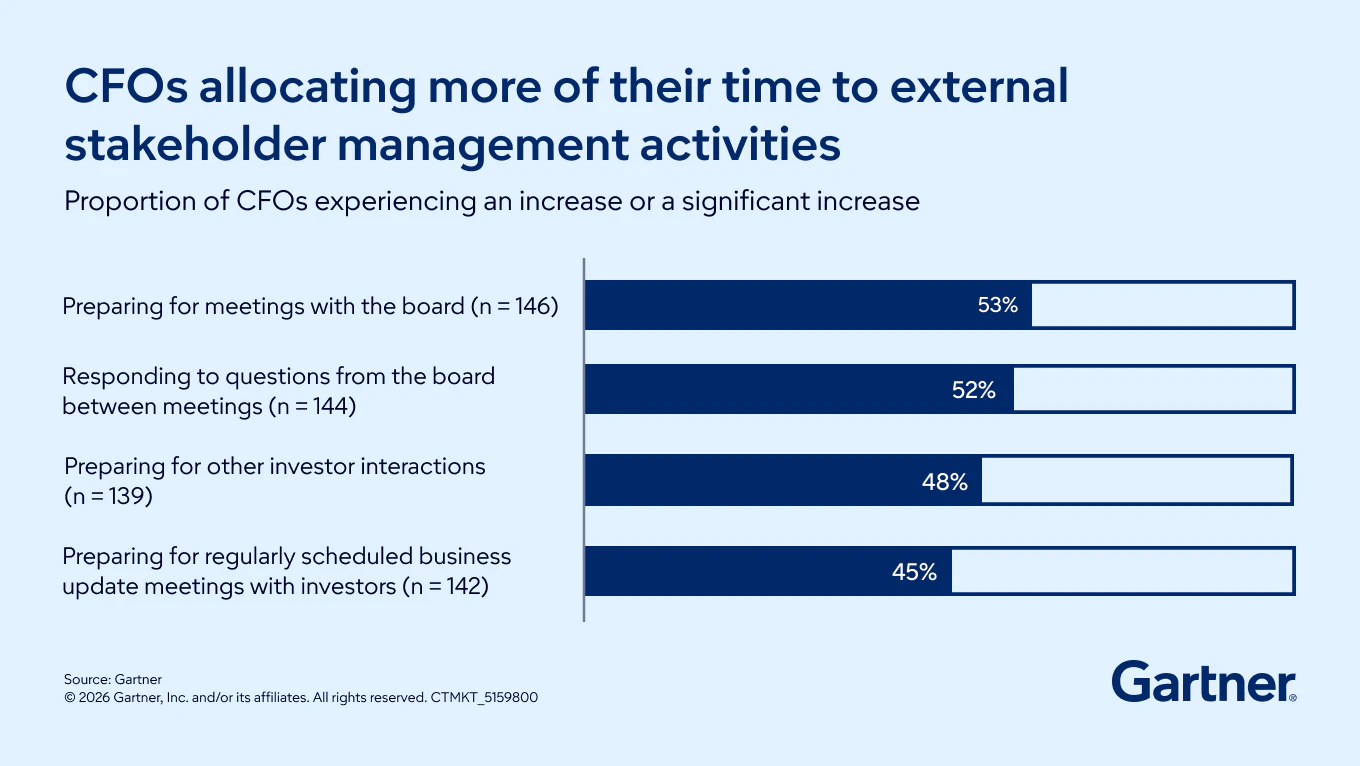
CFOs spend more time with boards and investors, with more than half reporting increased interaction. Delegating these activities is not an option due to stakeholder involvement and the topics that require additional time investment.
New personal upskilling requirements
CFOs must invest time in learning, especially AI literacy. Gartner finds that 74% of CFOs self-assess as “intermediate” or lower, and only 16% of CEOs describe their CFO as very AI-savvy. Personal development is often sacrificed, creating a gap between future importance and current commitment. This is an area where accountability by default is unsustainable.
The solution: Distributed accountability
Technology can help, but requests for advice and decisions will continue to go to CFOs unless explicitly redirected. CFOs must become architects of distributed accountability by reprioritizing quality over quantity in enterprise involvement. Practical steps include:
Writing and sharing explicit criteria for what is “CFO-worthy,” establishing thresholds for involvement and clear delegation for matters that do not meet the bar
Shifting intervention from answering questions to framing decisions, clarifying ownership, constraints and success metrics
Making nonintervention a leadership signal, stating when and why not to engage and publicly reinforcing decisions made without CFO escalation
Additional actions include establishing a cross-functional AI council, facilitating management coordination ahead of board interactions and orienting finance business partnering to equip executives with information for decision ownership.
CFO effectiveness FAQs
How can CFOs reduce time overload through distributed accountability?
CFOs can reduce time overload by prioritizing quality over quantity in decisions, establishing clear criteria for involvement and empowering other leaders to own decisions. Distributed accountability helps prevent bottlenecks and improves enterprise performance.
What are the main factors contributing to CFO time overload?
The 2026 Gartner Annual CFO Survey identifies accelerating AI ambitions, rising board and investor demands, and new personal upskilling requirements as the main factors contributing to CFO time overload.
Why is distributed accountability important for CFOs?
Distributed accountability is important for CFOs because it prevents decision bottlenecks, reduces mental fatigue and ensures high-quality decisions across the organization. It is essential for sustainable enterprise performance.
Attend a Conference
Join Gartner analysts and your peers to accelerate growth
Gather alongside your peers in National Harbor to gain insight on emerging trends, receive one-on-one guidance from a Gartner analyst and create a strategy to tackle your priorities head-on.
2 – 4 Jun 2027
Gartner Finance Symposium/Xpo™
National Harbor, MD

Drive stronger performance on your mission-critical priorities.