AI-powered forecasting shifts financial risk upstream and changes how CFOs stay accountable.
- Gartner client? Log in for personalized search results.
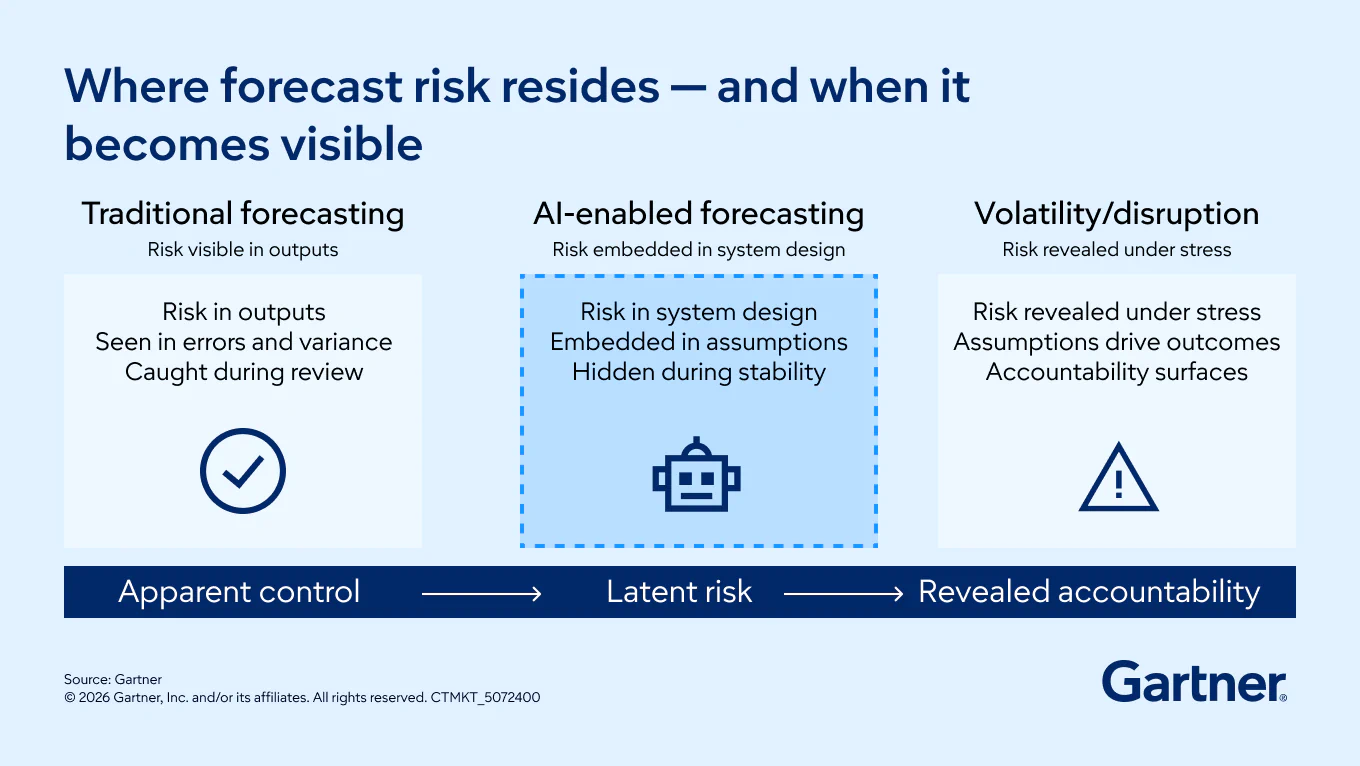
Forecast risk is shifting and becoming less visible
AI-enabled forecasting is fundamentally changing how risk forms and becomes visible in enterprise planning. In traditional forecasting, errors were tied to human judgment, with downstream review and approval offering effective control. CFO accountability focused on validating results and explaining variances.
As AI-enabled systems scale, risk shifts away from visible output errors and to upstream assumptions and inputs that shape how forecasts respond to changing conditions. Over time, control over outcomes moves upstream, making traditional oversight signals less reliable. Strong performance in stable environments can reinforce trust while obscuring whether key assumptions remain valid. When conditions shift, outcomes reflect differences in underlying system design rather than recent accuracy.
CFOs are now accountable for upstream assumptions, not just results
AI-enabled forecasting changes the traditional model of managing risk through outputs and variance review as it scales. Forecast behavior is increasingly shaped by upstream assumptions and inputs that operate continuously and largely out of view. This creates a growing misalignment between accountability and control, as CFOs remain responsible for outcomes shaped by system elements they cannot fully observe or validate. This shift in structure becomes most visible during periods of disruption, often making outcomes abrupt and difficult to explain.
Approval loses value as a signal of understanding
As forecasts rely more on automated rules than human judgment, signoff no longer indicates how forecasts will behave when conditions change. CFOs remain responsible for forecasting systems even as the drivers of forecast behavior shift upstream, reducing visibility into what influences outcomes before they occur.
Disruption reveals hidden accountability gaps
When conditions shift, forecasts follow embedded assumptions rather than recent performance, exposing risks that remain invisible during stable periods. The gap between accountability and control becomes most visible at the point of decision, making it difficult to explain results.
Traditional oversight signals are no longer reliable
Strong performance in stable conditions can reinforce confidence without confirming whether underlying assumptions remain relevant. This means confidence in results can outpace understanding of how those results will change under stress, concentrating risk in less visible parts of the forecasting system.
What to do next to lead the shift to AI-first finance
AI has ushered in the biggest transformation to finance since the digital spreadsheet, requiring CFOs to act as catalysts for fundamental change by leading the shift from legacy systems and mindsets to an agile, AI‑powered finance function. That vision marks the starting point of a broader journey CFOs must navigate to fully deliver on the mission‑critical priority of leading the shift to AI-first finance.
The steps in that journey include:
Redesigning finance teams, roles and ways of working to maximize AI’s benefits. This includes shifting responsibilities, updating talent profiles and evolving workflows so the function captures transformational — not just fractional — productivity gains.
Reviewing validated finance AI use cases and applying best practices for identifying, prioritizing and piloting new opportunities. CFOs should also assess emerging vendors that can support evolving finance needs as use case complexity grows.
Assessing digital and technical capabilities required for successful finance AI implementation. That means deploying emerging best-practice solutions to build both the systems and the people capabilities needed to accelerate adoption and scale value.
Creating a finance AI roadmap that builds value-added capabilities while delivering measurable ROI. CFOs should ensure the roadmap explicitly ties automation, efficiency and potential headcount displacement to clear financial outcomes.
Learning how to approach build‑versus‑buy decisions for finance AI solutions. Understanding where vendor capabilities lead or lag CFO expectations helps determine which capabilities are best sourced externally and which should be developed in‑house.
For more on how Gartner helps drive success on this and other mission-critical priorities for CFOs, speak to us today.
AI-enabled forecasting FAQs
How does AI-enabled forecasting shift CFO accountability?
AI-enabled forecasting concentrates on risk in upstream assumptions and system design, making CFOs accountable for choices that influence outcomes before results are even reviewed.
Why are traditional oversight signals less reliable with AI forecasting?
Traditional oversight signals like approval and variance review lose reliability because they don’t reveal whether assumptions remain valid as conditions change.
What should CFOs focus on to govern AI-enabled forecast risk?
CFOs should shift oversight upstream, focusing on system design, driver selection and governance defaults rather than just reviewing final outputs.
Attend a Conference
Join Gartner analysts and your peers to accelerate growth
Gather alongside your peers in National Harbor to gain insight on emerging trends, receive one-on-one guidance from a Gartner analyst and create a strategy to tackle your priorities head-on.
2 – 4 Jun 2027
Gartner Finance Symposium/Xpo™
National Harbor, MD

Drive stronger performance on your mission-critical priorities.