LONDON, U.K., September 18, 2024
- Gartner client? Log in for personalized search results.
Gartner ReimagineHR Conference, London: Day 2 Highlights
Overview
We are bringing you news and highlights from the Gartner ReimagineHR Conference, concluding today, in London, U.K. Below is a collection of the key announcements and insights coming out of the conference. You can read the highlights here from Day 1.
On Day 2 from the conference, we are highlighting how to modernize talent management, the importance of successfully enabling business leaders to drive DEI outcomes, how to reduce bias in talent management, and reducing work friction.
Key Announcements
- Gartner HR Research Finds Organizations’ Current Talent Management Efforts Inhibit Optimal Employee and Organizational Performance
- Culture Connectedness is Crucial for HR Leaders in Driving Culture Change: Q&A with Cian O Morain
- Gartner HR Research Reveals Only 33% of Employees Say Their Organizations Consistently Deliver on Promises
The New Era of DEI Accountability: Equipping Business Leaders to Own DEI Outcomes
Presented by Oreoluwa George-Taylor, Director, Advisory, Gartner
The DEI function is expected to drive organization-wide change, often without organization-wide ownership of DEI outcomes. As a result, DEI leaders are overwhelmed and DEI efforts are lacking the necessary participation to sustain and maximize DEI impact. In this session, Oreoluwa George-Taylor, Director, Advisory, Gartner, outlined a series of steps and components needed to successfully enable business leaders to drive DEI outcomes.


Key Takeaways
- “The number one challenge for 53% of DEI leaders in 2024 is the lack of business leader ownership for DEI outcomes. ”
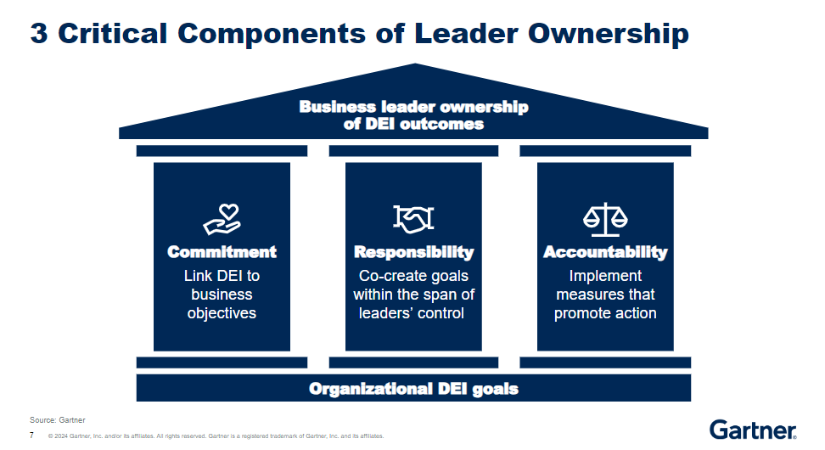
“Ownership for business leaders can broken down into three critical components:
Commitment: linking DEI to business objectives
Responsibility: co-creating leader-owned goals within the span of leaders’ control
Accountability: implementing measures that promote leader action”
“When it comes to commitment, only three in five DEI leaders say their business leaders believe that DEI helps achieve business goals. Because of this, it’s critical to position DEI as a tool to achieve business success.”
“One in three organizations do not have DEI goals or do not customize goals, leaving business leaders unclear of their role in DEI.”
“Sixty-four percent of HR leaders feel they are lagging behind on leader accountability for driving DEI outcomes. To help solve this, it’s important to implement measures to promote action on DEI responsibilities, such as linking leadership competencies to DEI KPIs.”
Modernizing Talent Management
Presented by Dion Love, Vice President, Advisory, Gartner
In the context of business volatility, economic uncertainty and rapid technological advancement, organizations’ workforces currently lag behind talent demands. In this session, Dion Love, Vice President, Advisory, Gartner, examined how organizations can best adapt their workforce to meet the demands of the business.


Key Takeaways
“A Gartner survey of 190 HR leaders revealed:
41% agree their workforce lacks required skills
50% agree their organization does not effectively leverage skills
62% agree that uncertainty around future skills poses a significant risk.”
“When an organization does not consistently deliver on talent needs, employee performance decreases by 26 percentage points.”
“HR must focus on talent fluidity – building and buying skills efficiently as supply and demand evolve, moving talent where it has the greatest impact on the business, and responding quickly and appropriately to changing business conditions.”
“To create targeted talent fluidity, HR must do three things:
Prioritize skills intelligence investments
Reduce personal risks and downsides that impede mobility
Focus on the core skills of today.”
- “Organizations that successfully embrace fluid talent can increase how they deliver on talent needs by up to 60%.”
Additional information is available in the press release Gartner HR Research Finds Organizations’ Current Talent Management Efforts Inhibit Optimal Employee and Organizational Performance
Reduce Bias in Talent Management Through Technology
Presented by Laura Gardiner, Director Analyst, Gartner
While bias reduction in talent management is not new, continuous technology innovation means more opportunities exist to reduce that bias. In this session, Laura Gardiner, Director Analyst, Gartner, explored what current technology can offer, and how HR leaders should prioritize investment for the greatest impact.


Key Takeaways
“The work to reduce bias across talent management activities has so far focused on three main stages:
Training employees, managers and leaders
Embedding DEI in talent processes
Measuring the impact of these efforts.”
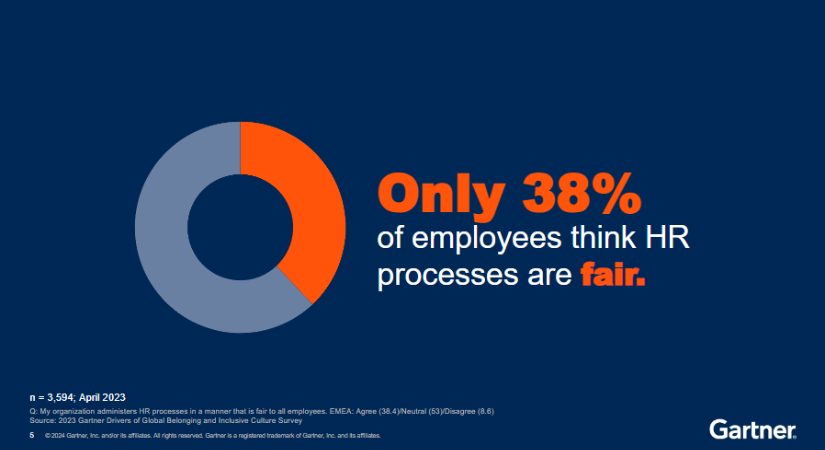
“A lot of work has been done, yet only 38% of Europe-based employees think HR processes are fair.”
“Only 2% of organizations are using technology to improve talent outcomes.”
“There are three key issues to consider in regards to using technology to mitigate bias within talent management:
What technology exists to interrupt bias across processes? HR must survey what technology they have today – both within and outside of HR – that could potentially be leveraged in this capacity.
How can HR identify where to prioritize efforts? HR leaders need to connect with DEI leaders to share data, concerns, priorities, and ultimately to explore the possibilities where the priorities overlap and where there are gaps.
Which option is best? HR must prioritize which processes can be most improved via technology; for each potential solution, it is critical to consider the impact and cost.”
Reduce Work Friction to Unlock Employee Productivity
Presented by Kamil Donaldson, Senior Principal, Advisory, Gartner
Efforts to engage and motivate employees often miss a huge barrier: work friction. Gartner research has shown that two-thirds of employees "hack" their way around work, wasting hours each day on unnecessary and frustrating activities. In this session, Kamil Donaldson, Senior Principal, Advisory, Gartner, examined how employee experience leaders can remove work friction to drive key talent outcomes.


Key Takeaways
“Most employees experience work friction every day. This can include anything that makes work unnecessarily hard, for instance, processes that are out of date or struggling with different places to find information.”
“Employees who experience high work friction are less likely to stay with their employer, are less engaged, put forth less effort, have lower performance and worse mental well-being.”
“To drive productivity, leaders should address three specific causes of work friction:
Change Adds Meetings. Empower employees to flag low-value meetings with pre-meeting requirements, and in-the-moment, productivity alerts to reduce meeting overload.
Change Misaligns Strategy and Workflows. Encourage employees to assume that all processes should be removed unless proven useful, and to justify keeping, not removing, legacy work processes.
Change Creates Hidden Challenges. Engage employees in change implementation to limit unforeseen obstacles.
That's a wrap for Gartner ReimagineHR in London. See you next year!
Media contacts
Mary Baker
Gartner
mary.baker@gartner.com
Gerri Weinberger
Gartner
gerri.weinberger@gartner.com


Latest releases
About Gartner
Gartner (NYSE: IT) delivers actionable, objective business and technology insights that drive smarter decisions and stronger performance on an organization’s mission-critical priorities. To learn more, visit gartner.com.