SYDNEY, Australia, November 17, 2026
The Future of Integrated Talent Management: Unlocking Better Talent Outcomes
December 16 2026
SYDNEY, Australia, November 17, 2026
More than 27% of Australian employees are concerned about AI making their skills obsolete, according to a survey by Gartner, Inc. a business and technology insights company. This increases significantly to 46.2% among Gen Z employees, who are the most frequent users of AI.
The Gartner Global Talent Monitor Survey, conducted in 3Q26 with 589 Australian employees, found 18.6% are frustrated with how AI has changed their role and 29.8% worry AI will make errors that negatively impact their work. These numbers are significantly higher for Gen Z employees at 30.8% and 42.3% respectively.
Speaking at Gartner HR Symposium/Xpo in Sydney today, Jonathan Tabah, Director Analyst in the Gartner HR practice, said, "As AI adoption accelerates, the biggest risk isn’t the new skills that need to be built, but some of the old ones that will disappear. Unmanaged AI-driven skills atrophy can reduce performance while increasing business risk, yet few organizations have a plan to address it.”
The Gartner survey revealed nearly half of Australian employees (46%) are already expected to use AI as part of their role. Among those employees, 90% said their organization provides enterprise AI tools. However, only 60.9% report receiving clear AI guidelines and fewer report formal learning opportunities (54.6%) and manager support (56.9%).
"Some skills will naturally decline as work changes, but organizations must intentionally decide which skills can be allowed to atrophy, and which remain critical to future performance, so they can be deliberately safeguarded before becoming business risks," said Tabah.
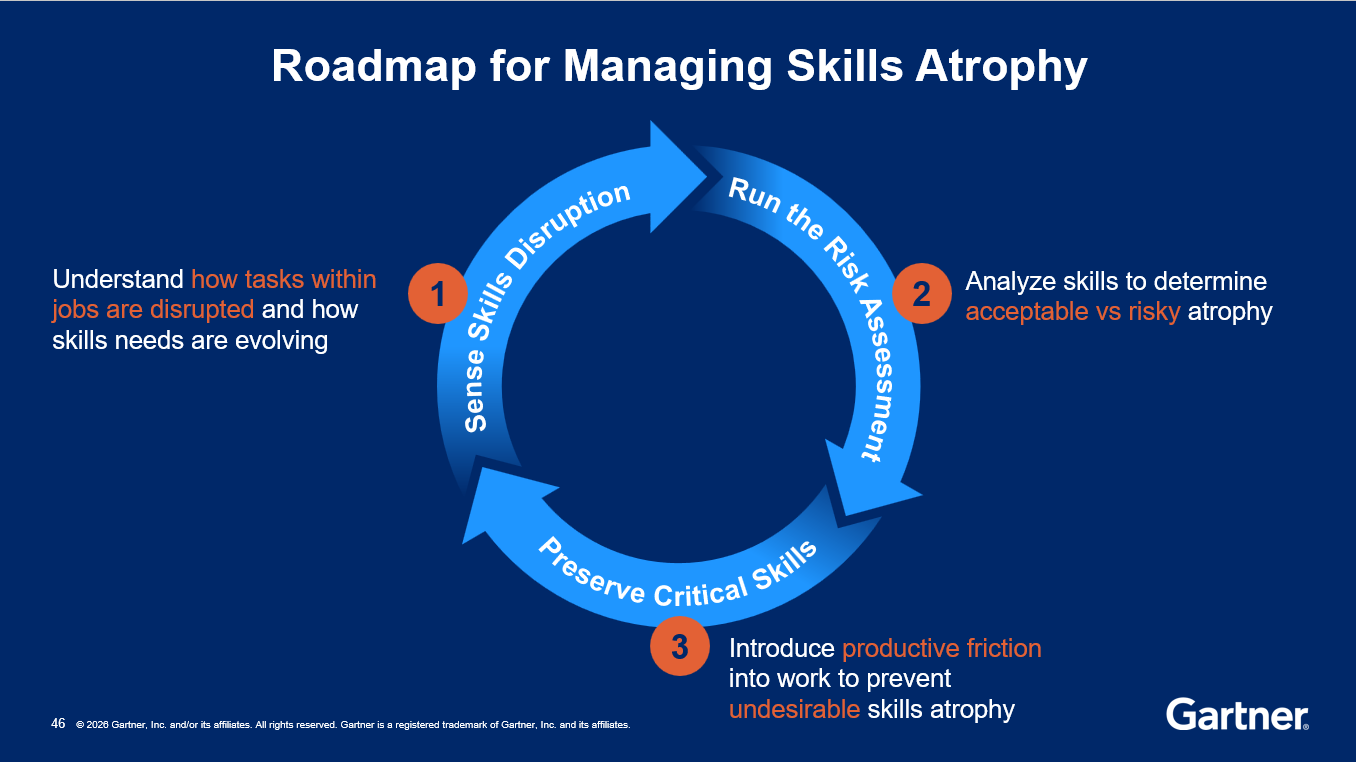
Gartner recommends HR leaders take three steps to address AI-driven skills atrophy (Figure 1):
Source: Gartner (November 2026)
1. Understand How Skills Needs Are Evolving
As AI replaces traditional human tasks, it creates skill atrophies that pose performance, regulatory and operational risks to the enterprise. HR leaders must partner with business leaders to identify which skills pose the greatest risk if allowed to decline and mitigate their loss through targeted interventions.
"Many organizations are focused on what AI can do for productivity, but far fewer are considering what happens when critical human capabilities disappear," said Tabah. "Just as pilots must know how to fly when autopilot fails, employees need to retain critical skills to perform when technology can't provide the answer."
2. Determine Acceptable vs Risky Atrophy
Organizations need a structured approach to identify which skills are becoming less relevant but remain critical to future success. Assessing how tasks change with AI and evaluating the business impact of fading skills can distinguish between acceptable and risky skills atrophy. This helps HR and leaders prioritize interventions before capability gaps create significant business risks.
"The new pace of skills obsolescence means that organizations can no longer assume they have time to adapt as skills fade," said Tabah. "A clear understanding of which capabilities create risk when allowed to atrophy is critical. This enables organizations to intervene early, safeguard those capabilities and protect future performance."
3. Take Action to Preserve Critical Skills
The risk of skills atrophy can be reduced by introducing productive friction into work, which creates deliberate opportunities for employees to practice critical skills even as AI automates tasks. Whether through hands-on exercises, simulated experiences or periodic manual execution of AI-assisted tasks, the goal is to preserve critical business capabilities without sacrificing the productivity benefits of AI.
"The goal isn't to slow AI adoption or the productivity enhancements it can offer; it's to ensure critical business skills don't disappear as work evolves," said Tabah. "By creating deliberate opportunities for employees to practice and strengthen essential capabilities, organizations can capture the benefits of AI while protecting the expertise they can't afford to lose."
Gartner clients can read more in the report: AI-Driven Skills Atrophy: Understand and Manage the Risk of Declining Skills.
Gartner HR Symposium/Xpo is where CHROs and their leadership teams gather each year to reimagine their strategies through the lens of Gartner’s research-driven insights and expert advice on leadership and learning, employee experience, culture and change, talent acquisition and workforce planning, and HR technology. Gartner HR Symposium/Xpo is taking place this week in Sydney, November 16-17. Follow news and updates on LinkedIn using #GartnerHR.
The Gartner HR practice brings together the best relevant content approaches across Gartner to offer individual decision makers strategic business advice on the mission-critical priorities that cut across the HR function. Additional information is available at https://www.gartner.com/en/human-resources/products/gartner-for-hr. Follow news and updates from the Gartner HR practice on X and LinkedIn using #GartnerHR.
Gartner is the indispensable partner to C-Level executives and technology providers as they implement AI strategies to achieve their mission-critical priorities. The independence and objectivity of Gartner insights provide clients with the confidence to make informed decisions and unlock the full potential of AI. Clients across the C-Level are using Gartner's proprietary AskGartner AI tool to determine how to leverage AI in their business. With more than 2,500 business and technology experts, 6,000 written insights, as well as more than 4,000 AI use cases and case studies, Gartner is the world authority on AI. More information can be found here.
Gartner (NYSE: IT) delivers actionable, objective business and technology insights that drive smarter decisions and stronger performance on an organization’s mission-critical priorities. To learn more, visit gartner.com.


