Productivity gains depend on how organizations assign AI authority and preserve human accountability.
- Gartner client? Log in for personalized search results.
When human review becomes the bottleneck
Marketing leaders are under pressure to use AI agents to increase the speed and scale of their operations. Yet the responsibility for customer experiences, brand reputation and business outcomes remains human, even when an AI agent performs the work.
Many organizations respond by inserting AI agents into approval workflows designed for human-created work. While universal review may preserve trust and control, it creates a scaling problem. As agent participation increases, human review becomes the limiting factor, constraining productivity gains and slowing execution. Trust fails to scale, accountability becomes ambiguous and organizations risk automating work without increasing their capacity to execute.
“Organizations are rapidly introducing AI agents into marketing operations, but most continue to govern them using approval workflows designed for human-created, legacy workflows,“ says Richard Tso, Senior Director Analyst at Gartner.
You might also like this webinar: How CMOs Can Lead AI Transformation to Adaptive Intelligence Marketing
Authority determines how far AI can scale
Gartner finds that productivity gains from agentic AI depend less on deploying additional agents and more on creating systems that assign authority, preserve human accountability and expand AI autonomy through earned trust.
AI scale is fundamentally an authority-management challenge. Organizations that continue treating human review as the primary control mechanism will realize lower productivity gains than those that systematically assign authority, preserve accountability and expand autonomy through earned trust. Earned-autonomy operating models allow capacity to grow without proportionally increasing human oversight.
Stop treating human review as the primary control mechanism
Review-centric operating models create a scaling problem. As more work is reviewed, productivity gains become constrained and marketers spend more time evaluating outputs than driving execution.
Gartner data reflects how widespread this model remains. Seventy-three percent of marketing functions heavily review AI outputs for strategy and planning, 64% heavily review creative development and 50% heavily review execution and optimization. Organizations that rely predominantly on universal review will realize significantly lower productivity and growth than those that implement earned-autonomy operating models.
Expand agent authority through earned trust
According to Gartner, organizations should stop asking whether AI agents can be trusted and instead ask whether they have built systems that allow trust to be earned.
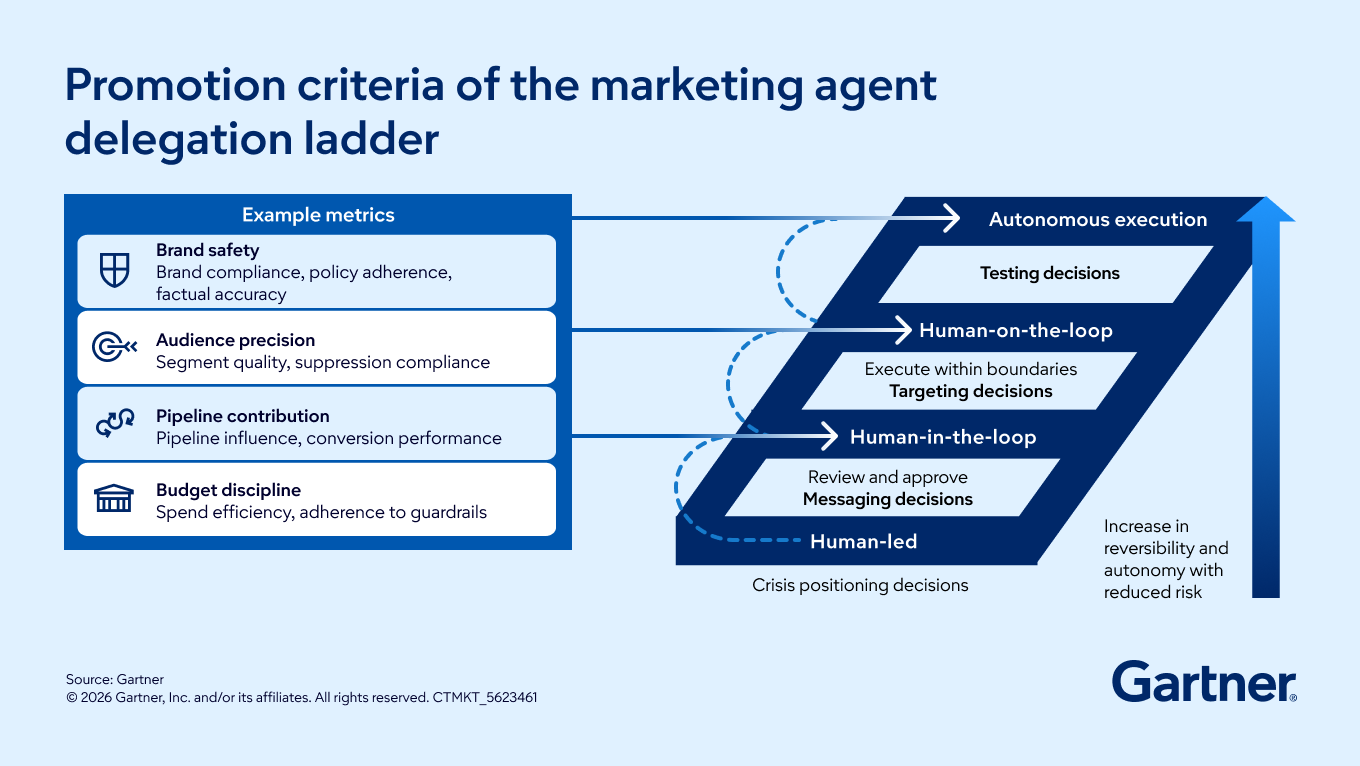
Not all workstreams should be autonomous. Leading organizations do not grant maximum autonomy by default. Instead, they align authority levels to business risk and demonstrated performance using a marketing agent delegation ladder. Agents begin at appropriate levels of autonomy and earn greater authority through consistent performance.
Reliability determines whether an agent can act. Authority determines whether an agent is allowed to act. Authority is not granted once. It is earned, expanded, and when necessary, reduced.
Design accountability before expanding autonomy
Thirty-four percent of marketing leaders say they have emerging central AI guidance, but lack well-defined policies. As organizations expand agent autonomy, responsibility for outcomes can become unclear. An agent may influence a decision, generate a recommendation or execute an action, but accountability does not transfer with authority. Human accountability remains constant even as agent authority expands.
High-performing organizations focus less on the authority agents receive and more on the accountability humans retain. Before expanding autonomy, marketing leaders should define ownership, accountability and escalation authority for key workflows. They should understand which decisions remain human-owned, which can be delegated to agents and which require shared responsibility.
Explicit accountability creates the foundation for expanding autonomy without sacrificing trust and control.
AI agent governance FAQs
How should CMOs govern AI agents?
According to Gartner, CMOs should govern AI agents by assigning authority, preserving human accountability and expanding autonomy through earned trust. Organizations should define ownership and escalation paths before deployment rather than relying on human review alone.
Why does human review limit AI scale?
Gartner finds that review-centric operating models become bottlenecks as agent participation increases. As more work is reviewed, productivity gains become constrained and organizations risk limiting scalability and growth.
What is earned autonomy?
Earned autonomy is an operating approach in which AI agents gain authority through demonstrated performance. Gartner recommends matching authority to business risk and demonstrated reliability, then expanding autonomy as performance is proven over time.
What determines whether an AI agent can act?
Reliability determines whether an agent can effectively perform a task. Authority determines whether it is permitted to perform that task. Organizations achieve greater scale when they deliberately manage both, expanding authority as trust is earned rather than relying on universal human review.
Attend a Conference
Join Gartner analysts and your peers to accelerate growth
Gather alongside your peers in Denver to gain insight on emerging trends, receive one-on-one guidance from a Gartner expert and create a strategy to tackle your priorities head-on.
7 – 9 Jun 2027
Gartner Marketing Symposium/Xpo™
Denver, CO

Drive stronger performance on your mission-critical priorities.