Work is changing. Is your culture keeping pace?
- Gartner client? Log in for personalized search results.
The growing gap between work transformation and culture
The way we work is changing fast, but most organizational cultures aren’t evolving at the same speed. Gartner insights indicate that 80% of employees experience a conflict between their organization’s culture and the realities of their work. And as Gartner Vice President Analyst, Jessie Knight, notes “when culture change lags behind work transformation, it becomes a liability that fails to support new strategic ambitions, blocking performance.” For example, 57% of employees say their culture doesn’t help them succeed and many CEOs cite culture as a top barrier to organizational growth. A “high-performance culture” mandate isn’t enough. Culture must move faster, not just aim higher, to keep up with work transformation.
You might also like this webinar: The Culture Strategy Reset: How to Help Your Culture Evolve and Stay Relevant
Transform culture at the speed of work
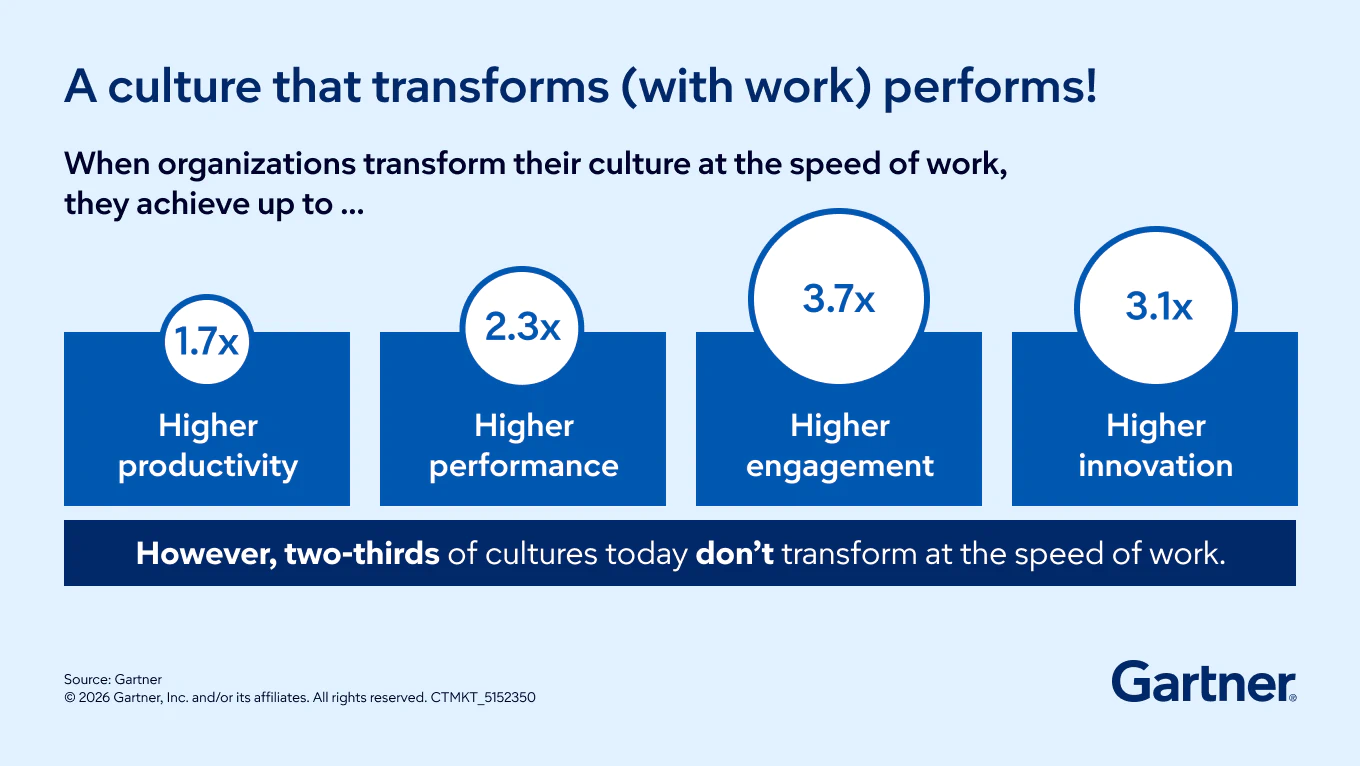
CHROs must drive culture transformation at the speed of work, continuously realigning behaviors and mindsets to keep pace with changing business priorities. Organizations that succeed in doing so unlock stronger business performance, making culture a critical driver of enterprise success.
Set expectations
Organizations often describe culture as fixed and enduring — using terms like “who we are,” “our anchors,” and “our non-negotiables” — even as business priorities continue to evolve. This makes culture change feel like a broken promise. Organizations that set the expectation that culture is a moving target that can reduce resistance to change and better engage employees in shaping the behaviors needed for future success.
Align changes
Only 41% of HR leaders have a process to anticipate necessary changes in culture. Values are too broad to provide clear signals of what needs to change. Instead, CHROs should surface culture risks by translating critical work changes into desired behaviors and underlying beliefs. This reveals necessary changes aligned directly to business priorities and results.
Activate culture
Organizations often rely on performance management and other formal talent processes to reinforce culture, but these touchpoints are too infrequent on their own. To transform culture at speed, leaders also need to remove barriers to desired behaviors in day-to-day work. When employees can consistently work in ways that align with culture, change happens faster and is more likely to last.
What’s next for transforming culture?
As work continues to rapidly evolve, CHROs must embed desired cultural norms into the organization. They must ensure that processes, budgets and technology — not just communications and individual behaviors — reflect and reinforce how the culture needs to evolve. This is just one critical step in the CHRO’s mandate to strengthen culture to power performance.
Culture transformation FAQs
Why is culture transformation important?
When culture fails to keep pace with business change, it can become a barrier to performance, innovation and growth. A culture that supports evolving business priorities helps employees adapt more effectively, improve collaboration and achieve better organizational outcomes.
What outcomes can organizations expect from transforming culture at the speed of work?
Organizations that successfully align culture with changing business needs are better positioned to improve employee engagement, accelerate change adoption, strengthen performance and support long-term business growth.
Attend a Conference
Join Gartner analysts and your peers to accelerate growth
Gather alongside your peers in Orlando to gain insights on emerging trends, receive one-on-one guidance from a Gartner expert and create a strategy to tackle your priorities head-on.
26 – 28 Oct 2026
Gartner HR Symposium/Xpo™
Orlando, FL

Drive stronger performance on your mission-critical priorities.