Strong governance is essential for IT procurement to stay relevant and deliver business outcomes.
- Gartner client? Log in for personalized search results.
IT procurement’s influence problem is a governance problem
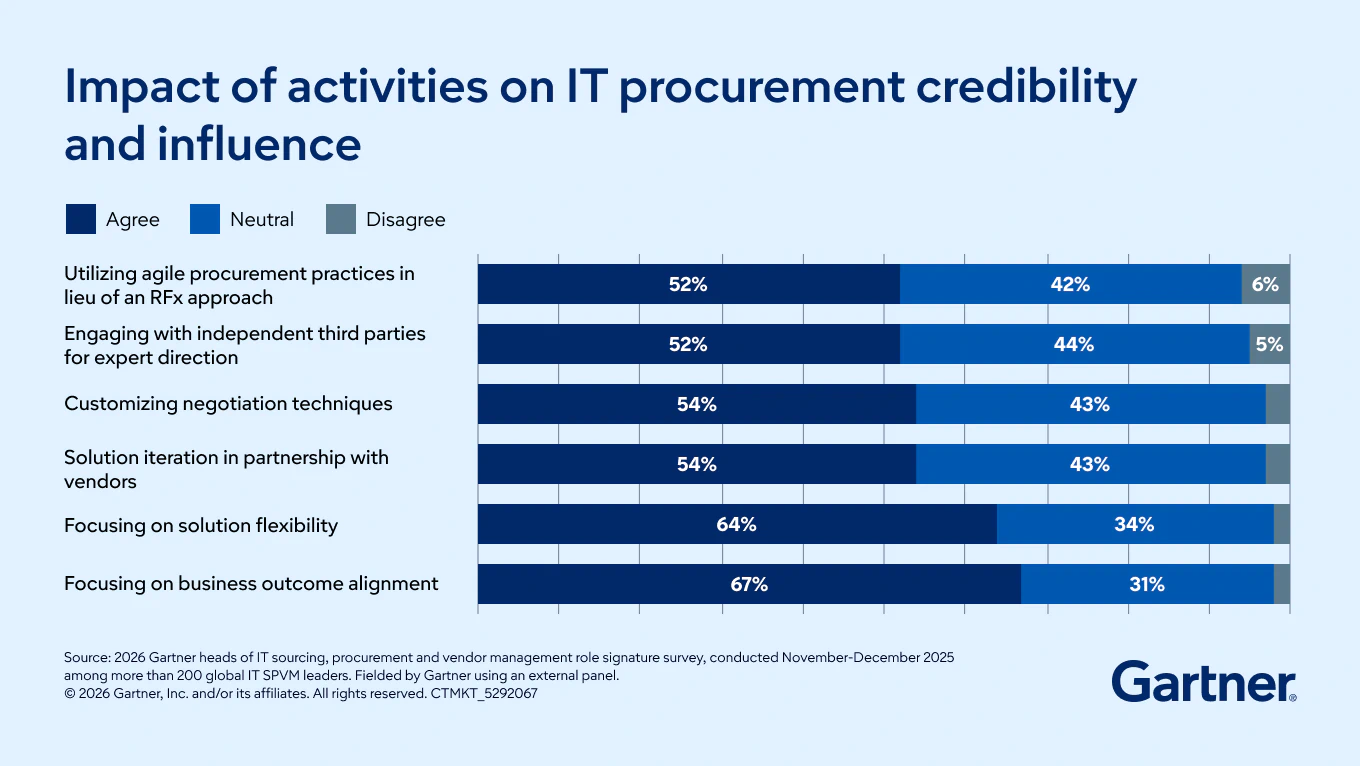
IT procurement manages technology investments, vendor relationships and risk, but many teams are still seen as transactional — focused on cost control and compliance, not business outcomes. As a result, procurement is often brought into technology decisions too late to effectively manage risk, accelerate delivery or maximize value. To become a more influential business partner, IT procurement leaders must redesign governance to align the function’s mandate, processes, decision rights, culture and communication with business priorities. As Luke Ellery, Vice President Analyst at Gartner, notes, “Effective governance strengthens credibility by enabling IT procurement to deliver business-relevant outcomes, provide trusted advice and participate earlier in strategic decisions.”
You might also like this webinar: The Future of Procurement: Accelerating Value Through AI, Talent and Operating Model Reinvention
Governance redesign is essential for business relevance
Redesigning governance is crucial to reposition IT procurement for business relevance. Without it, teams face slower execution, misaligned contracts and missed opportunities to capture value from technology innovation. Influence depends on delivering business-relevant results, applying expertise and communicating effectively.
Realigning mandate and processes for business priorities
Many IT procurement teams remain narrowly focused on cost savings, causing stakeholders to view them as administrative gatekeepers rather than strategic advisors. Gartner recommends redefining mandate and scope to prioritize business engagement and outcomes. Procurement charters should clearly document stakeholders, governance responsibilities, metrics and reporting expectations. Leaders should also review policies to address technology-related risks, such as open-source software and nontechnology purchases with embedded technology. Simplifying procurement processes through Lean and Agile principles can reduce friction, accelerate execution and improve stakeholder experiences.
Designing structure, roles and decision rights for agility
Unclear ownership and approval authority can slow decisions, create risk and reduce confidence in IT procurement’s expertise. Leaders should align structures, roles and responsibilities with business priorities, supported by clear governance to reduce duplication, confusion and noncompliance, while increasing accountability.
Decision rights should extend beyond spending limits to define who has authority to accept risk, including contract terms, renewals, amendments and exceptions. Clear escalation paths and predefined fallback positions can streamline negotiations and strengthen procurement’s reputation as a trusted business partner.
Shaping culture and communication around business outcomes
Many procurement organizations continue to measure success through tactical metrics, such as cost savings or spend under management. While useful, these measures do not capture the broader impact procurement can have on business outcomes. Heads of IT procurement should align communication with organizational priorities and the objectives of key stakeholders, including business leaders, CIOs, CISOs, CFOs and legal teams. Leaders should also focus on demonstrating technology expertise, providing trusted advice and communicating in ways that resonate with stakeholder goals. Building relationships through planning sessions, strategy meetings and ongoing collaboration can help position IT procurement as a strategic advisor rather than a transactional service provider.
What’s next in procurement redesign
Building a compelling business case is essential to establish IT sourcing, procurement and vendor management as the owner of the IT vendor risk framework. By quantifying the potential financial, operational and reputational impact of third-party disruptions, leaders can secure executive sponsorship, define required resources and authority, and gain alignment on a consistent approach to managing vendor risk across the enterprise. This is a critical step in the mandate to minimize third-party disruption in the enterprise.
IT procurement FAQs
Why does IT procurement lack influence?
According to Gartner, IT procurement’s influence problem is often rooted in governance rather than capability. Many organizations define the function through cost control, compliance and transactional execution, limiting its involvement in strategic decisions.
How can IT procurement increase business influence?
IT procurement can increase influence by realigning its mandate with business objectives, establishing clear decision rights and communicating value through business outcomes rather than procurement metrics alone.
Why is governance important for IT procurement?
Governance aligns mandate, processes, roles, decision rights, culture and communication with business priorities. Effective governance can strengthen credibility, improve stakeholder confidence and increase IT procurement’s participation in strategic decisions.
Attend a Conference
Experience Information Technology conferences
With exclusive insights from Gartner analysts on the latest trends, sessions curated for your role and unmatched peer networking, Gartner conferences help you accelerate your priorities.
19 – 22 Oct 2026
Gartner IT Symposium/Xpo™
Orlando, FL

Drive stronger performance on your mission-critical priorities.